
.svg)
.svg)
.svg)
.svg)


.svg)
If your team is still running nutrition calculations in Genesis R&D while tracking supply chain risks in a spreadsheet and managing formulation versions over email, you already know the problem. The tools don't talk to each other. Every time something breaks — an ingredient goes out of stock, a reformulation request lands, a label claim needs updating — you're stitching together data from three different places.
This comparison is for R&D leads, food scientists, and product development managers evaluating whether Genesis R&D still fits their workflow in 2026, or whether a platform built for the full development cycle makes more sense.
Let's get into it.
Genesis R&D has been a reliable nutrition calculation engine for decades. Its core strength is regulatory compliance: USDA nutrient databases, FDA label formatting, and nutrient analysis for finished products. For teams whose primary job is calculating nutrition facts panels and staying compliant, it handles that work accurately.
The platform also supports recipe scaling, ingredient substitution within a formulation, and basic batch costing. For a single food scientist working in isolation, it covers the nutrition analysis workflow.
That's a real, specific value — and it shouldn't be dismissed.
The problems surface the moment your workflow extends beyond the nutrition panel.
No supply chain integration. Genesis R&D has no real-time ingredient availability data. When a supplier goes down or a raw material price spikes, you find out the same way everyone else does — too late. No alert system, no alternative ingredient suggestions, no proactive signal.
Legacy interface. The UI hasn't kept pace with modern SaaS expectations. Onboarding new team members takes longer than it should. Workflows that should be fast — searching for an ingredient, comparing two formulation versions — require more clicks than necessary.
No collaborative development layer. Genesis R&D is built for individual use. If your formulation team has more than one person, you're managing version control manually. That means email chains, shared drives, and the constant risk of someone working from an outdated file.
No sustainability or cost intelligence. Ingredient scoring in Genesis R&D is primarily nutritional. If your team needs to evaluate an ingredient against sustainability targets or model cost impact across formulation options at the same time, that work happens outside the platform.
For teams that have grown beyond solo nutrition analysis, these gaps add up to real time lost and real risk.
Journey Foods is an AI-powered platform built for the full product development workflow — ingredient discovery, multi-criteria scoring, formulation management, and supply chain monitoring in one dashboard.
The core AI engine, Operations Scientist, scores ingredients across nutrition, cost, and sustainability simultaneously. You don't run three separate analyses and reconcile the outputs. Search an ingredient, and the platform scores it across all three dimensions in a single view.
That changes how fast decisions get made.
Instead of looking up an ingredient in a database and then separately checking cost and sustainability data, Journey Foods surfaces all three signals together. R&D teams evaluating a new functional ingredient or a reformulation swap can compare options against their actual targets — not just nutritional benchmarks.
This is where Journey Foods has no direct equivalent. The platform monitors supply chain conditions and sends real-time alerts when ingredient availability or pricing shifts. When something changes, the system flags it and surfaces AI-driven alternative ingredient recommendations.
For teams that have experienced a product launch delay because of a supply disruption, this feature alone changes the risk profile of the development process. The supply chain intelligence built into the platform is designed to move your team from reactive to proactive.
Journey Foods is built for teams, not individuals. Every team member works from the same data set. Formulations are version-controlled. No competing files, no email chains asking "which version is current," no onboarding confusion when someone new joins the project.
This matters most at mid-market CPG brands where R&D, procurement, and supply chain teams all touch the same formulation data but have historically worked from different sources.
Journey Foods publishes its pricing publicly:
For a team moving off Genesis R&D, the Group tier at $999/month covers ten users with the full platform — supply chain alerts, collaborative formulation management, and multi-criteria ingredient scoring included.
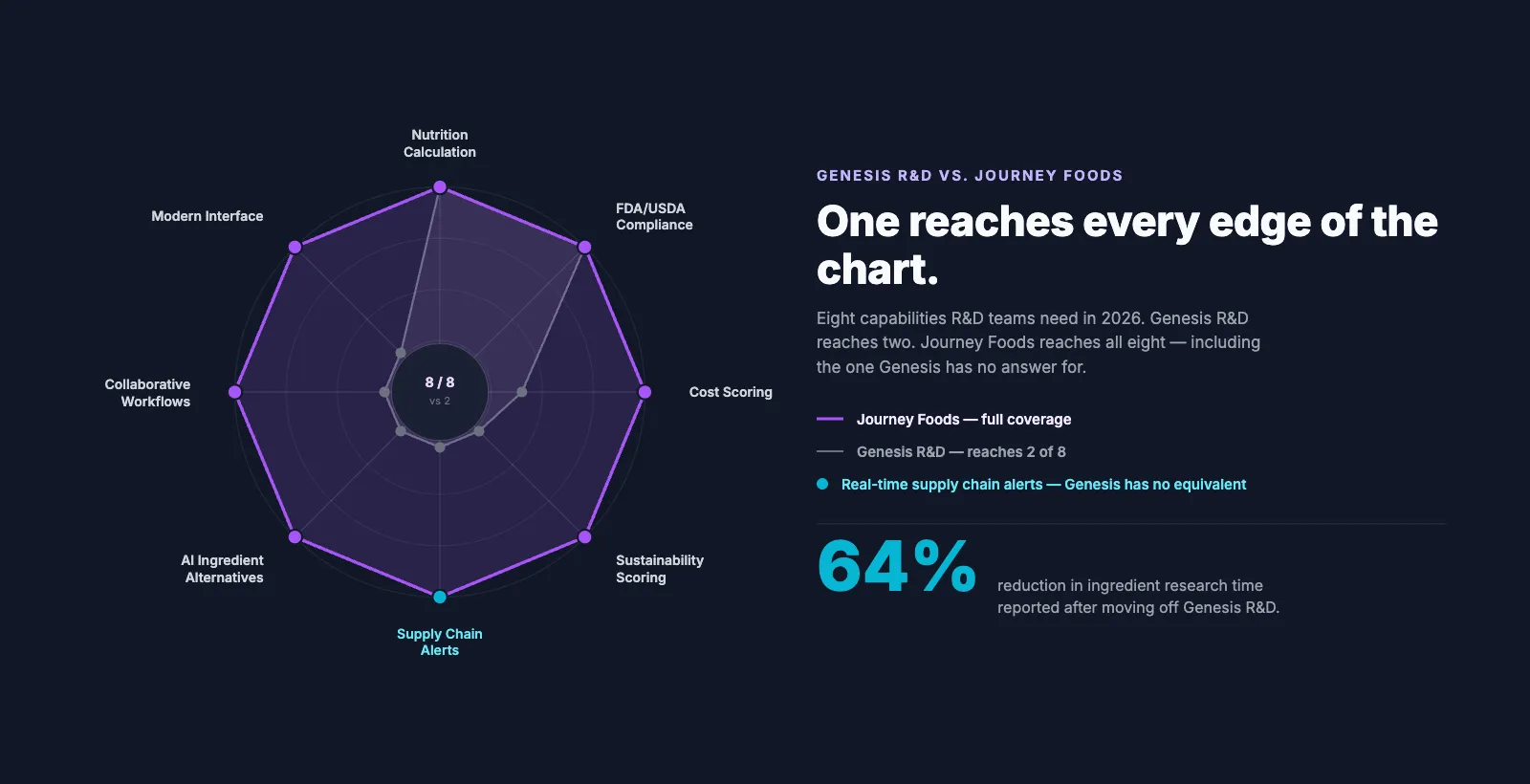
CapabilityGenesis R&DJourney FoodsNutrition calculationStrongYes, via Operations ScientistFDA/USDA compliance formattingYesYesCost scoringLimitedYes, simultaneous with nutrition and sustainabilitySustainability scoringNoYesReal-time supply chain alertsNoYesAI ingredient alternativesNoYesCollaborative team workflowsNoYes, version-controlledModern SaaS interfaceLegacyYesAPI accessLimitedYes, documented APIPricing transparencyNot public$199–$1,999/month, published
Genesis R&D still makes sense for a specific type of user: a solo food scientist or small team whose entire job is nutrition analysis and label compliance, with no need for supply chain visibility, collaborative development, or sustainability tracking.
If your workflow is "calculate the nutrition panel, format the label, export the report," Genesis R&D handles that reliably. The switching cost isn't worth it for that use case.
If any of the following describes your team, Genesis R&D is holding you back:
One CPG brand documented a 64% reduction in ingredient research time after moving to Journey Foods. That's not a marginal improvement. That's a structural change in how fast the team operates.
Journey Foods is also built for cross-functional buying teams. Role-specific workflows exist for food scientists, supply chain managers, procurement officers, and CFOs — meaning the platform fits the way decisions actually get made at mid-market CPG brands, not just the way a single user works.
Genesis R&D is a mature nutrition calculation tool. It does one thing well and has done it for a long time. But the product development environment in 2026 demands more than nutrition analysis. Supply chain volatility, sustainability reporting requirements, and the pace of competitive reformulation mean R&D teams need ingredient intelligence — not just ingredient databases.
Journey Foods is built for that environment. It's not a one-for-one replacement for a single Genesis R&D feature. It's a different category of tool — one that covers the full development workflow from ingredient discovery through supply chain monitoring, with collaborative infrastructure built in.
If you're evaluating your options more broadly, the 2026 guide to food product development platforms covers the full competitive set and what to look for in each category.
Ready to see how Journey Foods handles your specific workflow? Book a demo at journeyfoods.io/book-a-demo.
Is Journey Foods a direct replacement for Genesis R&D?
Journey Foods covers nutrition scoring, formulation management, and label compliance — but its primary differentiator is multi-criteria ingredient intelligence and real-time supply chain monitoring. If your workflow is limited to nutrition calculation and label formatting, Genesis R&D handles that specific task. If you need the full development workflow — ingredient discovery, cost and sustainability scoring, collaborative formulation management, and supply chain alerts — Journey Foods covers all of it in one platform.
Does Journey Foods support FDA-compliant nutrition label formatting?
Journey Foods scores ingredients across nutrition, cost, and sustainability through its Operations Scientist AI engine. For specific FDA label formatting requirements, confirm the feature set directly with the Journey Foods team during a demo, as compliance tooling can vary by tier and configuration.
What is the main limitation of Genesis R&D for modern CPG teams?
Genesis R&D has no supply chain integration, no real-time ingredient availability alerts, and no collaborative team workflows. It's built for individual nutrition analysis — not for cross-functional product development teams managing multiple formulations against cost, sustainability, and supply chain constraints at the same time.
How does Journey Foods handle supply chain disruptions?
The platform monitors supply chain conditions in real time and sends alerts when ingredient availability or pricing changes. It also surfaces AI-driven alternative ingredient recommendations, so your team can act before a disruption becomes a product delay — not after.
What does Journey Foods cost for a small R&D team?
The Growth plan is $499/month for two users. The Group plan is $999/month for ten users. Both include formulation management, ingredient scoring, and supply chain monitoring. Enterprise pricing at $1,999/month covers fifty users and adds product optimization AI and customer reporting.
Can Journey Foods support both R&D and procurement teams on the same platform?
Yes. Journey Foods is built for collaborative, cross-functional workflows. Every team member works from the same data set with version-controlled formulations. Role-specific workflows exist for food scientists, supply chain managers, and procurement officers — so each function sees the data most relevant to their decisions without working from separate tools.
How long does it take to get started on Journey Foods compared to Genesis R&D?
Journey Foods is a modern SaaS platform designed for fast onboarding without heavy IT implementation. Genesis R&D uses a legacy interface that typically requires more setup time and training. The exact onboarding timeline for Journey Foods depends on team size and integration requirements — the best way to assess fit is through a demo at journeyfoods.io/book-a-demo.
Research and Content Fellow. Biology and Farming Researcher