.svg)
.svg)
.svg)
.svg)


.svg)
Chocolate is one of the most chemically complex ingredients in food manufacturing. A single cacao bean contains more than 600 volatile compounds — and by the time it reaches your formulation as cocoa powder, couverture, or compound chocolate, it has been through fermentation, drying, roasting, conching, and tempering. Each step alters its chemistry in ways that directly affect flavor, texture, shelf life, and nutritional profile.

.svg)
If you're formulating with chocolate, understanding what's happening at a molecular level isn't academic. It determines whether your product holds up on shelf, hits your nutrition targets, and survives a supply disruption when cacao prices spike.
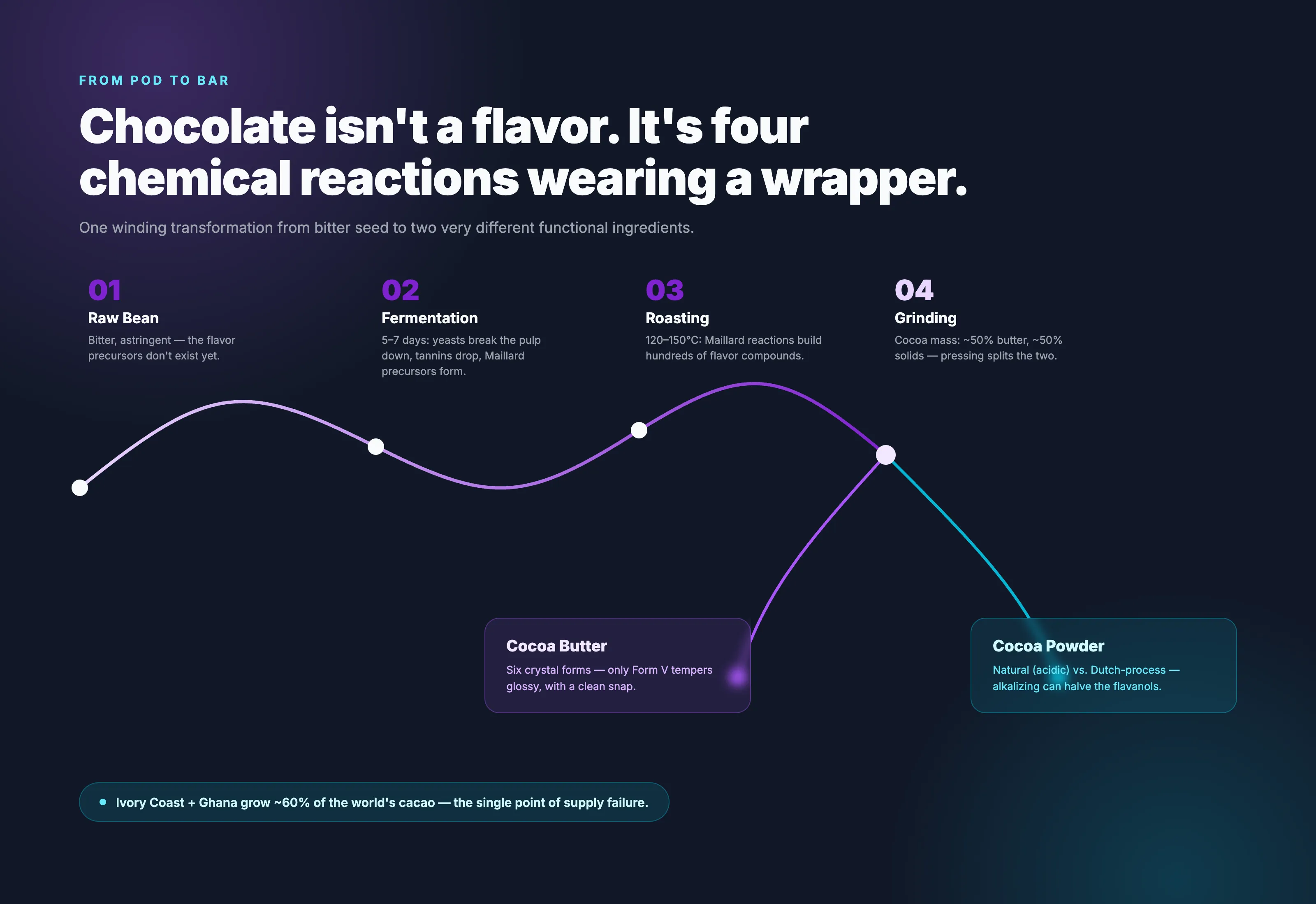
Raw cacao beans are bitter, astringent, and nothing like the chocolate flavor consumers expect. That's because the flavor precursors don't exist yet — they form during fermentation.
Fresh cacao seeds are surrounded by a mucilaginous pulp rich in sugars. Over five to seven days of fermentation, yeasts and bacteria break down that pulp. The heat generated kills the seed's embryo and triggers enzymatic reactions inside the cotyledon: proteins break into amino acids, polyphenols oxidize, and the Maillard precursors that will become flavor compounds during roasting begin to form.
Fermentation also reduces tannins and other astringent polyphenols. Well-fermented cacao tastes dramatically different from poorly fermented cacao — even before roasting.
Roasting is where cacao flavor actually develops. At temperatures between 120°C and 150°C, Maillard reactions between amino acids and reducing sugars produce hundreds of flavor compounds: pyrazines (nutty, roasted notes), aldehydes (fruity, floral), and furans (caramel-like). Strecker degradation contributes additional aldehydes and ketones.
The roast profile is a formulation decision. Lighter roasts preserve fruity, acidic notes and higher polyphenol content. Darker roasts develop bitterness and deeper chocolate character but reduce antioxidant activity. If your product makes a health claim around flavanols, roast profile is a specification variable — not a background detail.
Dutch-process cocoa goes through alkalization before or after roasting. Treating cacao with potassium carbonate raises pH from roughly 5.5 to anywhere between 6.8 and 8.0. This neutralizes acids, darkens color, and mellows flavor. It also reduces flavanol content significantly — a relevant trade-off if you're targeting a clean-label or functional positioning.
Natural cocoa retains its acidity and higher polyphenol load. It also behaves differently in baked applications because of how it interacts with leavening systems. These aren't minor details. They affect your formulation chemistry downstream.
After roasting and optional alkalizing, cacao nibs are ground into cocoa mass (also called cocoa liquor) — roughly 50% cocoa butter and 50% cocoa solids. Pressing separates them. The solids become cocoa powder. The fat becomes cocoa butter.
Cocoa butter is predominantly composed of three triglycerides: POS (palmitoyl-oleoyl-stearoyl), SOS (stearoyl-oleoyl-stearoyl), and POP (palmitoyl-oleoyl-palmitoyl). This specific triglyceride composition gives cocoa butter its sharp melting point — solid at room temperature, melting near body temperature at around 34–38°C. That's what creates the melt-in-mouth sensation that defines real chocolate.
It also makes cocoa butter one of the most technically demanding fats to work with. It crystallizes in six polymorphic forms (Forms I through VI). Only Form V produces the glossy surface, clean snap, and smooth texture of properly tempered chocolate. Tempering — controlled cooling through specific temperature curves — is the process of seeding Form V crystals.
If you're using real chocolate in your CPG formulation, tempering consistency affects product quality at scale. Compound chocolate, which replaces cocoa butter with lauric fats like palm kernel oil, eliminates the tempering requirement — but at a cost to the sensory profile.
Cacao is one of the most concentrated dietary sources of flavanols, particularly epicatechin and catechin. These are the compounds behind most of the health research on dark chocolate.
Flavanol content varies dramatically depending on:
For a CPG team positioning a product around cardiovascular or cognitive health benefits, these variables aren't background information. They're specification decisions that need to be locked into your ingredient sourcing criteria.
Cacao contains both theobromine and caffeine, though theobromine dominates at roughly a 10:1 ratio. Theobromine is a mild stimulant and bronchodilator. Caffeine is a stronger central nervous system stimulant.
In a standard 40g dark chocolate serving, you're looking at approximately 200–250mg theobromine and 20–30mg caffeine. These numbers matter if you're formulating for children's products, sports nutrition, or any application where stimulant content affects your label or regulatory position.
Commercial chocolate almost always contains soy lecithin or sunflower lecithin at concentrations of 0.3–0.5%. Lecithin reduces viscosity by coating cocoa particles and reducing friction, improving flow properties during manufacturing.
From a clean-label standpoint, sunflower lecithin is increasingly preferred over soy — it avoids GMO concerns and allergen labeling requirements. This is a straightforward swap, but it requires viscosity testing because the two lecithins behave slightly differently in practice. The clean-label formulation trade-offs involved in ingredient substitutions like this are worth mapping before you commit to a new spec.
The chemistry of chocolate doesn't exist in isolation from its supply chain. Cacao is one of the most geographically concentrated commodities in food manufacturing. The Ivory Coast and Ghana together account for roughly 60% of global cacao production. Climate variability, disease pressure (Frosty Pod Rot and Witches' Broom are the primary fungal threats), and geopolitical instability in West Africa all create recurring price volatility and availability risk.
The chocolate shortage dynamics that have driven ingredient innovation in recent years aren't a temporary anomaly. They reflect structural supply constraints that formulation teams need to plan around.
For CPG brands, that means:
Cocoa butter equivalents (CBEs) made from shea, illipe, or sal fats can replace a portion of cocoa butter in compound coatings. Their triglyceride profiles are similar enough to maintain tempering behavior. But they don't replicate the full sensory profile of cocoa butter in high-cocoa-solid formulations.
When you're evaluating a cacao-derived ingredient, you're simultaneously managing three dimensions:
Most formulation teams hit friction here because these three dimensions live in different places. Nutrition data is in one system. Cost data is in procurement. Sustainability certifications are buried in supplier documentation. None of it is connected.
That's the problem Journey Foods is built to solve. The Operations Scientist AI engine scores ingredients across nutrition, cost, and sustainability in a single workflow — so when you're evaluating whether to shift from Dutch-process cocoa to natural cocoa, or from soy lecithin to sunflower lecithin, you see the full impact before you change the spec. You can see how a CPG brand cut ingredient research time by 64% using this approach.
Explore the platform at journeyfoods.io.
Tempering control is the primary technical challenge. Real chocolate requires precise temperature curves — melting at ~45–50°C, cooling to ~27°C, then working at ~31–32°C for dark. Compound coatings simplify this but require fat bloom testing under your specific storage and distribution conditions.
Shelf life is largely determined by water activity and fat migration. Chocolate-enrobed products with fillings need careful aw management to prevent moisture migration into the chocolate layer, which causes bloom and texture degradation.
Natural cocoa and Dutch-process cocoa are not interchangeable in leavening-dependent applications. Natural cocoa is acidic (pH ~5.5) and reacts with baking soda. Dutch-process is neutral to alkaline and requires baking powder. Substituting one for the other without adjusting your leavening system changes rise, texture, and color.
If flavanol content is a selling point, specify minimum epicatechin levels in your ingredient spec and verify them with your supplier. Processing conditions between harvest and delivery can reduce flavanol content by 50% or more. Specification without verification is not a specification.
Milk chocolate achieves its characteristic flavor through Maillard reactions between milk proteins and reducing sugars during conching. Dairy-free alternatives use oat milk powder, coconut milk solids, or rice-based ingredients to approximate this — but the flavor chemistry is different. Expect iteration cycles.
What makes the chemistry of chocolate different from other food ingredients?
Cacao contains more than 600 volatile flavor compounds, and the final flavor profile is determined by a sequence of distinct chemical reactions — fermentation, Maillard reactions during roasting, and crystallization during tempering. No other common food ingredient goes through this many chemical transformation steps before it reaches a formulation.
How does roasting affect the nutritional profile of cacao?
Higher roast temperatures reduce flavanol content, particularly epicatechin and catechin. Lighter roasts preserve more polyphenols but produce a less developed chocolate flavor. If your product makes a health claim around antioxidants or cardiovascular benefits, roast profile is a specification variable — not a background detail.
What is the difference between natural cocoa and Dutch-process cocoa in formulation?
Natural cocoa is acidic (pH ~5.5) and reacts with baking soda as a leavening agent. Dutch-process cocoa has been alkalized to a neutral or slightly alkaline pH and doesn't react with baking soda the same way. They are not interchangeable in baked applications without adjusting the leavening system. Dutch-process also carries significantly lower flavanol content.
Why is cocoa butter so difficult to work with at manufacturing scale?
Cocoa butter crystallizes in six polymorphic forms. Only Form V produces the glossy, snappy, smooth-melting texture of properly tempered chocolate. Achieving and maintaining Form V crystals consistently at scale requires precise temperature control during tempering, cooling, and storage. Deviations produce fat bloom, dull surfaces, and texture defects.
What are the main supply chain risks for cacao-derived ingredients in 2026?
Geographic concentration is the primary risk. The Ivory Coast and Ghana produce roughly 60% of global cacao. Climate variability, fungal disease pressure, and regional instability create recurring price spikes and availability gaps. Dual-sourcing across origins and building specification flexibility into formulations are the standard risk mitigation approaches.
How does alkalization affect cacao's sustainability and clean-label positioning?
Alkalization is a processing step, not an additive, so it doesn't affect clean-label status in most regulatory frameworks. It does significantly reduce polyphenol content, which affects any functional or health-oriented positioning. From a sustainability standpoint, the origin and certification of the cacao matter more than the processing method.
Can cocoa butter be replaced in chocolate formulations without losing functionality?
Partially. Cocoa butter equivalents made from shea, illipe, or sal fats can replace a portion of cocoa butter in compound coatings while maintaining tempering behavior — their triglyceride profiles are close enough. Full replacement changes the sensory profile. In high-cocoa-solid formulations, the melt characteristics and flavor release of real cocoa butter are difficult to replicate completely.
Chocolate is not a simple ingredient. Every decision you make about cacao sourcing, processing specification, and formulation chemistry has downstream effects on nutrition, cost, shelf life, and supply chain exposure. The teams that manage those variables proactively — not reactively — ship better products faster.
If you want to see how ingredient scoring across nutrition, cost, and sustainability works in practice, book a demo at journeyfoods.io.

Structured Q&A marked up with FAQ Page schema so it can be surfaced and cited by Al engines and search.
In Journey Al's 12 month dataset, the median plant protein reformulation came in -6.5% on raw material cost versus an animal protein control the first year that line went negative, driven by Tier 1 isolate suppliers reaching spec parity.
In Journey Al's 12 month dataset, the median plant protein reformulation came in -6.5% on raw material cost versus an animal protein control the first year that line went negative, driven by Tier 1 isolate suppliers reaching spec parity.
In Journey Al's 12 month dataset, the median plant protein reformulation came in -6.5% on raw material cost versus an animal protein control the first year that line went negative, driven by Tier 1 isolate suppliers reaching spec parity.