

.svg)
.svg)
.svg)
.svg)


.svg)
Quick Answer: Recalls in 2026 are fewer in number but far larger in scale. A single contaminated ingredient source can now trigger a recall across dozens of SKUs simultaneously. For CPG R&D and procurement teams, the question isn't whether a supplier issue will happen — it's how fast you can trace it, contain it, and act.
Key Takeaways:
Over 160 FDA and USDA recalls have been recorded in 2026 so far. That number is notable. But the more important signal is in the structure of those recalls.
The Q1 2026 Sedgwick Product Safety and Recall Index shows recalled units up 27% to 492.31 million — despite fewer individual recall events. Fewer events, more units. Recalls are concentrating. When one hits, it hits wide.
That's not a statistical anomaly. It's a structural shift in how food supply chains work.
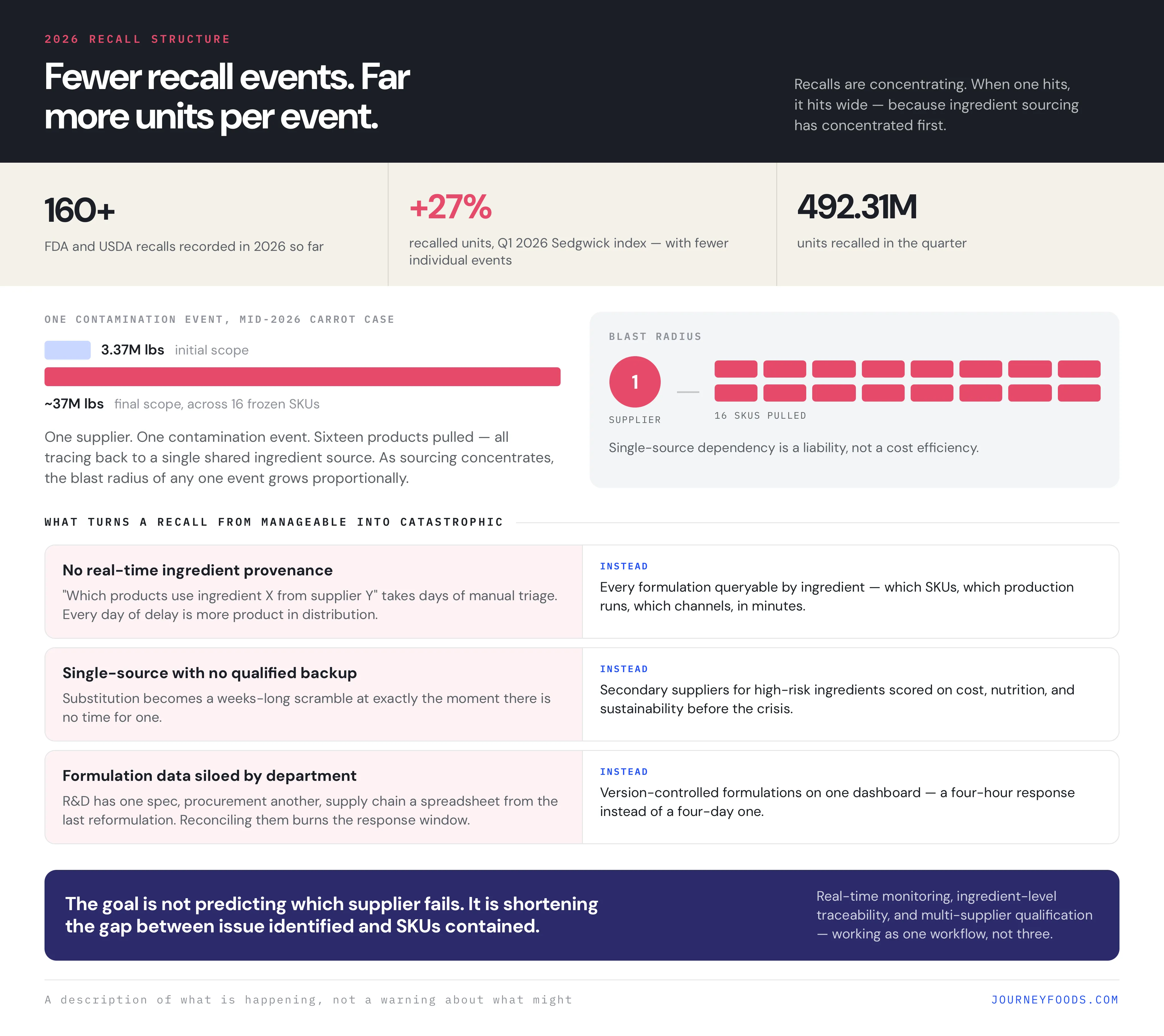
Supply chain consolidation is the underlying driver. As suppliers consolidate and ingredient sourcing concentrates around fewer, larger players, a single point of failure can propagate across dozens of products at once.
The carrot contamination case from mid-2026 makes this concrete. What started as a recall covering approximately 3.37 million lbs of product expanded to roughly 37 million lbs across 16 frozen food SKUs — all tracing back to one shared ingredient source. One supplier. One contamination event. Sixteen products pulled.
CNBC's reporting on the cyclospora outbreak tied to industry consolidation reinforces the same pattern: when ingredient sourcing concentrates, the blast radius of any single contamination event grows proportionally.
For R&D Directors and procurement leads, this is the operating environment you're inside right now. The question is whether your systems are built for it.
When a recall expands from manageable to catastrophic, it's rarely because the contamination was undetectable. It's usually one of these:
1. No real-time visibility into ingredient provenance. If your team can't immediately answer "which of our products use ingredient X from supplier Y," you're doing triage manually. That takes days. Every day of delay means more product in distribution, more liability exposure, more brand damage.
2. Single-source concentration with no backup. When a supplier issue hits and you have no alternative sourced and qualified, substitution becomes a weeks-long scramble. Teams that maintain multi-supplier visibility for critical ingredients can pivot. Teams that don't are stuck.
3. Formulation data siloed across departments. R&D has one version of a spec. Procurement has another. Supply chain is working from a spreadsheet that hasn't been updated since the last reformulation. When a recall hits, reconciling those data sources wastes time you don't have.
These aren't edge cases. For most mid-market CPG teams, this is standard operating reality.
Getting ahead of ingredient risk isn't about predicting which supplier will fail. It's about reducing the time between "supplier issue identified" and "affected SKUs contained."
That requires three things working together:
Real-time supply chain monitoring. You need alerts when a supplier status changes, when a recall is issued upstream, or when an ingredient's availability or compliance status shifts. Waiting for a supplier to call you is reactive sourcing. By the time you hear about it, the problem has already propagated.
Ingredient-level traceability across formulations. Every formulation in your portfolio should be queryable by ingredient. If carrot puree from Supplier X appears in your product line, you need to know which SKUs, which production runs, and which distribution channels — in minutes, not days.
Multi-supplier qualification as standard practice. The carrot contamination case is a reminder that single-source dependency is a liability, not a cost efficiency. Teams that have already qualified secondary suppliers for high-risk ingredients can act immediately when a primary source goes down.
None of this is theoretical. It's the operational difference between a recall that costs you one SKU and a recall that costs you sixteen.
This is where the tooling conversation becomes relevant for R&D and procurement leads.
Journey Foods is built around exactly this kind of ingredient-level visibility. The Operations Scientist AI engine lets teams search, score, and track ingredients across their entire portfolio — with real-time supply chain alerts when something changes upstream. Formulations are version-controlled and centralized, so when a supplier issue surfaces, your team isn't reconciling three different spreadsheets to figure out which products are affected.
The centralized dashboard means R&D, procurement, and supply chain leads are all working from the same data. In a recall scenario, that's the difference between a four-hour response and a four-day one.
Multi-supplier visibility is built into the ingredient discovery workflow. Teams can evaluate alternatives across nutrition, cost, and sustainability criteria before a crisis forces their hand — so when a supplier issue hits, qualified alternatives already exist.
To see how this works against your team's specific ingredient portfolio, book a demo at journeyfoods.io/book-a-demo or review current platform options at journeyfoods.io.
The 2026 recall data isn't a warning about what might happen. It's a description of what is happening. Concentrated recalls, shared ingredient sources, and supply chain consolidation are the operating environment now.
R&D Directors, procurement leads, and supply chain teams that treat ingredient risk as a compliance checkbox will keep getting caught flat-footed. The teams building real-time ingredient visibility and multi-supplier qualification into their standard workflows are the ones who contain the next event before it becomes a sixteen-SKU recall.
The window for building that infrastructure is open right now.
What is causing food recalls to increase in scale in 2026?
Supply chain consolidation is the primary driver. As ingredient sourcing concentrates around fewer, larger suppliers, a single contamination event can affect dozens of products at once. The Q1 2026 Sedgwick data — recalled units up 27% despite fewer individual events — is a direct result of that concentration pattern.
How does single-source ingredient dependency increase recall risk?
When multiple SKUs share a single ingredient source, a contamination or compliance issue at that source triggers a recall across all affected products simultaneously. The 2026 carrot contamination case, which expanded from ~3.37M lbs to ~37M lbs across 16 SKUs from one shared source, shows exactly how concentration amplifies blast radius.
What is the fastest way to identify which products are affected during a recall?
Teams with ingredient-level traceability built into their formulation management system can identify affected SKUs in minutes. Teams relying on siloed spreadsheets or manual cross-referencing face delays measured in days.
How can CPG teams reduce their exposure to single-source ingredient risk?
By qualifying secondary suppliers for high-risk ingredients before a crisis forces the issue. Ingredient intelligence platforms that support multi-supplier evaluation — scoring alternatives across cost, nutrition, and sustainability — make backup sourcing a standard practice rather than an emergency response.
What role does real-time supply chain monitoring play in recall prevention?
Real-time monitoring gives teams early warning when a supplier's status changes, when upstream recalls are issued, or when ingredient availability shifts. Acting on that information before affected product reaches distribution is the difference between containment and escalation.
How does formulation version control help during a recall event?
Version control ensures R&D, procurement, and supply chain teams are all working from the same current formulation data. When a recall hits, there's no time to reconcile conflicting specs across departments. A single source of truth for every formulation dramatically cuts response time.
What should CPG teams prioritize when evaluating ingredient risk management tools?
Three capabilities matter most: real-time supply chain alerts tied to specific ingredients in your portfolio, ingredient-level traceability across all formulations, and multi-supplier visibility that supports proactive alternative sourcing. Platforms that centralize these functions — rather than treating them as separate workflows — close the operational gaps that let recall events escalate.