
.svg)
.svg)
.svg)
.svg)


.svg)
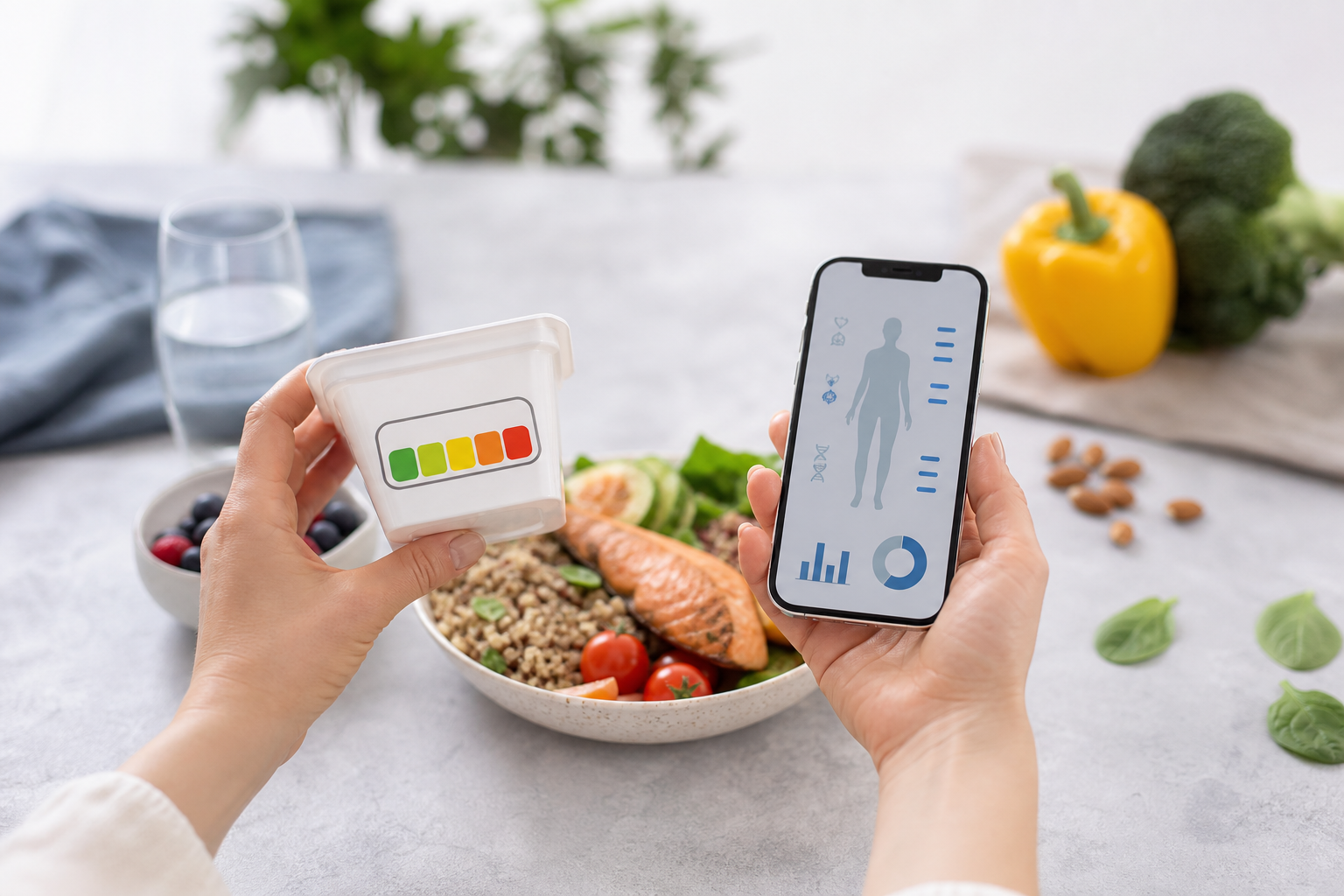
In September 2026, Poland's Ministry of Health made a decision that most of the food industry noticed but few have fully processed. After consulting 25 industry and scientific organizations, 22 of them opposed Nutri-Score front-of-pack labeling. The Ministry responded by formally initiating a withdrawal. No new Nutri-Score products after December 31, 2028. Existing stock off shelves by December 31, 2030. Reported through IGI Food Law and Rynek Zdrowia, this is one of the clearest regulatory signals yet that a single letter on a package cannot carry the weight we've asked it to carry.
I've been thinking about this for a long time. Not just as someone who watches food policy, but as a founder who built Journey Foods specifically because the food system's relationship with nutrition data is broken in a way that a color-coded score was never going to fix.
Key Takeaways
To be fair: Nutri-Score was trying to solve a real problem. Consumers are overwhelmed. Back-of-pack nutrition panels are dense, inconsistent, and require a level of nutritional literacy that most people don't have time to develop. The impulse to simplify — to give someone a single signal at the moment of purchase — is understandable.
But simplification at the expense of accuracy isn't a service to consumers. It's a substitution. You replace a complex truth with a legible fiction.
Nutri-Score's algorithm penalizes certain fats, rewards fiber, adjusts for protein. It doesn't know whether you're a 28-year-old endurance athlete, a 60-year-old managing type 2 diabetes, or a child in a household where caloric density is a feature, not a bug. It doesn't know your APOE genotype, your gut microbiome composition, or whether you carry a MTHFR variant that changes how you process folate. It produces one score for one imaginary average person.
That person doesn't exist.
Poland isn't an outlier. The near-unanimous opposition from scientific and industry organizations reflects a growing recognition that population-level nutrition scoring has fundamental limits — not because the underlying science is wrong, but because the frame is too narrow.
Nutrition science has moved. Research on nutrigenomics, metabolic individuality, and the microbiome has made it harder to defend universal dietary prescriptions with confidence. What raises LDL in one person has no effect in another. What spikes blood glucose in one metabolic profile is processed efficiently by another. These aren't edge cases. They're the norm.
When 22 of 25 scientific and industry bodies tell a government that a labeling system doesn't reflect the science, that's not a political outcome. That's the field correcting itself.
The question isn't whether Nutri-Score was well-intentioned. It was. The question is whether the food system is ready to build something better.
I want to be precise about what "personalized nutrition" means here, because the term gets used loosely.
It doesn't mean every consumer gets a custom product. It doesn't mean food companies need to sequence their customers' DNA. It means the food system needs to stop designing for a single average consumer and start designing with the full range of human variability in mind.
That requires two things working together: better consumer education and better data infrastructure on the product side.
Consumer education matters because no label — however well-designed — replaces understanding. People who know why saturated fat affects them differently than it affects their partner, or why a high-fiber product might cause problems for someone with IBS, make better decisions. Simplification that bypasses that understanding doesn't build nutritional literacy. It erodes it.
But consumer education alone doesn't get you there. The product side has to change too.
If you're formulating a product, the data you work with determines the product you can build. If your ingredient data only tells you macros and cost, you're formulating blind. You don't know the bioavailability of the protein you're using. You don't know whether your fiber source is fermentable or insoluble, and what that means for different gut profiles. You don't know how ingredient interactions affect the nutrient matrix at scale.
Most food companies are still working with fragmented data — nutrition in one system, supplier specs in another, formulation history in a spreadsheet that three people have edited without version control. That fragmentation makes personalization impossible. You can't build for variability when you can't see your own formulation clearly.
This is the problem Journey Foods was built to address. Not as a consumer genetics platform — we're a B2B ingredient intelligence platform — but as the data layer that connects ingredient attributes, nutrition profiles, supplier data, and formulation history so R&D teams can reason across all of it at once. Journey AI doesn't replace the food scientist. It gives them the data surface they need to ask better questions and make decisions that reflect real nutritional complexity, not a simplified score.
More on how the platform approaches this at Journeyfoods.io.
Personalized nutrition is not a trend. It's a permanent requirement the food system has been slow to meet.
The biology hasn't changed. Humans have always had different metabolic profiles, different genetic variants, different health contexts. What's changed is that the science has gotten precise enough to describe that variability in actionable terms, and the technology has gotten capable enough to act on it at scale.
Poland's decision is a signal that the regulatory environment is catching up. When a government withdraws a front-of-pack scoring system because the scientific community says it doesn't reflect nutritional reality, that's not the end of nutrition labeling. It's the beginning of a harder, more honest conversation about what nutrition information should actually do.
That conversation has to include the product side — the data infrastructure food companies use to formulate, source, and bring products to market. A better label on a poorly understood product doesn't help anyone.
The margin for oversimplification has disappeared. Not because regulators are demanding more, though some are. Because the science demands more, and the consumers who understand that science are asking for it.
The Poland decision is worth sitting with — not because it changes your labeling requirements today, but because it signals where the pressure is going.
The food companies positioned well in five years are the ones building with nutritional depth now. That means:
None of that is possible when your data lives in systems that don't talk to each other.
Why did Poland withdraw Nutri-Score?
Poland's Ministry of Health initiated a formal withdrawal of Nutri-Score front-of-pack labeling in September 2026 after 22 of 25 consulted scientific and industry organizations opposed the system. The phase-out prohibits new Nutri-Score products after December 31, 2028, with existing stock required off shelves by December 31, 2030. The decision was reported through IGI Food Law and Rynek Zdrowia.
What is the main criticism of Nutri-Score?
A single letter grade cannot reflect individual variation in metabolism, genetics, age, health status, or dietary context. A score calibrated to an average consumer fails the real population, which has significant variability in how it processes the same ingredients.
What does personalized nutrition actually require from food companies?
Ingredient data with depth beyond macros, supplier traceability, formulation infrastructure that supports iteration across nutritional criteria, and the ability to reason across multiple variables simultaneously during product development.
Is Journey Foods a consumer genetics or direct-to-consumer platform?
No. Journey Foods is a B2B ingredient intelligence platform. It connects ingredient, supplier, nutrition, formulation, and market data so food and CPG companies can make better product development decisions. It does not process consumer DNA or provide direct-to-consumer genetic testing.
How does ingredient intelligence support better nutrition outcomes?
When R&D teams have access to connected, multi-dimensional ingredient data, they can formulate with greater nutritional precision — understanding bioavailability, fiber type, amino acid completeness, and ingredient interactions rather than relying on simplified scores or fragmented spec sheets.
Will other countries follow Poland in withdrawing Nutri-Score?
That's a policy question that depends on each country's regulatory process. What the Polish decision demonstrates is that scientific consensus can shift regulatory outcomes, and that the case for population-level single-score systems is harder to defend as nutritional science becomes more precise about individual variability.
What should food companies do now in response to evolving nutrition labeling policy?
Build formulation and data infrastructure that supports nutritional depth and traceability. Companies that understand their ingredient profiles at a granular level will be better positioned to adapt to whatever labeling requirements emerge, rather than scrambling to reverse-engineer claims after the fact.