Yuka vs Journey Foods: Consumer-Facing Scoring vs Professional Ingredient Intelligence - What Your Team Actually Needs

Quick answer
Quick Answer: Yuka is a consumer app that scores finished products for shoppers. Journey Foods is a professional ingredient intelligence platform built for R&D teams, food scientists, and CPG decision-makers. If your team is using Yuka — or anything like it — to inform formulation decisions, you're working with a tool that was never designed for that job.
Key Takeaways:
Using Consumer Tools for Professional Work Is a Workflow Problem
Yuka has 50 million users. That number gets cited constantly in CPG circles, usually as a reason to care about how your product scores. Fair enough — consumer perception matters, and a poor Yuka score will reach your retail buyer.
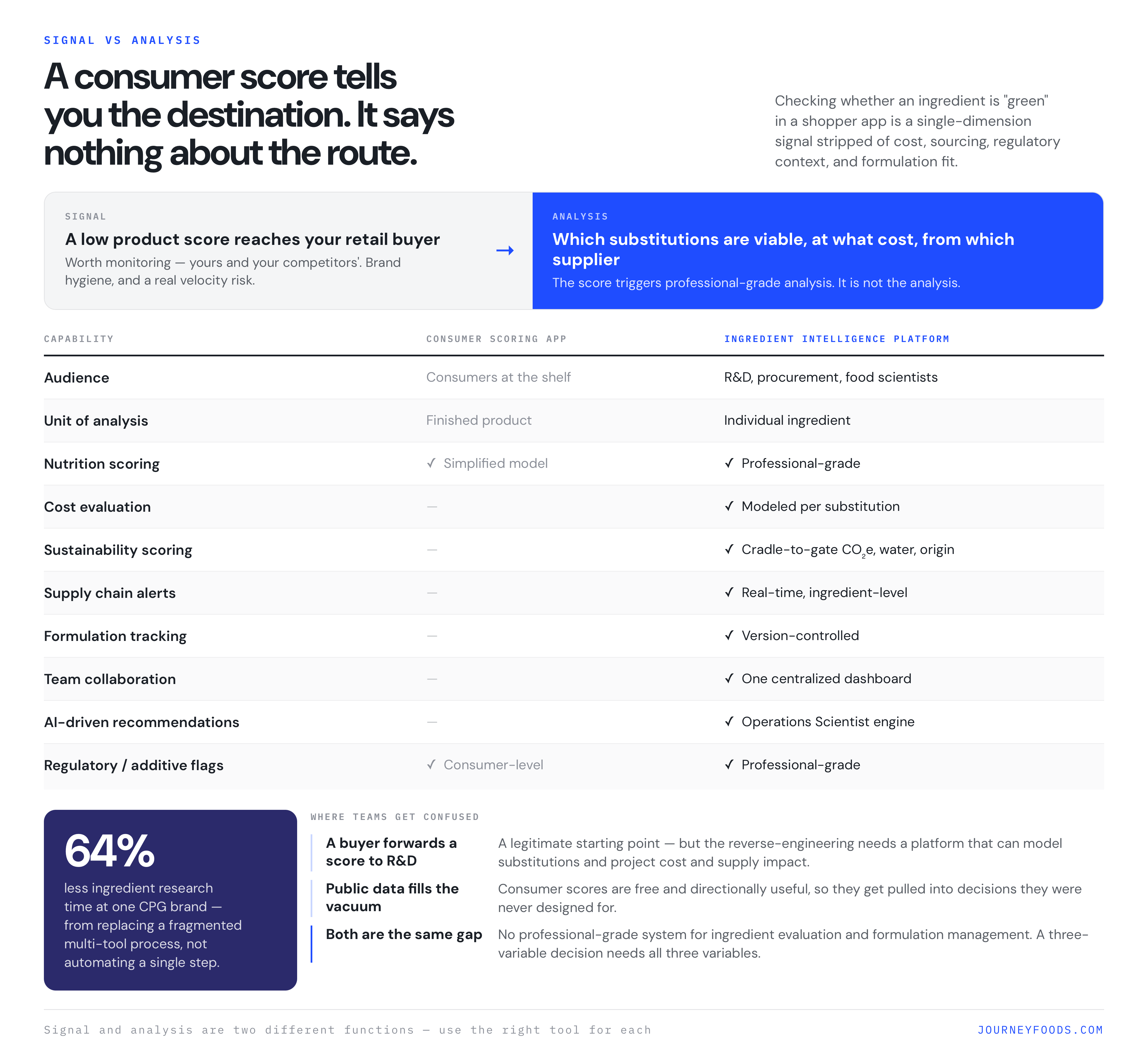
But there's a version of this conversation that goes sideways: R&D teams and procurement leads using Yuka's scoring logic as a proxy for formulation guidance. Checking whether an ingredient is "green" on a consumer app is not ingredient intelligence. It's a single-dimension signal stripped of cost, sourcing availability, regulatory context, and formulation fit.
That's the gap this article addresses.
What Yuka Actually Does
Yuka scans a product barcode and returns a score — color-coded from poor to excellent — based on nutritional content and the presence of food additives. Additive scoring draws from published studies and regulatory classifications. Nutritional scoring uses a simplified model (similar to Nutri-Score) that evaluates macros, sugar, sodium, and saturated fat per 100g.
It's a clean, useful consumer tool. It does exactly what it claims to do.
What it does not do:
If you're an R&D lead trying to reformulate a product to improve its Yuka score, the app gives you no actionable path forward. It tells you the destination. It has nothing to say about the route.
What Professional Ingredient Intelligence Actually Looks Like
This is where the comparison gets useful for CPG teams evaluating tools.
Professional ingredient intelligence means evaluating ingredients — not finished products — across the dimensions that drive a real development decision: nutrition, cost, sustainability, regulatory status, and supply chain viability. At scale. Across hundreds or thousands of ingredient candidates. With data that updates in real time.
Journey Foods is built around exactly that workflow. The Operations Scientist AI engine lets product teams search and score ingredients simultaneously across nutrition, cost, and sustainability criteria. That's not three separate research tasks — it's one query with a multi-dimensional output.
In practice: a three-week supplier email chain and a scattered spreadsheet of ingredient specs becomes a structured, queryable dataset with version control and real-time alerts. That's what reactive sourcing costs you when you're operating without it.
A Direct Feature Comparison
CapabilityYukaJourney FoodsAudienceConsumersR&D, procurement, food scientistsUnit of analysisFinished productIndividual ingredientNutrition scoringYes (simplified)Yes (professional-grade)Cost evaluationNoYesSustainability scoringNoYes (cradle-to-gate)Supply chain alertsNoYes, real-timeFormulation trackingNoYes, with version controlTeam collaborationNoYes, centralized dashboardAI-driven recommendationsNoYes (Operations Scientist)Regulatory / additive flagsConsumer-levelProfessional-grade
These tools are not competing for the same use case. Yuka isn't trying to be Journey Foods, and Journey Foods isn't trying to replace Yuka. But if your team is treating them as interchangeable — or using Yuka as a stand-in for professional ingredient evaluation — that's a workflow problem worth fixing.
Where CPG Teams Get Confused
The confusion usually starts in one of two places.
First: A retail buyer or brand manager flags a Yuka score and sends it to R&D. The team tries to reverse-engineer what's driving it and figure out what to change. That's a legitimate starting point. But the tool for that reverse-engineering work is not Yuka — it's a platform that can model ingredient substitutions, score alternatives, and project the cost and supply chain impact of each change.
Second: Teams without a dedicated ingredient intelligence platform start using whatever data is available. Yuka scores are public, easy to access, and directionally useful — so they get pulled into internal conversations they were never designed for.
Both scenarios are symptoms of the same underlying gap: no professional-grade system for ingredient evaluation and formulation management.
What R&D Teams Actually Need at Mid-Funnel
If you're evaluating tools at this stage, you're past spreadsheets. You already know that manual ingredient research — cross-referencing supplier specs, nutrition databases, cost sheets, and sustainability certifications across email threads — doesn't scale.
The question is what the right infrastructure looks like.
For CPG teams that need more than nutrition analysis, the best AI-powered ingredient management platforms for CPG companies in 2026 share a few common capabilities: multi-criteria ingredient scoring, supply chain integration, and team-level collaboration tools. Yuka has none of these. It's not a platform — it's an app.
The tools that do compete in the professional space — ESHA, Trace One, and others — are worth evaluating on their own terms. But many were built for nutrition compliance or regulatory documentation, not for the kind of dynamic, multi-variable ingredient discovery that modern CPG development requires. ESHA alternatives for CPG teams that need more than nutrition analysis in 2026 covers that comparison in more depth.
The Sustainability Dimension Yuka Doesn't Touch
Consumer-facing scoring tools reduce sustainability to a binary: is this additive on a "bad" list or not. Useful for consumer trust. Not useful for formulation decisions.
Professional sustainability scoring — the kind that actually informs a sourcing decision — operates at the ingredient level, using cradle-to-gate CO2e metrics, water use, land impact, and supply chain origin data. A food scientist choosing between two protein isolates needs to know which one hits the better CO2e number per serving, what the cost delta is, and whether the preferred supplier can deliver at volume. That's a three-variable decision. Yuka gives you zero of those variables.
Journey Foods scores ingredients across all three simultaneously. That's the difference between a consumer signal and ingredient intelligence.
When Yuka Data Is Still Useful
To be direct: Yuka data has a place in CPG strategy. A poor product score is a consumer perception problem that can translate into real retail velocity issues. Monitoring your Yuka score — and your competitors' — is reasonable brand hygiene.
The right workflow is to use Yuka as a signal that triggers professional-grade analysis, not as the analysis itself. A low Yuka score tells you something needs attention. Journey Foods tells you what to do about it — which ingredients to evaluate, which substitutions are viable, what the cost and supply chain implications are, and how the reformulation affects your nutrition profile.
Signal and analysis are two different functions. Use the right tool for each.
What the Research Time Difference Looks Like
The practical impact of professional ingredient intelligence versus consumer-grade tools shows up in development speed. A CPG brand cut ingredient research time by 64% using Journey Foods — not by automating a single step, but by replacing a fragmented, multi-tool research process with a centralized, AI-driven workflow.
That kind of efficiency gain doesn't come from a better consumer app. It comes from building the right infrastructure for the actual work.
The Workflow Gap in Plain Terms
Here's what using Yuka for professional ingredient decisions actually looks like:
Here's what using Journey Foods looks like:
The comparison isn't about features on a spec sheet. It's about how much of your R&D team's time goes to research overhead versus actual development work.
For teams that have hit the ceiling on what ESHA or Excel-based workflows can handle, the breakdown of why Genesis R&D and Excel workflows fail at scale covers the structural reasons why.
The Bottom Line
Yuka is a consumer tool. It does its job well. Your customers use it, and their scores matter for brand health.
But if your R&D team is using Yuka — or anything like it — as a substitute for professional ingredient intelligence, you're making formulation and sourcing decisions with incomplete data. That gap shows up in slower development cycles, reactive sourcing, and reformulations that fix one problem while creating two others.
Professional ingredient intelligence means evaluating ingredients on the dimensions that drive business decisions — nutrition, cost, sustainability, and supply chain viability — simultaneously, at scale, with your whole team working from the same data.
That's what Journey Foods is built for. See it in action at Journeyfoods.io.
FAQs
Is Yuka a tool for food industry professionals?
No. Yuka is designed for consumers evaluating finished products before purchase. It doesn't support ingredient-level evaluation, cost modeling, supply chain tracking, or team collaboration — the core requirements for professional CPG product development.
Can I use Yuka to guide a reformulation?
Yuka can tell you a product scores poorly and flag which additives or nutritional attributes are driving that score. It cannot tell you which ingredient substitutions are viable, what they cost, whether suppliers can fulfill them, or how they affect your full nutritional profile. You need a professional platform for that work.
What makes Journey Foods a Yuka alternative for CPG professionals?
Journey Foods operates at the ingredient level, not the finished-product level. It scores ingredients across nutrition, cost, and sustainability simultaneously, tracks formulations with version control, and provides real-time supply chain alerts. These are professional-grade capabilities that consumer apps like Yuka were never designed to offer.
Does Journey Foods replace Yuka entirely?
No. Yuka serves a consumer-facing function — helping shoppers evaluate products — that Journey Foods doesn't replicate. Use Yuka as a consumer signal. Use Journey Foods as the professional platform that tells you what to do with it.
What types of teams use Journey Foods?
Journey Foods is built for R&D leads, food scientists, procurement teams, and CPG decision-makers at food, beverage, and ingredient supplier companies. It's designed for teams that are past spreadsheets and need a centralized, AI-driven system for ingredient management and formulation development.
How does Journey Foods handle sustainability scoring compared to Yuka?
Yuka flags additives based on published studies and regulatory lists — a consumer-level proxy. Journey Foods scores ingredients on cradle-to-gate CO2e, water use, and supply chain origin data, giving R&D teams the specific metrics needed to make sourcing decisions that hold up to scrutiny.
What's the main risk of relying on consumer-grade tools for professional ingredient decisions?
Incomplete data driving consequential decisions. Consumer tools give you a single-dimension signal stripped of cost, sourcing, and sustainability context. Formulation decisions made on that basis tend to create downstream problems — cost overruns, supply disruptions, or nutritional trade-offs that weren't modeled before the change was made.
As published
64%
Data from this story
Shareable Journey Intelligence
Yuka vs Journey Foods: Consumer-Facing Scoring vs Professional Ingredient Intelligence - What Your Team Actually Needs
Industry Insights
64%
A CPG brand cut ingredient research time by 64% using Journey Foods — not by automating a single step, but by replacing a fragmented, multi-tool research process with a centralized, AI-driven workflow.