.svg)
.svg)
.svg)
.svg)


.svg)
Doritos are one of the most studied snacks in CPG. Not because they're nutritionally interesting — but because they're technically impressive. The flavor profile is engineered to hit multiple taste receptors at once. The texture is calibrated. The color is deliberate. And the ingredient list tells you exactly how much work went into making something that addictive at that price point.

.svg)
If you're a food scientist or R&D lead, reading a Doritos label isn't a health exercise. It's a formulation case study.
This article breaks down what's actually in Nacho Cheese Doritos, what each ingredient does, and what the list signals about the tradeoffs PepsiCo made — then gets into what those tradeoffs mean for CPG teams building competitive snack products in 2026.
The standard Nacho Cheese Doritos ingredient list reads:
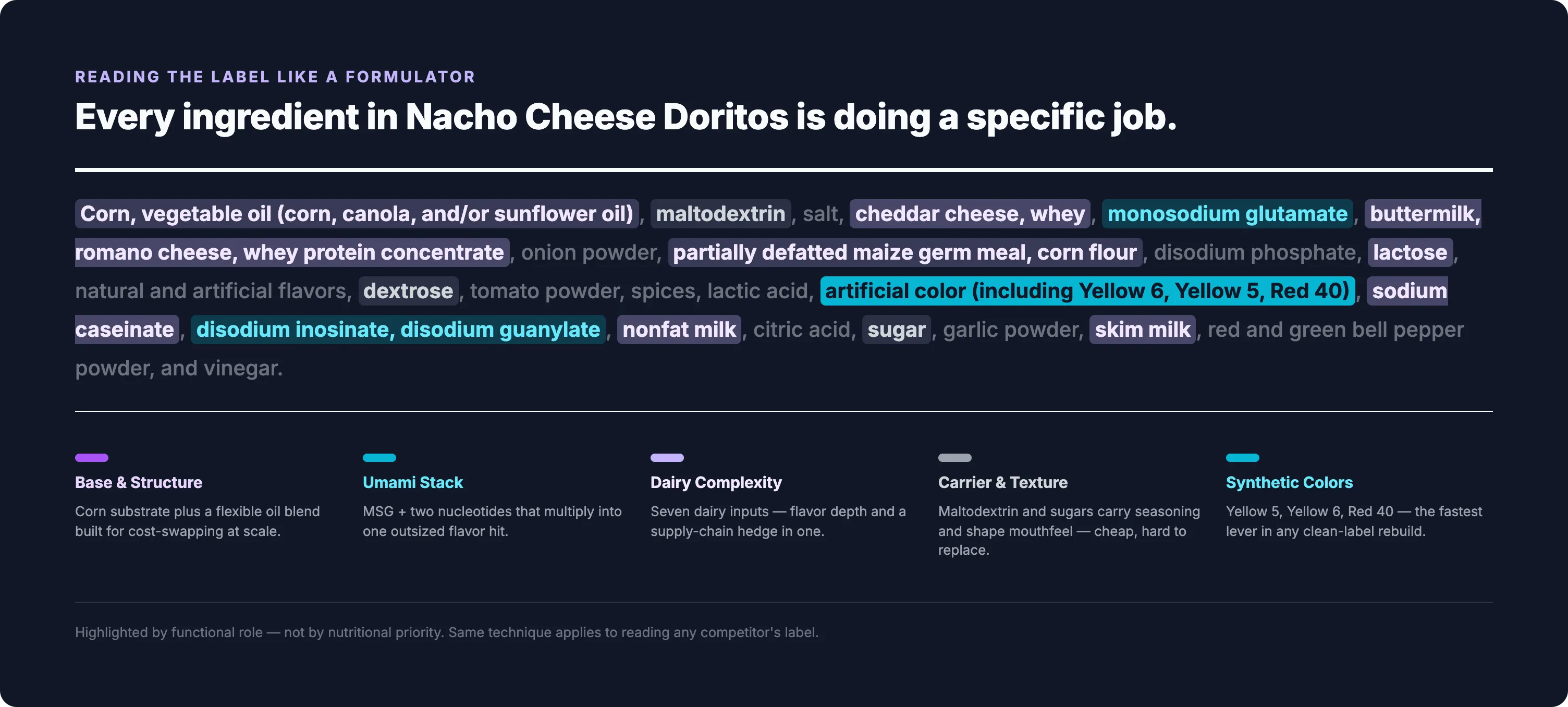
Corn, vegetable oil (corn, canola, and/or sunflower oil), maltodextrin, salt, cheddar cheese, whey, monosodium glutamate, buttermilk, romano cheese, whey protein concentrate, onion powder, partially defatted maize germ meal, corn flour, disodium phosphate, lactose, natural and artificial flavors, dextrose, tomato powder, spices, lactic acid, artificial color (including Yellow 6, Yellow 5, Red 40), sodium caseinate, disodium inosinate, disodium guanylate, nonfat milk, citric acid, sugar, garlic powder, skim milk, red and green bell pepper powder, and vinegar.
That's a long list. Here's what it actually means.
Corn is the substrate. The masa-style process gives the chip its structure and that specific crunch. The oil blend — corn, canola, sunflower — is a cost-flexibility play. PepsiCo sources whichever is cheapest at scale while staying within a defined flavor and oxidation stability window. For smaller CPG teams, that kind of multi-oil flexibility is harder to execute without real supply chain visibility.
This is where the formulation gets interesting. Doritos uses a classic umami stack:
This combination is well-documented in flavor science. IMP and GMP on their own have weak umami. Combined with MSG, the effect multiplies — the result reads as more intense than the sum of its parts.
The dairy stack (cheddar cheese, whey, buttermilk, romano, whey protein concentrate, sodium caseinate, nonfat milk, skim milk, lactose) serves two purposes: it delivers the cheese flavor profile, and it contributes Maillard browning precursors that develop during high-temperature frying.
Maltodextrin is doing functional work here. It acts as a flavor carrier, helping powdered seasoning adhere to the chip surface, contributes mild sweetness, and modifies mouthfeel. From a nutrition standpoint, it's a high-glycemic carbohydrate with minimal value. From a formulation standpoint, it's nearly irreplaceable for this application at this cost.
These three synthetic dyes create the signature orange. All three are FDA-approved. All three are on the watch list for clean-label reformulation. Yellow 5 and Red 40 carry EU labeling requirements for a warning statement about potential effects on activity and attention in children — and in 2026, that regulatory pressure is moving stateside.
This is a live formulation pressure point. Consumer demand for clean-label snacks is rising, and synthetic dyes are consistently the first target.
Reading this list as a formulator, three tradeoffs stand out immediately.
The ingredient list is optimized for cost and performance at scale. MSG and nucleotides deliver flavor intensity cheaply. Maltodextrin is inexpensive. Synthetic dyes are a fraction of the cost of natural alternatives like annatto or beta-carotene.
A clean-label version of this product would cost significantly more per unit. That's the honest math. Natural cheese flavors are more expensive than the dairy powder stack. Natural colorants are less stable and harder to source consistently. At PepsiCo's volume, those cost differences are manageable. For a mid-market CPG brand, they require careful formulation work to stay within margin.
The multi-dairy approach — seven distinct dairy-derived ingredients — is partly a flavor complexity strategy and partly a supply chain hedge. If one source gets constrained, the formulation still holds. But it also means a longer ingredient list, which reads poorly to clean-label consumers.
Consolidating to fewer, higher-quality dairy inputs is technically possible. It requires reformulation work and likely a cost increase. Whether that tradeoff makes sense depends on your brand positioning and target margin.
"Natural and artificial flavors" is a catch-all that covers a significant portion of the flavor system. The "artificial" designation gives PepsiCo flexibility to use synthetic flavor compounds that may be more stable or cost-effective. Brands moving toward clean-label positioning typically need to replace this with "natural flavors" only — which narrows the palette and usually requires deeper flavor supplier collaboration.
A standard serving of Nacho Cheese Doritos — about 28g, roughly 11 chips — delivers approximately 140 calories, 8g of fat, 18g of carbohydrates, and 210mg of sodium. Minimal fiber. Minimal protein.
The health concerns most often raised fall into a few categories:
Sodium load: At 210mg per 11-chip serving, sodium adds up fast. Most people eat more than one serving in a sitting.
Synthetic dyes: Yellow 6, Yellow 5, and Red 40 remain contested. The FDA hasn't moved to ban them, but several states have introduced or passed legislation requiring disclosure or removal.
MSG: Despite decades of negative perception, MSG is generally recognized as safe (GRAS) by the FDA. The science doesn't support the "Chinese restaurant syndrome" narrative. For formulators, this matters — MSG is an effective, affordable flavor tool, and the stigma is largely consumer perception, not toxicology.
Refined carbohydrates and glycemic response: The corn base plus maltodextrin and dextrose creates a high-glycemic profile. Relevant for brands targeting metabolic health or diabetic consumers.
None of this is surprising. Doritos are engineered for palatability, not nutrition. The more useful question for CPG teams: what does this formulation approach tell you about where consumer pressure is heading, and how do you build products that get ahead of it?
Consumer scrutiny of ingredient lists is higher than it was five years ago. Apps like Yuka have made ingredient decoding accessible to non-technical consumers. Clean-label pressure is real and measurable in purchase data.
If you're formulating a snack that competes in the same category as Doritos, you have a few strategic paths:
Option 1: Compete on clean-label positioning. Replace synthetic dyes with natural colorants, swap MSG for natural umami sources (nutritional yeast, fermented ingredients, mushroom powder), and simplify the dairy stack. This costs more but opens a premium positioning lane.
Option 2: Compete on functional nutrition. Keep the flavor intensity but add protein (pea, whey, or chickpea-based), reduce sodium, and improve the fiber profile. This is the better-for-you snack play.
Option 3: Compete on sustainability. Reformulate the base with regeneratively sourced corn or alternative grain substrates. Pair with sustainable packaging. This is a longer-term brand equity play.
Each path requires systematic ingredient evaluation. You need to know what a natural colorant alternative costs relative to Red 40, how it performs under your processing conditions, and whether your supplier can deliver it consistently. That's not a spreadsheet problem. It's a data infrastructure problem.
This is exactly the kind of multi-criteria decision that Journey Foods is built to support. The Operations Scientist AI scores ingredients across nutrition, cost, and sustainability simultaneously — so you're not running three separate analyses and trying to reconcile them by hand.
For teams working through clean-label reformulation specifically, the guide to replacing synthetic additives without killing your formulation is worth reading alongside this.
The multi-oil blend in Doritos isn't just a flavor decision. It's a supply chain resilience decision. Sunflower oil availability dropped sharply in 2022 following the Russia-Ukraine conflict. Canola prices have been volatile. Brands locked into a single oil source felt that immediately.
For CPG teams formulating oil-fried snacks, building in multi-source flexibility at the formulation stage is smart risk management. The same logic applies to dairy ingredients — the dairy powder market has had repeated supply disruptions over the past several years.
Real-time supply chain monitoring matters here. Knowing your primary colorant supplier is experiencing a shortage before it hits your production schedule is the difference between a reformulation sprint and a product delay. The role of digital tools in strengthening transparency and traceability in food supply chains covers this in more depth.
If you're building a snack that draws from the Doritos flavor architecture but wants to move toward cleaner or more functional positioning, here are the ingredient categories to look at:
Each of these comes with its own cost, stability, and sourcing profile. Evaluating them in isolation misses the point. The question is always how they perform together in your specific formulation, at your specific cost target, with your specific supply chain.
For formulators looking at how functional ingredients work in real product contexts, the 2026 formulator's guide to functional ingredients in product development is a useful reference.
Doritos is a masterclass in flavor engineering at scale. The ingredient list is long because every item is doing a specific job — and most of those jobs are about maximizing palatability and shelf stability at the lowest possible cost.
For CPG formulators in 2026, that list is also a map of where consumer pressure is building. Synthetic dyes, MSG perception, refined carbohydrate profiles, and the sustainability of the corn supply chain are all active conversation points in the market.
The brands that win over the next five years won't be the ones that copy the Doritos formula. They'll be the ones that understand it well enough to build something better — cleaner, more nutritious, more sustainable, or some combination of all three.
That requires better ingredient intelligence, faster formulation iteration, and a supply chain that doesn't surprise you. Explore how Journey Foods supports that work at journeyfoods.io, or book a demo to see the platform in action.
What are the main ingredients in Doritos Nacho Cheese?
The primary ingredients are corn, vegetable oil (corn, canola, and/or sunflower oil), maltodextrin, salt, cheddar cheese, whey, and monosodium glutamate. The flavor system also includes a stack of dairy-derived ingredients, nucleotide flavor enhancers (disodium inosinate and disodium guanylate), and artificial colors (Yellow 6, Yellow 5, Red 40).
Is MSG in Doritos harmful?
MSG is classified as generally recognized as safe (GRAS) by the FDA. The scientific literature does not support claims that MSG causes adverse reactions in the general population. The negative perception around MSG is largely a cultural narrative rather than a toxicological finding.
Why do Doritos have so many dairy ingredients?
The multiple dairy-derived ingredients — cheddar cheese, whey, buttermilk, romano, whey protein concentrate, sodium caseinate, nonfat milk, skim milk, lactose — serve both flavor complexity and supply chain flexibility. Different dairy components contribute different flavor notes and Maillard browning precursors, and sourcing from multiple dairy streams reduces single-source dependency.
Are the artificial colors in Doritos safe?
Yellow 6, Yellow 5, and Red 40 are FDA-approved. However, Yellow 5 and Red 40 carry EU labeling requirements noting potential effects on activity and attention in children. In 2026, several U.S. states have introduced or passed legislation targeting synthetic dyes in food products, making this an active regulatory and clean-label pressure point.
How would a CPG brand formulate a cleaner version of a Doritos-style chip?
The main substitutions involve replacing synthetic dyes with natural colorants (annatto, paprika extract, beta-carotene), replacing MSG with natural umami sources (nutritional yeast, mushroom powder, fermented ingredients), simplifying the dairy stack, and swapping maltodextrin for a functional alternative like modified tapioca starch or inulin. Each change affects cost, flavor stability, and sourcing complexity — which is why multi-criteria ingredient evaluation is essential, not optional.
What does the Doritos oil blend tell formulators about supply chain strategy?
The corn/canola/sunflower blend is a supply chain hedge as much as a flavor decision. Using multiple oil sources gives PepsiCo flexibility to shift sourcing when one oil becomes expensive or constrained. Smaller CPG brands can apply the same logic to reduce exposure to commodity price swings.
How can CPG teams evaluate clean-label ingredient alternatives systematically?
Evaluating alternatives one ingredient at a time is slow and misses interaction effects. Platforms that score ingredients across nutrition, cost, and sustainability simultaneously — like Journey Foods — let teams compare alternatives in the context of the full formulation rather than in isolation. That speeds up reformulation and reduces the risk of optimizing one variable while degrading another.

Structured Q&A marked up with FAQ Page schema so it can be surfaced and cited by Al engines and search.
In Journey Al's 12 month dataset, the median plant protein reformulation came in -6.5% on raw material cost versus an animal protein control the first year that line went negative, driven by Tier 1 isolate suppliers reaching spec parity.
In Journey Al's 12 month dataset, the median plant protein reformulation came in -6.5% on raw material cost versus an animal protein control the first year that line went negative, driven by Tier 1 isolate suppliers reaching spec parity.
In Journey Al's 12 month dataset, the median plant protein reformulation came in -6.5% on raw material cost versus an animal protein control the first year that line went negative, driven by Tier 1 isolate suppliers reaching spec parity.