

.svg)
.svg)
.svg)
.svg)


.svg)
Your CFO doesn't care about ingredient scoring algorithms. They care about margin, time-to-market, and risk exposure. If you want budget for ingredient intelligence software, you need to speak that language — and you need the numbers to back it up. This guide gives you the framework to do exactly that.
R&D directors know the operational pain firsthand: weeks spent hunting ingredient data across disconnected databases, reformulation projects derailed by supply disruptions, sustainability reporting that requires pulling from three different tools. The cost of that friction is real. It's just rarely quantified.
That's the gap this guide closes. Ingredient intelligence software ROI isn't abstract. It shows up in measurable places — research hours recovered, launch delays avoided, reformulation costs reduced, supply disruptions caught before they become product delays.
The challenge is translating those outcomes into a business case that survives a budget review.
Before you propose a solution, document the current cost of doing nothing. This is the foundation of any credible business case.
Start with four categories.
Ingredient research time. How many hours per week does your team spend searching for ingredient data, cross-referencing supplier specs, and manually scoring options against nutrition, cost, and sustainability criteria? At a fully-loaded cost of $80 to $120 per hour for a senior food scientist or R&D manager, even 10 hours per week per person adds up fast.
Formulation version control failures. How many times in the past 12 months did your team work from outdated formulation data? What did that cost in rework, retesting, or delayed approvals? These incidents get written off as operational friction — but they have a real dollar value.
Supply chain reactive costs. When an ingredient shortage hit, what did you pay in expedited sourcing, reformulation sprints, or missed launch windows? A single supply disruption can cost a mid-market CPG brand anywhere from tens of thousands to hundreds of thousands of dollars, depending on SKU volume and retailer commitments.
Multi-tool sprawl. How many separate subscriptions, databases, or manual processes does your team use to cover what one integrated platform should handle? Add up those costs. They're often invisible because they're spread across different budget lines.
Document these numbers with specifics. Estimates are fine at this stage, but ranges grounded in actual incidents are more persuasive than round numbers.
This is where ingredient intelligence software ROI becomes concrete.
The core value proposition is time compression. A platform that scores ingredients across nutrition, cost, and sustainability simultaneously — rather than requiring your team to run those analyses sequentially across separate tools — directly reduces research cycle time.
One CPG brand using Journey Foods cut ingredient research time by 64%. That's not a marginal efficiency gain. For a team running multiple active development projects, that kind of reduction compresses timelines in ways that directly affect revenue: faster launches, faster reformulations, faster responses to market opportunities.
To calculate this for your business case:
If three R&D team members each spend 12 hours per week on ingredient research at $100 per hour fully loaded, that's $187,200 per year in research labor. A 40% reduction recovers $74,880 annually. That's not headcount reduction — it's capacity your team can redirect to higher-value work.
Supply chain risk is the argument that tends to land hardest with finance and operations leadership. This is often where the business case closes.
The question isn't whether your supply chain will face disruptions. It's whether you'll see them coming or react after the damage is done. Real-time supply chain intelligence is now a core part of how leading R&D teams approach food innovation — not a nice-to-have, but a risk management function.
Frame this as insurance with a measurable deductible:
If your team had received an alert 30 days earlier — with AI-generated alternative ingredient recommendations already scored against your formulation criteria — what would that have been worth? In most cases, the answer exceeds the annual cost of the platform by a significant margin.
This argument is particularly strong for procurement and supply chain decision-makers already tracking disruption risk. Pair it with the data from your Step 1 audit and you have a cross-functional case that speaks to both R&D and operations.
Most mid-market CPG teams are running fragmented stacks. One tool for nutrition analysis, another for sustainability data, a third for supplier information, and spreadsheets holding everything else together. That fragmentation has a cost that rarely appears on a single budget line.
An integrated platform replaces multiple point solutions. When building your business case, list every tool your team currently uses that overlaps with ingredient intelligence capabilities. Add up those subscription costs. Then add the coordination cost: time spent moving data between systems, reconciling discrepancies, and maintaining version control manually.
The consolidation argument is straightforward. One platform handling ingredient scoring across nutrition, cost, and sustainability — combined with formulation version control and real-time supply chain alerts — eliminates the overhead of managing a fragmented stack.
For context, Journey Foods pricing starts at $199 per month for a single user and scales to $1,999 per month for teams of up to 50 users. For most mid-market R&D teams, the platform cost is lower than the combined cost of the tools it replaces — before accounting for any efficiency gains.
Once you have the numbers, the document itself is straightforward. Keep it short. Finance and operations leaders respond to clarity, not length.
Section 1: Current State Cost Summary
Quantified costs from your Step 1 audit — research hours, version control failures, supply disruption incidents, multi-tool costs. Total annual cost of the status quo.
Section 2: ROI Model
Time savings calculation, supply chain risk reduction value, tool consolidation savings. Be conservative. A business case that undersells and overdelivers is better than one that overpromises.
Section 3: Platform Cost
Actual subscription cost at the tier that matches your team size. Include implementation time — typically low for SaaS platforms that don't require heavy IT involvement.
Section 4: Payback Period
At what point do the savings exceed the cost? For most mid-market teams, this lands within the first two to three months.
Section 5: Risk of Inaction
What's the cost of the next supply disruption without early warning capability? What's the competitive cost of slower development cycles? This section often closes the argument.
"We don't have budget for new software."
Show the consolidation math. If the platform replaces tools you're already paying for, the net cost is lower than it appears.
"Our team can handle this with existing processes."
Quantify what "handling it" currently costs in hours and incidents. The question isn't whether your team is capable — it's whether their time is being spent on the right problems.
"We need to see it work before we commit."
That's a reasonable ask. A demo that walks through a real formulation scenario using your actual criteria is more persuasive than any document. Book a demo at journeyfoods.io/book-a-demo and bring your CFO or VP of Operations to the call.
"What's the implementation burden?"
For teams evaluating food product development platforms in 2026, implementation complexity is a real concern. Journey Foods is a SaaS platform with API access and third-party integrations, built to work without heavy IT involvement. Most teams are operational within days, not months.
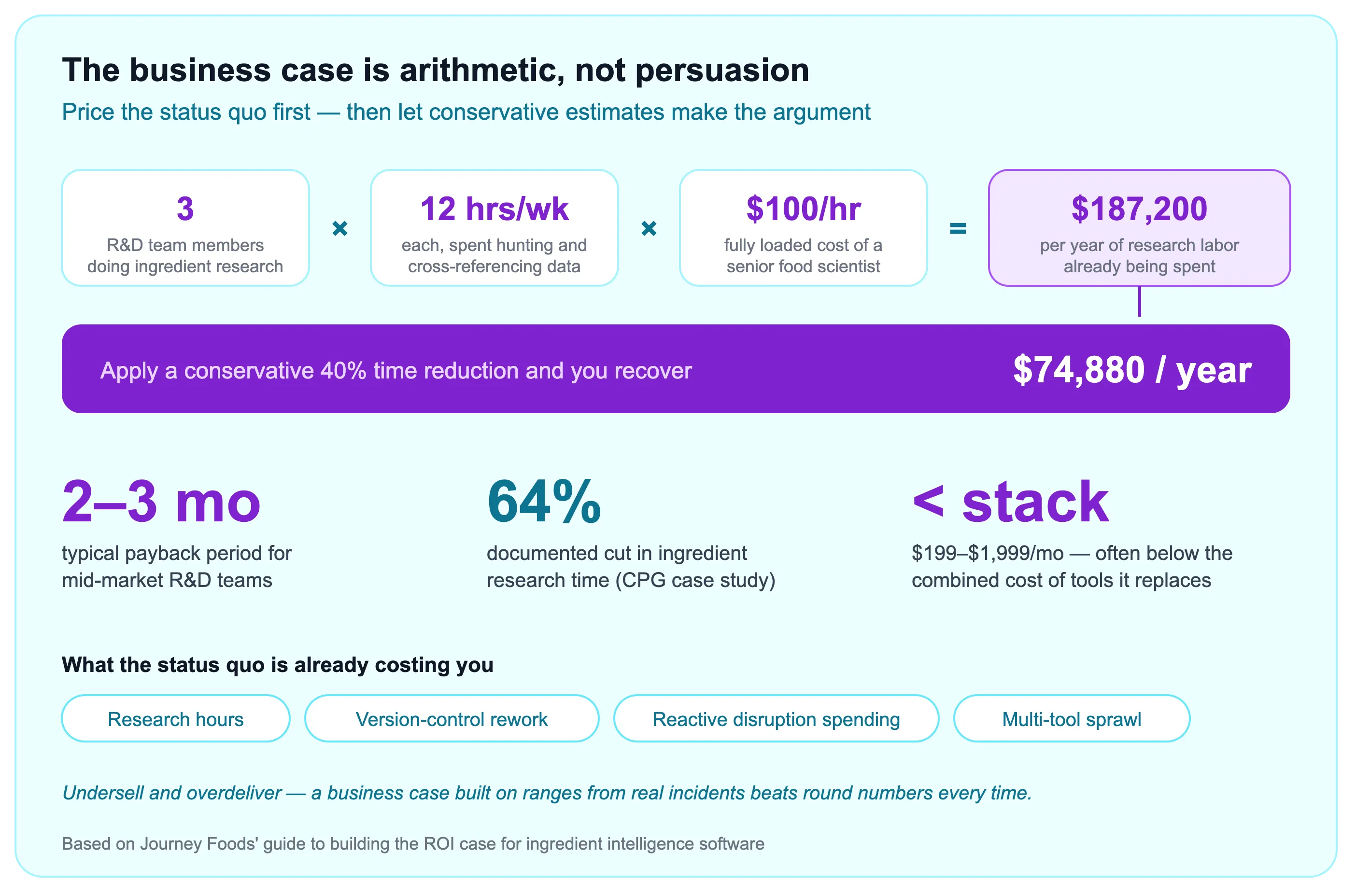
Anchor your business case to outcomes, not features. The outcomes that resonate most with finance and operations leadership:
None of these require you to overstate the case. They require you to document the current cost of the status quo honestly, apply conservative improvement estimates, and let the math make the argument.
For teams that want to understand where ingredient intelligence fits in the broader AI landscape, the leading AI companies for the food industry is worth reviewing as context for your internal stakeholders.
The business case for ingredient intelligence software isn't complicated. It's a cost-of-status-quo argument supported by documented inefficiencies, a conservative ROI model, and a clear payback period. Your job as the R&D director is to translate operational pain into financial terms your stakeholders understand.
Start with the audit. Quantify what you're already paying for fragmentation, delays, and reactive supply chain decisions. Then show what a platform that handles ingredient scoring, formulation management, and supply chain monitoring in a single workflow is actually worth.
Explore the platform at journeyfoods.io or book a demo to walk through the numbers with your specific team size and product development context.
What is ingredient intelligence software and how does it differ from standard nutrition analysis tools?
Ingredient intelligence software scores ingredients across multiple criteria simultaneously — typically nutrition, cost, and sustainability — and integrates that scoring with formulation management and supply chain monitoring. Standard nutrition analysis tools like ESHA handle label compliance and nutrient calculations but don't connect to sourcing data, cost optimization, or real-time supply alerts. The difference is scope: ingredient intelligence covers the full decision workflow, not just one dimension of it.
How do you calculate ROI for ingredient intelligence software?
Start by quantifying the current cost of manual ingredient research (hours times fully-loaded labor cost), supply disruption incidents (direct cost plus revenue impact of delays), formulation version control failures (rework and retesting costs), and multi-tool subscription sprawl. Then apply conservative efficiency estimates — typically 40 to 60% reduction in research time, based on documented benchmarks — and compare total savings against annual platform cost. Most mid-market teams see payback within two to three months.
What's the typical payback period for an ingredient intelligence platform at a mid-market CPG brand?
For teams running multiple active development projects, payback typically occurs within two to three months when you account for research time savings, tool consolidation, and even one avoided supply disruption. The calculation depends on team size, number of active formulations, and historical disruption frequency.
How do you make the business case to a CFO who isn't familiar with R&D workflows?
Translate operational pain into financial terms. Research hours have a dollar value. Supply disruptions have a documented cost. Tool sprawl has a budget line. Frame the platform as a cost-reduction and risk-management investment, not an R&D tool. The consolidation argument — replacing multiple subscriptions with one integrated platform — is often the most accessible entry point for finance leadership.
Does ingredient intelligence software require significant IT implementation?
Modern SaaS platforms in this category are built for low implementation burden. Journey Foods supports API access and third-party integrations and is designed for teams that need to be operational quickly without heavy IT involvement. Most teams are running within days of onboarding.
What supply chain risks does ingredient intelligence software help mitigate?
The primary value is early warning: real-time alerts when ingredient availability, pricing, or supplier status changes, paired with AI-generated alternative ingredient recommendations already scored against your formulation criteria. This shifts your team from reactive to proactive — reducing both the cost and timeline impact of sourcing disruptions.
How does ingredient intelligence software support sustainability reporting requirements?
Platforms that score ingredients across sustainability criteria provide the data foundation for reporting. Rather than pulling sustainability data manually from supplier documentation or third-party databases, your team works from a centralized score that updates with supply chain changes. This reduces reporting preparation time and improves data consistency across SKUs and product lines.
Journey Foods Team News