How to Write a Formulation Brief That Actually Speeds Up R&D — Not Slows It Down


Quick answer
A formulation brief should be the fastest document your R&D team produces. In practice, it's often the one that causes the most friction.
Briefs arrive missing cost targets. Or they include a nutrition spec but no constraint on ingredient origin. Marketing hands off something that describes a consumer concept, not a technical requirement. The food scientist fills in the gaps with assumptions, builds toward a target that shifts mid-project, and the whole cycle restarts three weeks later.
This is about writing briefs that actually function as alignment tools — not just paperwork. If you're in R&D, product development, or procurement at a CPG brand, this is for you.
Why Most Formulation Briefs Fail Before Development Starts
The problem isn't that teams skip the brief. Most teams write one. The problem is that briefs are written to satisfy a process, not to answer the questions a food scientist actually needs answered before opening a formulation tool.
A brief that says "clean-label, high-protein, cost-competitive" is not a brief. It's a mood board.
The food scientist still has to determine: what protein source, at what inclusion rate, at what cost per unit, with what label claim, for which target market, with which shelf-life constraint, and whether the supply chain can actually deliver that ingredient consistently. None of that is in the brief.
So the scientist either guesses, or goes back to the brief owner, and the project stalls.
What a High-Functioning Formulation Brief Actually Contains
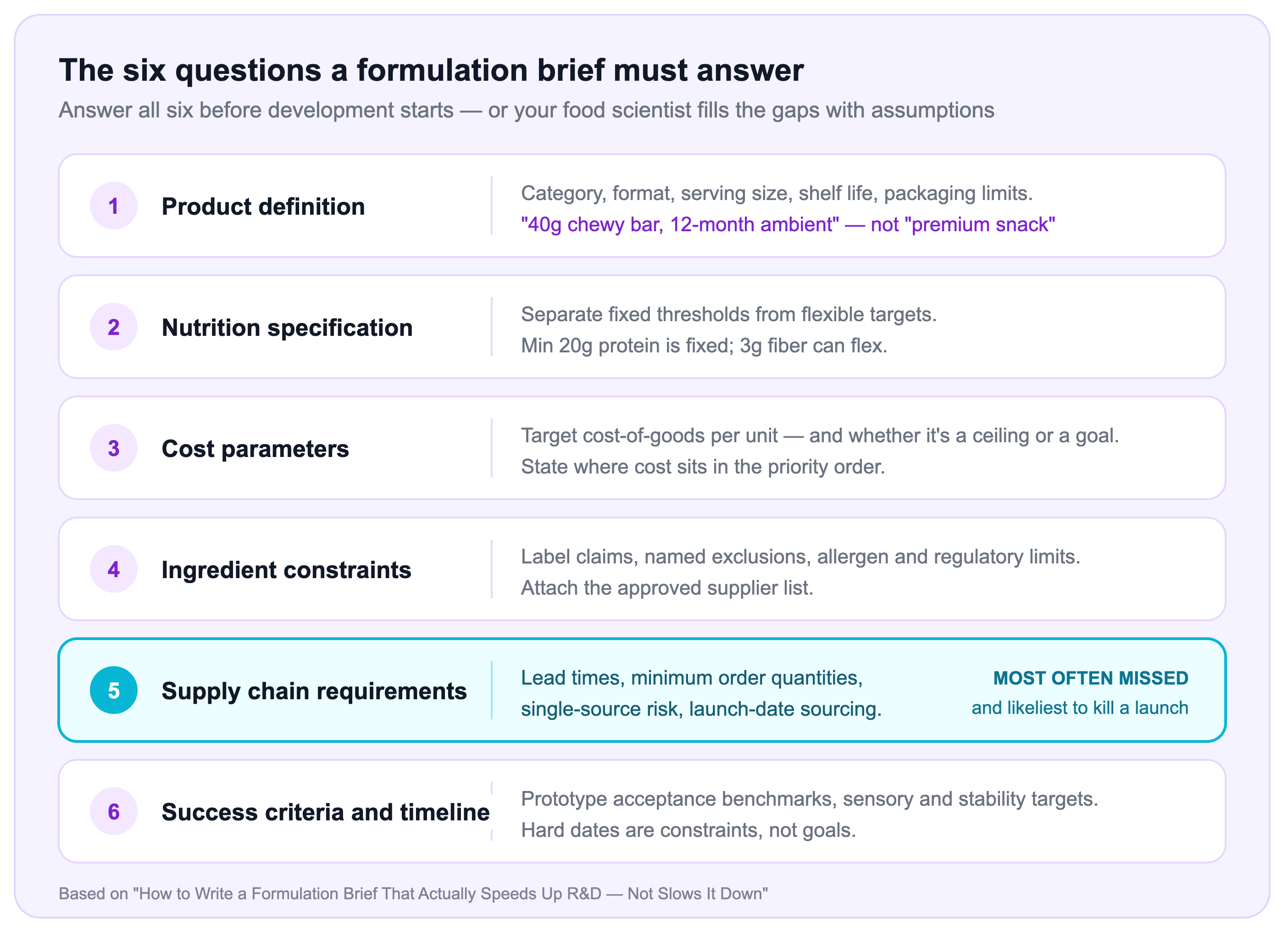
A brief that speeds up R&D answers six questions before development begins.
1. What Is the Product, Specifically?
Not the consumer concept. The technical format.
State the product category, format, and delivery mechanism. "A 40g protein bar in a chewy format with a 12-month ambient shelf life" is actionable. "A premium snack for active consumers" is not.
Include the target serving size and any packaging constraints that affect formulation — moisture barriers, fill weight tolerances, co-packer equipment limits.
2. What Are the Non-Negotiable Nutrition Targets?
List the specific nutrient thresholds that are fixed. Separate them from targets that are aspirational.
Fixed constraints might include: minimum 20g protein per serving, maximum 5g added sugar, no artificial sweeteners. Aspirational targets might include: 3g fiber, 150mg sodium or below.
If you don't distinguish between the two, your food scientist will treat everything as fixed and spend time optimizing for constraints that could flex. That's wasted iteration.
3. What Is the Cost Target, and How Hard Is It?
State the target cost-of-goods per unit. State whether it's a ceiling or a goal.
Also state where the cost target sits in the priority hierarchy. If the product has to hit a $0.85 COGS to land at the right retail price point, that's a ceiling. If $0.85 is preferred but $0.95 is acceptable for the right nutrition profile, say that.
Formulation decisions change significantly depending on whether cost is a constraint or a preference. Leaving this ambiguous forces the scientist to guess — or to build two versions of the same product.
4. What Are the Ingredient Constraints?
This is where briefs most commonly fail. Ingredient constraints include:
If your brand has a preferred supplier list or an approved ingredient library, attach it. If certain ingredients are excluded for brand, regulatory, or supply chain reasons, name them explicitly.
The cleaner this section is, the fewer dead ends your scientist hits during ingredient selection.
5. What Are the Supply Chain Requirements?
This is the section most briefs omit entirely — and the one most likely to kill a launch.
Before development starts, answer: Is there a preferred supplier? Is single-source acceptable? What's the minimum order quantity the business can support? Are there lead time constraints tied to a launch date?
A formulation built around an ingredient with a 16-week lead time and a single supplier will create a supply chain problem the moment that supplier has a disruption. If your brief doesn't surface this constraint upfront, your scientist won't know to build in an alternative.
This is also where real-time supply chain intelligence pays off. Teams using Journey Foods can flag supply risk on specific ingredients during formulation — not after the product is already in development. That's a fundamentally different workflow than discovering a sourcing problem at the prototype stage.
6. What Are the Success Criteria and the Timeline?
Define what "done" looks like at each stage. What does a passing prototype look like? What sensory benchmarks apply? What's the target for consumer testing?
State the hard dates. If there's a retailer presentation on a fixed date, or a co-packer slot that can't move, that date is a constraint, not a preference. Build the brief around it.
The Alignment Problem: Why Briefs Get Ignored Mid-Project
Even well-written briefs get abandoned. Usually because the brief lives in a document nobody updates when conditions change.
Marketing shifts the positioning. Procurement finds a better-priced ingredient. The co-packer changes the equipment spec. None of it gets reflected in the original brief, and the food scientist is now building toward a target that no longer exists.
This is a workflow problem, not a writing problem.
The fix is to treat the brief as a living document tied to the formulation — not a handoff artifact. When your brief and your formulation data exist in the same system, updates propagate. When they exist in separate files and email threads, they diverge.
Teams that have moved to centralized formulation management — where ingredient data, cost targets, nutrition scoring, and version history all live in one place — report significantly faster development cycles. The 64% reduction in ingredient research time documented in this CPG case study is partly a function of better tooling, but it's also a function of eliminating the back-and-forth that happens when brief and formulation are disconnected. See how that played out in practice here.
Common Brief Mistakes That Add Weeks to Development
Vague Sustainability Language
"Sustainable ingredients" means nothing without a definition. Does it mean certified organic? Regeneratively sourced? Low-carbon footprint? Specific supplier audit standards?
If your brand has a sustainability framework, reference it explicitly. If you're still building one, the brief is a good place to start operationalizing it. For teams working through clean-label reformulations, it's worth understanding the practical tradeoffs between label claims and ingredient performance before the brief is written — the clean-label formulation guide here covers how to replace synthetic additives without compromising product performance.
No Defined Prototype Acceptance Criteria
If the brief doesn't define what a passing prototype looks like, every prototype is debatable. Sensory benchmarks, texture targets, color specifications, and stability requirements belong in the brief — not discovered during review.
Missing Regulatory Context
If the product is launching in a market with specific additive restrictions, label claim requirements, or fortification rules, that context belongs in the brief. Discovering a regulatory constraint after a formulation is built means reformulation. That's weeks lost.
Treating the Brief as a One-Way Document
A brief is not a memo. It's a contract between the brief owner and the development team. If the brief owner isn't available to answer questions during development, the brief will be interpreted, not followed. Name a point of contact and build in a clear escalation path for constraint conflicts.
A Practical Brief Template for CPG R&D Teams
Here's a structure that works across most product categories. Adapt the specifics to your format.
Section 1: Product Definition
Section 2: Nutrition Specification
Section 3: Cost Parameters
Section 4: Ingredient Constraints
Section 5: Supply Chain Requirements
Section 6: Success Criteria and Timeline
How Centralized Formulation Tools Change the Brief Workflow
A brief template is a starting point. The bigger opportunity is connecting the brief directly to the tools your team uses to execute it.
When ingredient scoring, cost data, nutrition analysis, and supply chain risk all live in one platform, the brief stops being a document that gets handed off and starts being a set of parameters the team works against in real time. Constraints are visible to everyone. When an ingredient fails a cost threshold, the team sees it immediately. When a supply chain alert fires on a key ingredient, the brief can be updated before development goes further down a dead end.
That's the workflow Journey Foods is built for. The Operations Scientist AI scores ingredients across nutrition, cost, and sustainability simultaneously — which means the brief's three core parameters are evaluated together, not sequentially. If you want to see how that changes the formulation process, explore the platform at journeyfoods.io or see how it fits your current development stack.
FAQs
What should a formulation brief include for a CPG product launch?
A complete formulation brief covers six areas: product definition (format, serving size, shelf life), nutrition specification (fixed and aspirational targets), cost parameters (COGS ceiling or target), ingredient constraints (label claims, allergens, approved suppliers), supply chain requirements (lead times, sourcing flexibility), and success criteria with hard launch dates. Briefs missing any of these force R&D teams to fill in the gaps with assumptions — which adds iteration cycles.
How long should a formulation brief be?
Length matters less than completeness. A one-page brief that answers all six questions is more useful than a five-page document that describes the consumer concept without stating a cost target. Most effective briefs run one to three pages, with a clear structure a food scientist can reference quickly during development.
Who should write the formulation brief?
The brief owner is typically the product development manager or R&D lead, but it should be built with input from marketing (positioning and label claims), procurement (cost targets and supplier constraints), and supply chain (sourcing and lead time requirements). A brief written by one function without input from the others will have gaps.
What's the most common reason formulation briefs slow down R&D?
Ambiguous or missing constraints — particularly around cost, ingredient sourcing, and supply chain requirements. When these are undefined, the food scientist either guesses or goes back to the brief owner for clarification. Both add time. The second most common cause is a brief that doesn't get updated when conditions change, leaving the development team working toward a target that no longer reflects the business requirements.
How do you handle sustainability requirements in a formulation brief?
Be specific, not aspirational. State the certification required (organic, Rainforest Alliance, etc.), any carbon footprint targets, or the supplier audit standards your brand applies. Vague language like "sustainable ingredients" creates ambiguity that slows ingredient selection. If your brand is still defining its sustainability framework, use the brief to document the current minimum requirements and flag which parameters are still being defined.
How does real-time supply chain data affect the formulation brief process?
When supply chain data is integrated into your formulation workflow, you can surface sourcing risk on specific ingredients before development is complete — not after. The brief's supply chain requirements section can be validated against actual market conditions, and the team can build in approved alternatives before a disruption forces a last-minute reformulation.
At what stage should the formulation brief be finalized?
Before any formulation work begins. That said, treat it as a living document with a clear version history. If constraints change during development — which they often do — update the brief and communicate the change to the full team. A brief that diverges from actual project constraints without anyone noticing is worse than no brief at all.
A well-written formulation brief isn't a bureaucratic requirement. It's the fastest path from concept to prototype. Get the constraints right upfront, keep the document live throughout development, and connect it to the tools your team actually uses.
If your current workflow still relies on email threads and disconnected spreadsheets to manage formulation data, that's the constraint worth solving first. Book a demo at journeyfoods.io/book-a-demo and see how Journey Foods handles it.

Journey Ingredient Intelligence
Date
Are there lead time constraints tied to a launch date?
A South American tree in the family Lecythidaceae.
Nutrition. Date has a nutrition profile including 1279 kcal/lb calories, 11.11 g/lb protein, 36.29 g/lb fiber, and 287.35 g/lb total sugars.
Cost. Date is currently priced at $16.64/kg.
Sustainability. Journey AI evaluates ingredient sustainability using environmental indicators such as water usage, greenhouse gas emissions, and upcycled status.
As published
$0.85
Data from this story
Shareable Journey Intelligence
How to Write a Formulation Brief That Actually Speeds Up R&D — Not Slows It Down
Industry Insights
$0.85
If the product has to hit a $0.85 COGS to land at the right retail price point, that's a ceiling.
$0.85
If $0.85 is preferred but $0.95 is acceptable for the right nutrition profile, say that.