
.svg)
.svg)
.svg)
.svg)


.svg)
Inc 5000 leader Journey AI is an AI-powered ingredient intelligence platform built for CPG manufacturers, ingredient suppliers, and product development teams. The Operations Scientist AI scores ingredients across nutrition, cost, sustainability, and supply availability simultaneously — replacing fragmented spreadsheets and disconnected tools with a single workspace for ingredient decisions, formulation version control, and supply chain monitoring.
One summer. Here is what they mean and what we built to earn them.
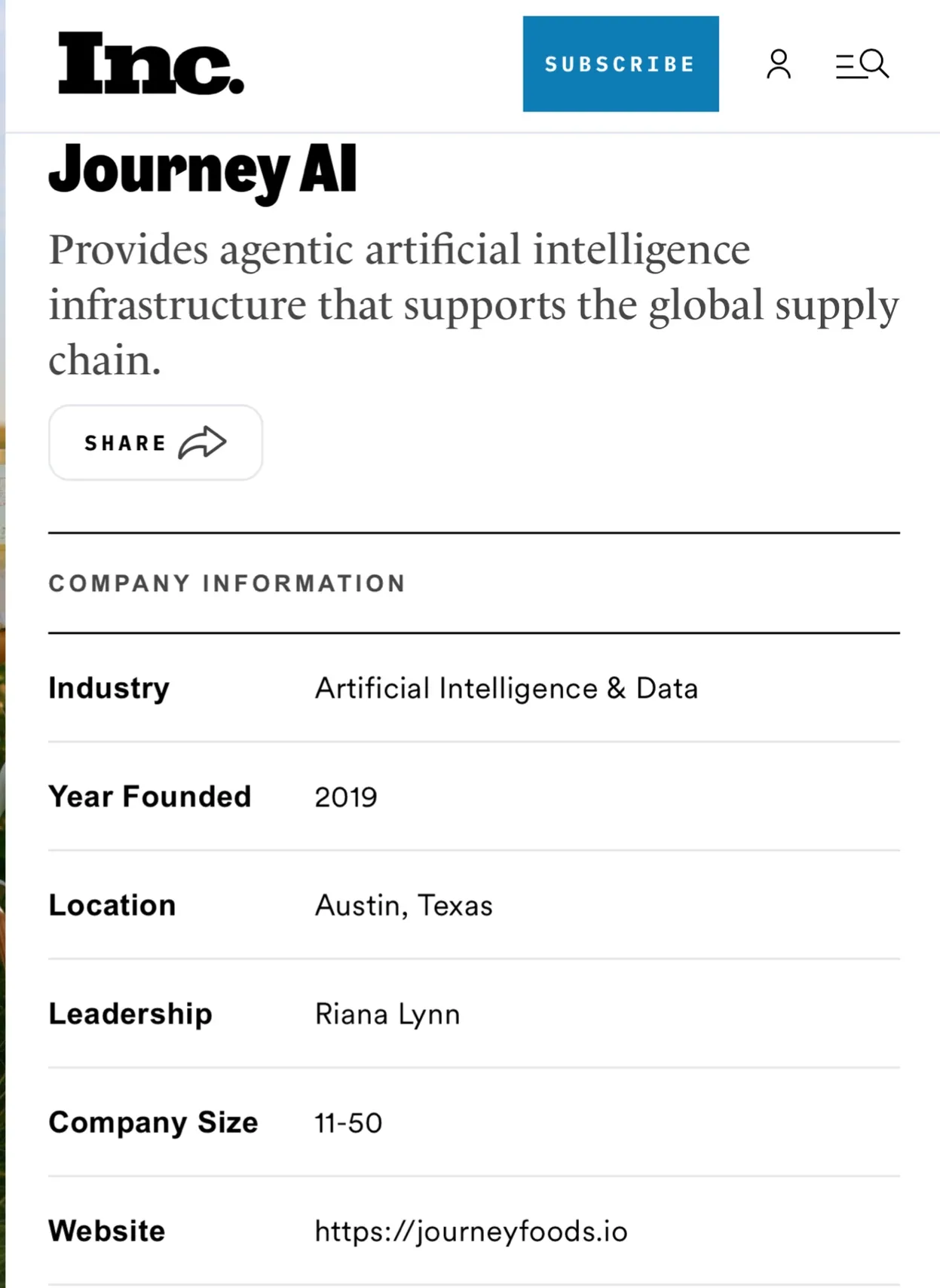
Journey AI by Journey Foods has been ranked No. 1610 on the 2026 Inc. 5000 — the most respected annual ranking of the fastest-growing private companies in America — and named to the Top 100 AI Companies list this year. Both in the same month. Neither was an accident.
What the Inc. 5000 Actually Measures
The Inc. 5000 is not a popularity contest. It does not measure funding raised, press coverage, or how many people follow you on LinkedIn. It measures one thing: real revenue growth over three years — 2022 through 2025 — for privately held, US-based companies that have cleared minimum revenue thresholds proving genuine commercial traction.
This year's Inc. 5000 honorees collectively generated $385 billion in revenue and created over 627,000 jobs. Companies that have appeared on this list at an early stage include Microsoft, Meta, Under Armour, and Chobani. They are not on it because they had the best pitch deck. They are on it because they grew.
Ranking No. 1610 puts Journey AI in the top third of every fast-growing private company in America over the past three years. Not just in food tech. Not just in AI. In all of American business.
What the Top 100 AI Companies Recognition Means
The AI landscape in 2026 is overcrowded. Thousands of companies claim to use artificial intelligence. Most of them have wrapped a foundation model in a domain-specific interface and called it a product.
The companies that earn serious AI recognition are the ones where AI is doing genuine operational work — not a chatbot bolted onto a legacy nutrition database, not a trend prediction engine built on social media scrapes, not a sustainability score that takes six months to implement.
Journey AI earned this recognition because our Operations Scientist is not a feature. It is the core of what we built. It scores ingredients simultaneously across nutrition, cost, sustainability, and supply availability. It surfaces supply chain risk signals weeks before disruptions reach production lines. It gives CPG manufacturers, ingredient suppliers, and product development teams the intelligence that used to require a team of analysts, three vendor relationships, and three months of research — and it delivers it in a single query.
Being named to the Top 100 AI Companies list is recognition that the industry sees that distinction. We are not playing in AI. We are building infrastructure in it.
What We Actually Built to Get Here
Journey AI started with a conviction that has not changed: the CPG and food manufacturing industry had a data infrastructure problem that nobody had properly solved.
Ingredient research lived in spreadsheets. Supply chain monitoring happened reactively, after disruptions had already hit production. Formulation version control was a shared folder with seventeen versions of a file called final_FINAL_v3. And the tools that existed were either too narrow — covering only nutrition math, or only sustainability scores, or only trend prediction — or too complex, requiring six-month enterprise implementations before a procurement lead could do anything useful.
We built something different.
A platform that combines ingredient intelligence, supply chain monitoring, and formulation version control in one workspace. Powered by a proprietary data moat that took years to build and cannot be replicated in a year. Built for every stakeholder in the room — not just food scientists, but CPG manufacturers, ingredient suppliers, procurement leads, supply chain managers, R&D directors, and product development teams of every size.
The results are measurable. Teams using Journey AI reduce ingredient research time by 64 percent. That is not a projection. That is what happens when you replace fragmented manual workflows with operational AI that already knows what you need to know about an ingredient before you ask.
Enterprise partners including Kroger, NASA, SAP, and the World Economic Forum validated the platform at scale. The data infrastructure we built is the foundation that makes everything else possible — and it is why two independent recognition bodies looked at the American business landscape in 2026 and put Journey AI on their lists.
What This Means for CPG Manufacturers and Ingredient Suppliers
If you are a CPG manufacturer, an ingredient supplier, a co-manufacturer, or a product development team at any stage — from a 10-person emerging brand to a multi-brand enterprise organization — these recognitions matter to you for one reason.
They are proof that the platform you are evaluating is real, growing, and built for the long term.
The Inc. 5000 ranking means the business is healthy and the commercial traction is verified. The Top 100 AI recognition means the technology is serious and the operational AI layer is recognized by the industry. Together, they mean Journey AI is not a startup experiment. It is infrastructure for how CPG teams will develop products, manage ingredients, and navigate supply chains for the next decade.
The teams that build on this infrastructure now will have a compounding advantage in product development speed, supply chain resilience, and ingredient intelligence that competitors still working on spreadsheets in 2026 will spend years trying to close.
If you want to see what that looks like in practice for your specific ingredient and formulation challenges, book a 30-minute demo at journeyfoods.io/book-a-demo. Plans start at $199 per month. See full pricing at journeyfoods.io/pricing. Download our white papers at journeyfoods.io/white-papers.
What Comes Next
We are not done. Not close.
We hired our Chief Revenue Officer this summer. We are actively hiring a Head of Data and a Head of Marketing right now — the two roles that will define how fast the platform grows and how deep the data moat gets. Both roles are at journeyfoods.io/careers.
The platform data layer is expanding. API capabilities are growing. Enterprise workflow features for multi-team manufacturer organizations are in development. The proprietary ingredient data moat gets deeper every month by design.
Two lists. One summer. A lot more to build.
About Journey AI by Journey Foods
Journey AI is an AI-powered ingredient intelligence platform built for CPG manufacturers, ingredient suppliers, and product development teams. The Operations Scientist AI scores ingredients across nutrition, cost, sustainability, and supply availability simultaneously — replacing fragmented spreadsheets and disconnected tools with a single workspace for ingredient decisions, formulation version control, and supply chain monitoring.
Trusted by teams working with Kroger, NASA, SAP, and the World Economic Forum.
Explore the platform at journeyfoods.io. Book a demo at journeyfoods.io/book-a-demo. See pricing at journeyfoods.io/pricing. Download our white papers at journeyfoods.io/white-papers.
Scientist. Nutrition Leader. Founder of Journey Foods