
.svg)
.svg)
.svg)
.svg)


.svg)
Beverage formulation is not food formulation with more water. The variables are different — solubility windows, pH stability, flavor masking, emulsification, preservative interactions. These aren't footnotes. They are the formulation. And most general-purpose ingredient management tools treat them exactly like footnotes.
If you're an R&D lead or food scientist at a beverage CPG company, you've felt this gap. A platform built for solid food formats gives you a database and a nutrition calculator. It doesn't tell you how a new botanical extract behaves in a low-pH RTD environment, or whether your current emulsifier supplier has a viable alternative that won't blow your cost-per-serving target.
That's the problem Journey Foods was built to address — not for food broadly, but for the specific complexity that liquid formulations bring.
Quick Answer: Journey Foods is an AI-powered ingredient intelligence and formulation management platform. For beverage CPG teams, it handles liquid-specific formulation tracking, multi-criteria ingredient scoring across nutrition, cost, and sustainability, and real-time supply chain monitoring — all in a single collaborative workspace.
Key Takeaways:
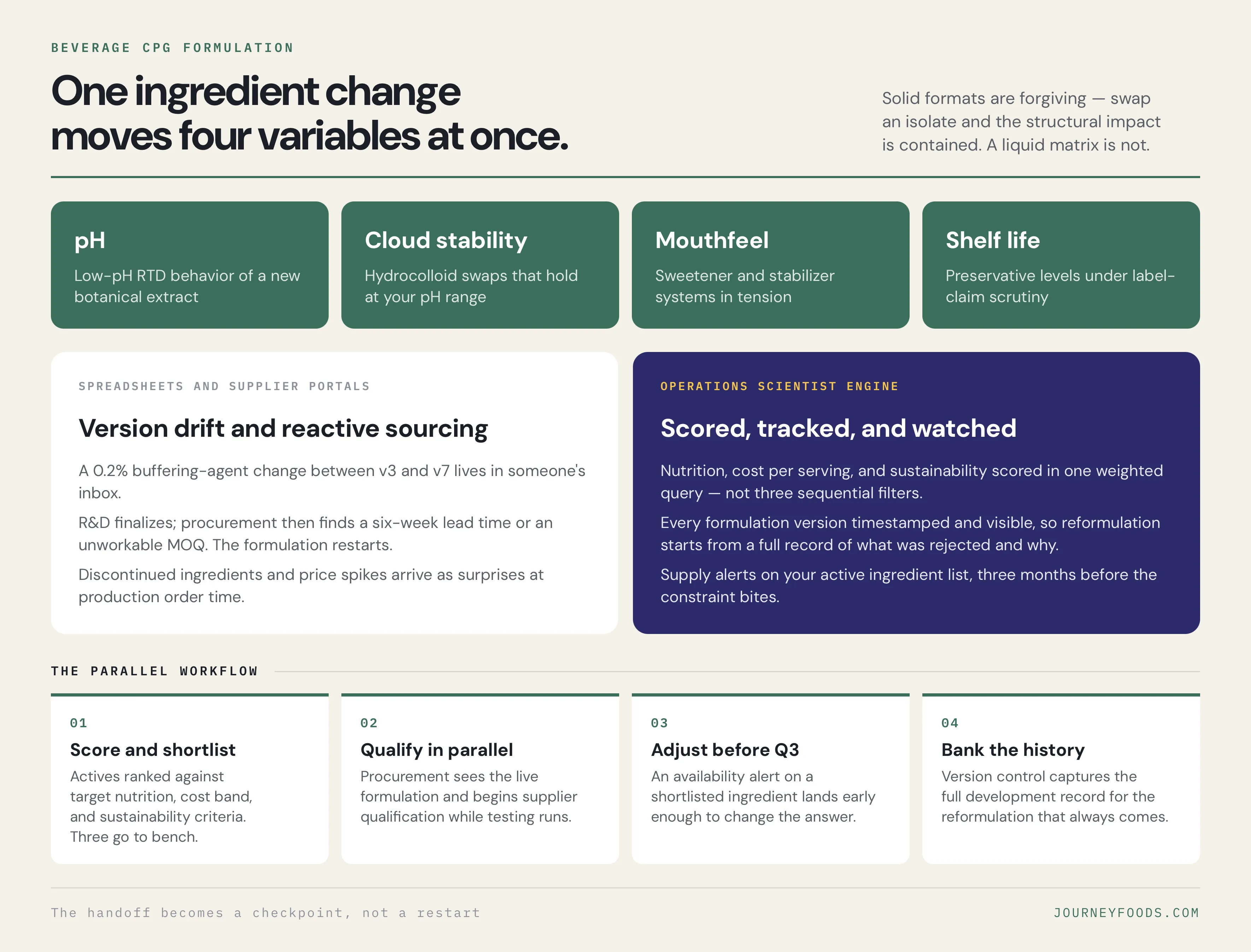
Solid food formats are relatively forgiving. Swap a protein isolate, run a bench test, and the structural impact is contained. In a beverage matrix, a single ingredient change can shift pH, cloud stability, mouthfeel, and shelf life — simultaneously.
Beverage R&D teams manage more variables per formulation decision than almost any other food category. They're also under tighter regulatory scrutiny on label claims, particularly in functional beverages where ingredient dosing and bioavailability documentation has to hold up to FDA review.
The tools most teams rely on — spreadsheets, shared drives, disconnected supplier portals — weren't designed for this. They create version drift, communication lag, and reactive sourcing behavior. When a supplier discontinues an ingredient or a raw material price spikes, teams find out late and scramble.
The category is also moving fast. Functional ingredients, adaptogens, nootropics, electrolyte blends — the beverage ingredient landscape in 2026 is wider and more complex than it was three years ago. Slow internal processes are a direct competitive disadvantage. Speed to shelf is the unlock.
Journey Foods gives beverage teams a centralized dashboard where every formulation lives — with full version history. That sounds basic. In practice, it isn't.
When you're iterating on a sparkling functional water with five active ingredients, the difference between version 3 and version 7 might be a 0.2% adjustment to a buffering agent. Without version control, that change lives in someone's inbox. With Journey Foods, it's logged, timestamped, and visible to the entire team.
This matters especially for beverage CPG because reformulation is constant. Regulatory changes, cost pressures, sustainability commitments, consumer preference shifts — every ingredient substitution is a formulation event that needs to be tracked.
One of the most consistent failure points in beverage product development is the handoff between R&D and procurement. R&D finalizes a formulation. Procurement discovers the primary supplier for a key ingredient has a six-week lead time or a minimum order quantity that doesn't work at current production volume. The formulation goes back to R&D. Weeks are lost.
Journey Foods keeps both functions working from the same data. Procurement sees the formulation in real time. R&D sees supplier availability and cost data while they're still in the development stage. The loop closes earlier, and the handoff becomes a checkpoint rather than a restart.
This is the kind of workflow improvement that food formulation software evaluations in 2026 increasingly treat as table stakes — not a differentiator.
The Operations Scientist AI engine is Journey Foods' core evaluation layer. For beverage CPG teams, it does three things that matter.
Most ingredient databases let you search. Journey Foods lets you score. When you're evaluating a new sweetener system, a stabilizer, or a functional ingredient for a new beverage line, the platform scores candidates across nutrition profile, cost per serving, and sustainability metrics simultaneously.
This isn't a sequential workflow where you filter by nutrition first, then check cost, then manually research sustainability claims. It's a single query that returns a ranked, scored set of options. R&D leads can adjust the weighting — if cost is the primary constraint this cycle, that's reflected in the output.
For beverage formulations specifically, this matters because ingredient interactions are complex and substitutions are rarely one-to-one. A lower-cost alternative to a hydrocolloid might score well on cost but poorly on stability at the pH range your formulation requires. The scoring layer surfaces those tradeoffs before you run a bench test.
Journey Foods monitors your ingredient list and flags supply chain risks as they emerge — price movements, supplier disruptions, availability changes. These appear as alerts in the dashboard rather than arriving as a surprise when you're about to place a production order.
For beverage CPG, this directly shapes reformulation planning. If you know three months out that a key botanical extract is facing supply pressure, you can evaluate alternatives before you're forced to. That's proactive sourcing. Reactive sourcing costs more and compresses your timelines. The difference between the two is often just visibility.
Beyond scoring, the platform generates recommendations grounded in your existing formulation data and ingredient history. If you've used a specific emulsifier system across multiple SKUs, the platform understands that context when you're developing something new. Recommendations reflect your actual formulation library — not generic database suggestions.
That's the difference between a search tool and ingredient intelligence. Search returns options. Intelligence returns options ranked by relevance to your specific situation.
Here's what the workflow looks like for a mid-size beverage CPG company launching a new functional line.
The R&D team opens a new formulation in Journey Foods and searches for active ingredients that meet their target nutrition profile, cost band, and sustainability criteria. The Operations Scientist AI engine scores and ranks candidates. The team shortlists three options and begins bench testing.
While testing is underway, procurement sees the formulation in real time and begins supplier qualification in parallel. A supply chain alert flags that one of the shortlisted ingredients has a known availability constraint in Q3. The team adjusts before the constraint becomes a problem.
When the formulation is finalized, version control captures the complete development history. When reformulation is eventually required — and it always is — the team has a full record of what was tried, what was rejected, and why.
That's the process that AI-powered ingredient management platforms are enabling for CPG teams that have moved past spreadsheets and disconnected supplier portals.
If you're evaluating Journey Foods alongside other options, ask specific questions. Not "does it handle formulations?" but "does it handle liquid formulations with version control, multi-criteria ingredient scoring, and real-time supply chain visibility in a single environment?"
Most platforms handle one or two of those. Some have formulation tracking but no supply chain layer. Others have ingredient databases but no collaborative workflow tools. The 10 questions to ask before choosing a food formulation software platform is a useful framework for structuring that evaluation.
For beverage CPG specifically, the criteria that matter most:
If a platform can't give you a clear answer on all five, it's not built for the complexity of beverage CPG at scale. The food product development platform evaluation guide for 2026 covers how to structure that comparison across vendors.
Journey Foods was designed for the operational reality of food and beverage CPG teams — not adapted from a general-purpose data tool. The Operations Scientist AI engine, the centralized formulation dashboard, the supply chain alert layer, and the collaborative workflows are all built around how product development actually happens in this industry.
For beverage CPG teams managing liquid formulations across multiple SKUs — with active ingredients, regulatory requirements, and cost pressures all running simultaneously — that specificity matters.
If your team is still managing formulations in spreadsheets or across disconnected tools, the operational cost is real. Time lost. Reactive sourcing decisions. Slower time to shelf.
Explore the platform at journeyfoods.io or book a demo to see how it handles your specific formulation environment.
What makes Journey Foods different from general food formulation software for beverage CPG?
Journey Foods combines ingredient scoring, formulation version control, supply chain monitoring, and collaborative workflows in a single platform. General formulation tools typically handle one or two of these. For beverage CPG teams managing complex liquid matrices and frequent reformulations, having all of them in one environment reduces handoff friction and accelerates development timelines.
How does the Operations Scientist AI engine score ingredients for beverage formulations?
It evaluates ingredients simultaneously across nutrition, cost, and sustainability criteria. R&D teams can adjust the weighting of each criterion based on the constraints of a specific project. The output is a ranked, scored list of candidates — not a raw database result — which makes it faster to shortlist options for bench testing.
Does Journey Foods support version control for liquid formulations specifically?
Yes. Every formulation is tracked with full version history, including timestamps and change logs. For beverage formulations where small adjustments — a pH buffer, an emulsifier level, a preservative concentration — can have significant downstream effects, that history is critical for both development efficiency and regulatory documentation.
How do real-time supply chain alerts work within the platform?
Journey Foods monitors the ingredients in your active formulations and surfaces alerts when supply conditions change — price movements, availability constraints, supplier disruptions. These appear in the centralized dashboard, giving procurement and R&D teams visibility into sourcing risks before they affect production schedules.
Can procurement and R&D teams use Journey Foods simultaneously without version conflicts?
Yes. Both functions work from the same formulation data in real time. Version control prevents conflicts, and the shared dashboard eliminates manual handoffs between teams.
Is Journey Foods suitable for smaller beverage CPG companies or only enterprise-scale operations?
Journey Foods is built for food, beverage, and CPG companies managing active product development pipelines. Whether you're a mid-size functional beverage brand or a large CPG operation with multiple beverage lines, the core value — faster ingredient evaluation, better supply chain visibility, cleaner formulation management — applies at both scales.
How does Journey Foods handle ingredient substitution during reformulation?
When a reformulation is triggered — by a supply chain disruption, a cost target, or a sustainability commitment — the Operations Scientist AI engine evaluates substitution candidates against the same multi-criteria scoring framework used in the original development. Because the platform retains your formulation history, recommendations are contextual to your existing ingredient relationships and SKU architecture, not generic.