

.svg)
.svg)
.svg)
.svg)


.svg)
You've evaluated the platforms. You've made the decision. Now the real question is: what actually happens next?
Onboarding is where software investments either pay off fast or stall out. For R&D leads and CPG product teams, time lost in setup is time not spent on formulation, sourcing, or launch prep. Here's what Journey Foods onboarding looks like in practice — the timeline, what data you need to bring, and what should be working by the end of month one.
Quick Answer
Journey Foods onboarding gets your team operational by centralizing your ingredient data, importing your formulations, and activating the Operations Scientist AI engine against your specific product portfolio. The first month focuses on data setup, team configuration, and running your first ingredient evaluations.
Key Takeaways
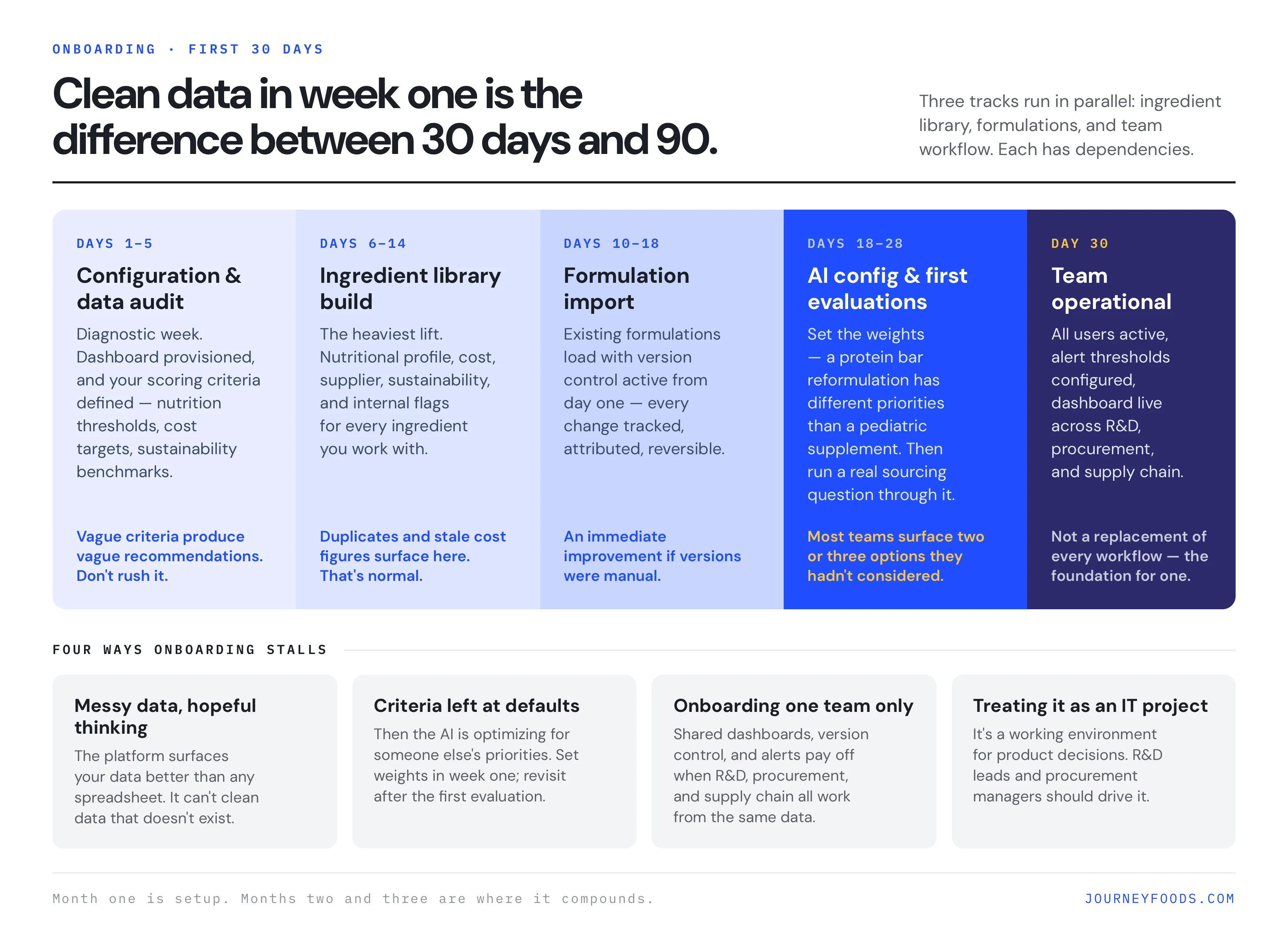
This isn't just configuring a database. You're building a centralized ingredient intelligence layer that R&D, procurement, and supply chain all pull from. Three setup tracks run in parallel: your ingredient library, your formulations, and your team's workflow configuration.
Each track has dependencies. Getting them right in the first few weeks determines how much value you extract in month two and beyond.
The first week is diagnostic. You're establishing what data you have, what format it's in, and where the gaps are — before any migration begins.
Your account gets provisioned with the centralized dashboard and Operations Scientist AI engine active. The first configuration step is defining your scoring criteria — the nutrition thresholds, cost targets, and sustainability benchmarks the AI uses when evaluating ingredients.
Don't rush this step. Vague criteria produce vague recommendations. Spend time here.
This is the heaviest lift. You're populating the platform with your actual data.
Every ingredient your team works with gets entered with its full data set: nutritional profile, cost, supplier information, sustainability attributes, and any internal flags. The ingredient search and scoring tools become useful the moment the library has enough depth to run meaningful comparisons.
Teams migrating from spreadsheets or legacy systems like Genesis R&D or ESHA typically surface data quality issues at this stage — duplicate entries, missing supplier fields, outdated cost figures. That's normal. Cleaning it now pays off on every formulation decision going forward. If you've been wondering whether your current workflow is holding you back, this is usually where the answer becomes obvious.
Existing formulations load with version control active from day one. Every change going forward is tracked, attributed, and reversible. If your team has been managing versions manually — or not managing them at all — this is an immediate operational improvement.
By week three, you have enough data in the system to start running the Operations Scientist engine against real decisions.
The AI scores ingredients across three axes: nutrition, cost, and sustainability. Your team sets the weights. A protein bar reformulation has different priorities than a shelf-stable sauce or a pediatric supplement. The engine needs those priorities defined explicitly before its output is meaningful.
This is also when you configure supply chain alert thresholds — which price movements, availability flags, or supplier risk signals should trigger a notification.
Run a real query. Take an active formulation challenge — an ingredient you're sourcing, substituting, or validating — and put it through the platform. The goal isn't a final decision in week four. The goal is seeing how the scoring output maps to your team's actual judgment, then calibrating from there.
Most teams find the first evaluation surfaces two or three ingredient options they hadn't considered. That's the signal the library and criteria are working.
A well-executed onboarding leaves you with:
What you should not expect at day 30: a complete replacement of every existing workflow. Onboarding is the foundation. The compounding value — faster reformulation cycles, fewer reactive sourcing decisions, better cross-team alignment — builds through months two and three as the platform becomes your team's default working environment.
It won't. Journey Foods organizes and surfaces your data better than any spreadsheet — but it can't clean data that doesn't exist. Audit your ingredient specs before you start.
Leaving scoring criteria at defaults means the AI is optimizing for someone else's priorities. Define your nutrition, cost, and sustainability weights in week one. Revisit them after your first evaluation.
The platform's collaboration features — shared dashboards, version control, real-time alerts — only pay off when R&D, procurement, and supply chain are all working from the same data. Onboard only your food scientists and you're running a fraction of the system's capability.
Journey Foods is not infrastructure. It's a working environment for product decisions. The people who should be driving onboarding are R&D leads and procurement managers — not whoever handles software setup.
Coming from Genesis R&D, ESHA, or Excel-based workflows, the structural difference is significant. Those tools are built around individual users managing data locally. Journey Foods is built around teams making decisions together, with AI scoring running continuously against a shared ingredient library.
The comparison between Genesis R&D and Journey Foods covers the workflow differences in detail, but the onboarding implication is straightforward: you're not just migrating data. You're changing how your team operates. That's a bigger shift, and it's worth treating it as one.
For CPG teams still finalizing the decision, the 2026 guide to food product development platforms covers what to look for in setup and ongoing support.
PhaseTimeframePrimary OutputAccount configuration + data auditDays 1–5Scoring criteria defined, data gaps identifiedIngredient library buildDays 6–14Library populated, supplier data loadedFormulation importDays 10–18Active formulations in platform with version controlAI configuration + first evaluationsDays 18–28Operations Scientist running against real queriesFull team operationalDay 30All users active, alerts configured, dashboard live
Timelines compress when teams arrive with clean, organized data. They extend when ingredient specs are scattered across email threads, supplier PDFs, and legacy systems.
How long does Journey Foods onboarding typically take?
Most teams reach full operational status within 30 days. The primary variable is data readiness — teams with organized ingredient specs and formulation records move faster. Teams migrating from fragmented spreadsheet workflows should plan for additional time to clean and structure their data before import.
What data do I need to prepare before starting onboarding?
Ingredient specifications (nutritional data, cost records, supplier documentation, sustainability certifications), existing formulation records, and a clear picture of your team's roles and access requirements. The more structured this is before you start, the faster setup moves.
Can multiple teams use Journey Foods simultaneously during onboarding?
Yes — and they should. The platform is built for collaborative use across R&D, procurement, and supply chain. Onboarding only one team limits the value you get from shared dashboards, version control, and real-time supply chain alerts.
When do AI-driven ingredient recommendations become useful?
The Operations Scientist engine starts producing meaningful recommendations once your ingredient library has sufficient depth and your scoring criteria — nutrition, cost, and sustainability weights — are defined. Most teams run their first useful evaluation in weeks three or four.
What happens if my ingredient data is incomplete or inconsistent?
Journey Foods surfaces gaps and inconsistencies during the import process. The platform can't generate accurate scores from incomplete data, so addressing quality issues early matters. For most teams, this is the most valuable part of onboarding — it forces a data audit that's been deferred for too long.
How does version control work for formulations?
Every formulation change is tracked, attributed to the team member who made it, and reversible. Version control is active from the moment formulations are imported — full audit trail, from day one.
What should I expect in months two and three after onboarding?
Month one is setup. Months two and three are where the compounding value shows up — faster reformulation cycles, fewer reactive sourcing decisions, and better cross-team alignment as the platform becomes the default environment for ingredient and formulation decisions.
Onboarding is only complicated when you walk in unprepared. Clean data, defined criteria, and the right people in the room from day one is the difference between a 30-day setup and a 90-day one.
Ready to see how the platform fits your team's specific workflow? Start at journeyfoods.io.
Communications and PR leader