Best Alternatives to Trace One for CPG Teams That Need Ingredient Intelligence, Not Just PLM


Quick answer
You're evaluating Trace One alternatives. That means you've already sat through the demo, seen the implementation scope, and thought: this is built for someone three times our size.
That's a fair read. Trace One is a serious enterprise PLM platform with real food and beverage compliance depth. But if your team needs ingredient scoring, supply chain alerts, and collaborative formulation management — not a multi-quarter IT project — you're looking for a different category of tool entirely.
Here's what Trace One does well, where it leaves ingredient intelligence gaps, and which platforms actually fill them for CPG teams in 2026.
Quick Answer
The best Trace One alternative depends on what's actually missing from your stack. If you need unified scoring across nutrition, cost, and sustainability with real-time supply chain alerts and no enterprise implementation overhead, Journey Foods is the closest fit. If your gap is purely sustainability data, HowGood covers that dimension deeply. If nutrition labeling and regulatory compliance are the priority, Genesis R&D or ESHA are the established options.
Key Takeaways:
What Trace One Actually Does Well
Before listing alternatives, it's worth being precise about where Trace One earns its reputation.
Trace One has genuine PLM depth. Decades in food and beverage have produced real functionality in supplier collaboration, compliance documentation, and spec management. The 2026 AI copilot addition signals continued investment. For a 5,000-person food manufacturer with a dedicated IT department and a multi-year implementation roadmap, that depth has value.
The compliance and documentation layer is particularly strong. If your primary need is managing regulatory specs across a large, complex supplier network, Trace One's architecture was built for exactly that.
The problem isn't what Trace One does. It's who it's built for — and what it doesn't do.
Where Trace One Breaks Down for Teams That Need Ingredient Intelligence
Implementation Is Measured in Quarters, Not Weeks
Teams that have gone through Trace One deployments describe timelines measured in quarters. That's not a knock on the architecture — it's a structural reality of enterprise PLM software. Configuration, training, IT integration, and change management at that scale require more bandwidth than most mid-market teams can absorb without derailing active product development.
If you're managing five formulations and trying to launch two SKUs in the next six months, an 18-month implementation timeline doesn't solve your problem. It becomes your problem.
Real-Time Supply Chain Intelligence Is the Bigger Gap
This is the gap that matters most in 2026. Trace One's strength is documentation and lifecycle management. What it doesn't provide is real-time supply chain monitoring. Ingredient shortages, supplier disruptions, and price volatility don't wait for your next PLM review cycle.
In the current tariff environment, procurement and R&D teams need alerts before a disruption becomes a production delay — not after. A platform that surfaces supply chain signals reactively, or not at all, leaves your team permanently behind the curve.
Ingredient Scoring Isn't the Core Function
Trace One manages product specs and compliance records. It doesn't score ingredients across nutrition, cost, and sustainability simultaneously and surface ranked alternatives when a supplier goes down. Those are different capabilities — and the distinction matters when your R&D team needs fast, data-backed reformulation decisions rather than documentation trails.
Pricing Is Enterprise-Only
No public pricing. No self-serve tier. No entry point for a team that wants to start with ingredient intelligence and scale from there. For a funded startup or a lean mid-market brand, the cost structure removes Trace One from consideration before a demo is even scheduled.
The Feature Set Assumes a Large Cross-Functional Organization
Mid-market CPG teams don't need a full PLM system. They need ingredient discovery, formulation management, supply chain alerts, and team collaboration in one place. Trace One's architecture is built around compliance and documentation workflows that assume dedicated IT, procurement, regulatory, and R&D departments. For a team of two food scientists and a procurement lead, it's solving a different problem.
What CPG Teams Actually Need Instead
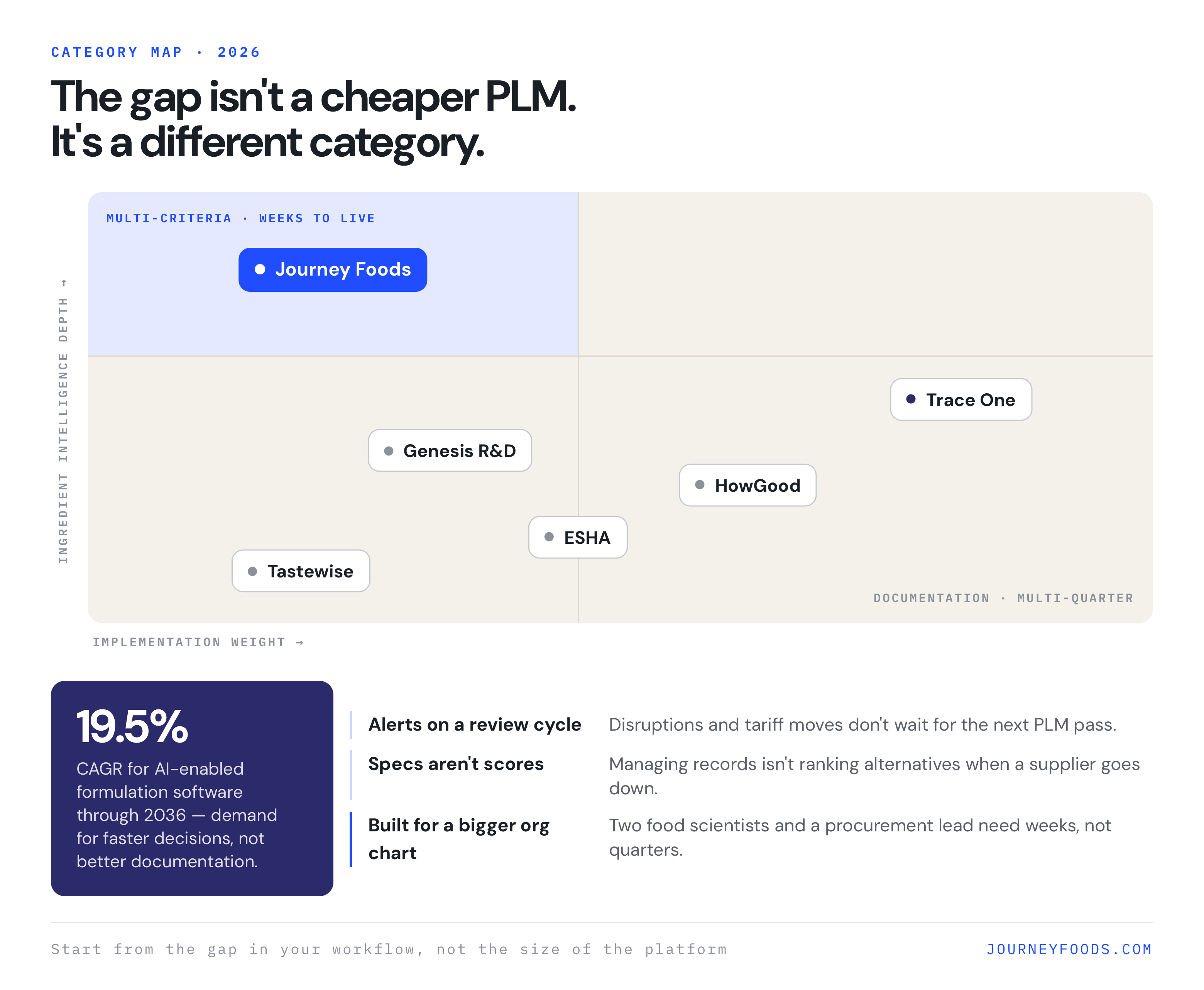
The gap in the market isn't a cheaper version of Trace One. It's a different category of tool — one that handles ingredient intelligence and formulation management without requiring enterprise infrastructure.
In practice, that means:
The Best Trace One Alternatives in 2026
Journey Foods — Best for Unified Ingredient Intelligence
Journey Foods is an AI-powered platform built specifically for food and CPG product teams that need ingredient intelligence and formulation management without enterprise PLM complexity.
The core AI engine — Operations Scientist — scores ingredients simultaneously across nutrition, cost, and sustainability. Not three separate modules you stitch together. A single query that returns ranked results across all three dimensions at once. When you're reformulating to hit a cost target without degrading nutritional profile or sustainability score, that simultaneous view is what makes fast decisions possible.
Real-time supply chain alerts are built into the platform, not bolted on. When a supplier disruption hits, the system surfaces it immediately and provides AI-driven ingredient alternatives ranked by your criteria. For procurement and R&D teams navigating the 2026 tariff environment, that's the difference between proactive sourcing and reactive scrambling.
Formulation records are version-controlled. Every iteration is tracked, comparable, and accessible to the whole team. No more emailing spreadsheets. No more "which version is current" conversations.
The platform supports cross-functional collaboration without IT implementation. Food scientists, procurement leads, and product managers work from the same centralized dashboard. Role-specific views exist for CFOs, CPOs, food scientists, and supply chain managers — the full buying committee, not just R&D.
Pricing starts at $199/month for the Fresh tier, with Growth at $499/month, Group at $999/month for teams of 10, and Enterprise at $1,999/month for up to 50 users. Custom enterprise pricing is also available. Partners include Kroger, NASA, SAP, the World Economic Forum, and Canada PIC.
For CPG teams that have outgrown spreadsheets but don't need enterprise PLM, Journey Foods occupies the gap Trace One leaves. Explore the platform at journeyfoods.io.
Best for: Mid-market CPG brands, food ingredient suppliers, and R&D teams managing 3 to 15 active formulations that need ingredient scoring, supply chain alerts, and formulation management in one place.
Not ideal for: Teams whose primary need is regulatory compliance documentation and spec management at enterprise scale — that's Trace One's core strength.
HowGood (Latis) — Best for Sustainability Data Depth
HowGood leads the market on sustainability intelligence. Its ingredient database covers more than 33,000 ingredients with Carbon Trust verification, and it's used by six of the top ten food companies. If your primary need is credible, third-party-verified sustainability scoring at scale, HowGood is the strongest option in the category.
The limitation is scope. HowGood covers sustainability metrics only. No cost optimization, no nutrition scoring, no collaborative formulation tools. It's a deep single-dimension tool, not a multi-criteria platform.
Best for: Large CPG companies with dedicated sustainability teams that need verified environmental impact data for reporting and product claims.
Not ideal for: Teams that need cost modeling, nutrition scoring, supply chain alerts, or formulation management alongside sustainability data.
Genesis R&D — Best for Nutrition Calculation and Labeling Compliance
Genesis R&D is the established standard for nutrition analysis and food labeling compliance. Its regulatory database is deep, and it's been the go-to for food scientists who need accurate nutrition facts panels and FDA/USDA compliance support.
The gaps are significant for teams that need more than nutrition. Genesis R&D has a legacy interface, no supply chain integration, and no ingredient sourcing intelligence. It calculates what's in your formulation — it doesn't help you find better ingredients, monitor supplier risk, or manage formulation versions collaboratively.
Best for: Food scientists and regulatory teams that need precise nutrition calculation and compliant label generation.
Not ideal for: Teams that need ingredient discovery, cost optimization, supply chain visibility, or collaborative formulation workflows.
For a broader look at this category, the ESHA alternatives comparison covers the full nutrition-tool landscape in depth.
ESHA — Best for Established Nutrition Analysis Workflows
ESHA occupies similar territory to Genesis R&D. Strong nutrition analysis, solid regulatory compliance support, and a long track record in the food industry. Widely used in institutional food service and manufacturing contexts where accurate nutrition data is the primary requirement.
Like Genesis R&D, ESHA has no supply chain integration, no ingredient sourcing intelligence, and no formulation collaboration tools. It's a nutrition calculation platform, not an ingredient intelligence platform.
Best for: Teams with established nutrition analysis workflows that need a reliable, compliance-focused tool.
Not ideal for: Teams that need ingredient scoring across multiple dimensions, supply chain monitoring, or collaborative R&D workflows.
Tastewise — Best for Consumer Trend Intelligence
Tastewise uses AI to analyze consumer behavior and predict food trends, with partnerships including PwC. If your team needs to understand what consumers are searching for, ordering, and talking about before making product development decisions, Tastewise provides that upstream intelligence.
It's not an ingredient intelligence platform. No formulation tools, no supply chain alerts, no ingredient-level scoring. The consumer trend data is useful before formulation decisions — not during them.
Best for: Brand and innovation teams that need consumer trend data to inform product strategy.
Not ideal for: R&D and procurement teams that need ingredient-level data, formulation management, or supply chain visibility.
How These Alternatives Compare
PlatformIngredient ScoringSupply Chain AlertsFormulation ManagementSustainability DataNutrition AnalysisImplementationJourney FoodsNutrition + Cost + SustainabilityReal-time, AI-drivenVersion-controlledYesYesNo IT requiredTrace OneLimitedNot confirmedPLM-basedCompliance-focusedLimitedEnterprise, multi-quarterHowGoodSustainability onlyNoNoDeep (33,000+ ingredients)NoEnterpriseGenesis R&DNutrition onlyNoBasicNoDeepModerateESHANutrition onlyNoBasicNoDeepModerateTastewiseConsumer trends onlyNoNoNoNoModerate
The Ingredient Intelligence Gap Trace One Doesn't Fill
The AI-enabled food formulation software market is growing at 19.5 percent CAGR through 2036. That growth isn't driven by demand for better compliance documentation. It's driven by R&D and procurement teams that need faster, smarter ingredient decisions — and the tools to make them without a six-figure IT project.
Trace One is a strong platform for what it does. But "what it does" is enterprise PLM, not ingredient intelligence. The teams searching for Trace One alternatives in 2026 are typically looking for something that sits between a single-purpose nutrition tool and a full PLM system — a platform that handles ingredient scoring, formulation management, and supply chain visibility without a dedicated implementation team.
That's the gap Journey Foods was built to fill. For a broader look at the ingredient intelligence category, the best AI-powered ingredient management platforms for CPG companies in 2026 covers the full landscape.
If ingredient cost volatility is a specific pressure point, the food ingredient cost optimization guide is worth reading alongside this comparison.
Making the Decision
The right Trace One alternative depends on what's actually missing from your workflow.
If your gap is regulatory compliance documentation at enterprise scale, Trace One may still be the right answer — just with a realistic implementation timeline and budget.
If your gap is ingredient intelligence — scoring, sourcing, supply chain monitoring, and formulation management in one place — you're in a different category entirely. Journey Foods, HowGood, Genesis R&D, and ESHA each fill part of that picture. Only Journey Foods combines ingredient scoring across all three dimensions with real-time supply chain alerts and collaborative formulation management in a single platform.
Book a demo at journeyfoods.io/book-a-demo to see how the Operations Scientist AI engine handles your specific ingredient and formulation challenges.
Frequently Asked Questions
What is the best Trace One alternative for mid-market CPG teams?
Journey Foods is the strongest alternative for mid-market CPG teams that need ingredient intelligence rather than enterprise PLM. It scores ingredients across nutrition, cost, and sustainability simultaneously, provides real-time supply chain alerts, and supports collaborative formulation management without IT implementation. Pricing starts at $199/month, compared to Trace One's enterprise-only model with no public pricing.
Does Trace One have ingredient scoring capabilities?
Trace One's core strength is product lifecycle management, compliance documentation, and spec management. Its 2026 AI copilot adds some intelligence features, but real-time ingredient scoring across nutrition, cost, and sustainability simultaneously is not a confirmed core capability. Teams that need multi-criteria scoring are better served by platforms built specifically for ingredient intelligence.
What does Trace One lack that ingredient intelligence platforms provide?
The primary gaps are real-time supply chain monitoring, simultaneous multi-criteria ingredient scoring across nutrition, cost, and sustainability, and AI-driven ingredient alternatives when a supplier disruption occurs. Trace One is built around documentation and compliance workflows — not proactive supply chain intelligence or ingredient discovery.
How long does Trace One take to implement?
Trace One implementations are typically measured in quarters, not weeks. The platform requires significant IT configuration, training, and change management — a structural reality of enterprise PLM software. Teams that need to be operational within weeks should evaluate platforms that don't require enterprise IT onboarding.
Is HowGood a good Trace One alternative?
HowGood is a strong alternative specifically for sustainability data. Its database covers more than 33,000 ingredients with Carbon Trust verification, and it's used by six of the top ten food companies. But it covers only sustainability metrics — no cost optimization, nutrition scoring, supply chain alerts, or formulation management. It's a deep single-dimension tool, not a full Trace One replacement.
Can Journey Foods replace Trace One's compliance and regulatory features?
No. Journey Foods is not a PLM system and doesn't replace the regulatory compliance documentation workflows that Trace One is built for. Journey Foods handles ingredient intelligence, formulation management, and supply chain monitoring. Teams with complex regulatory compliance requirements at enterprise scale may still need Trace One or a comparable PLM platform for that specific function.
What should CPG teams prioritize when evaluating Trace One alternatives?
Start with the specific gap in your current workflow. If it's ingredient scoring and discovery, look for platforms that handle nutrition, cost, and sustainability simultaneously. If it's supply chain visibility, prioritize real-time alert capabilities and AI-driven sourcing alternatives. If it's formulation version control and team collaboration, look for platforms with built-in workflow tools that don't require IT setup. Most teams find their gap spans two or three of these areas at once — which is why platforms that combine them tend to win the evaluation.
As published
$199
Data from this story
Shareable Journey Intelligence
Best Alternatives to Trace One for CPG Teams That Need Ingredient Intelligence, Not Just PLM
Industry Insights
$199
Pricing starts at $199/month for the Fresh tier, with Growth at $499/month, Group at $999/month for teams of 10, and Enterprise at $1,999/month for up to 50 users.
$199
Pricing starts at $199/month, compared to Trace One's enterprise-only model with no public pricing.