

.svg)
.svg)
.svg)
.svg)


.svg)
We're at an inflection point in food product development. R&D timelines that once stretched across quarters are getting compressed to weeks. Supply chain volatility has made reactive sourcing genuinely dangerous. And the volume of ingredient data available to formulation teams has long outpaced any spreadsheet-based workflow.
We're at an inflection point in food product development. R&D timelines that once stretched across quarters are getting compressed to weeks. Supply chain volatility has made reactive sourcing genuinely dangerous. And the volume of ingredient data available to formulation teams has long outpaced any spreadsheet-based workflow.
Journey Foods was built for exactly this operating reality — an AI-powered platform that helps CPG companies and food manufacturers discover ingredients, manage formulations, and monitor supply chain risk from one place. If you're evaluating it seriously, here's what you need to know.
Journey Foods is not a recipe tool. It's not a nutrition labeling app. It's supply chain intelligence software for food product development teams.
The platform sits at the intersection of ingredient discovery, formulation management, and supply chain visibility. AI surfaces ingredient recommendations, scores options across nutrition, cost, and sustainability, and alerts teams to supply chain risks before those risks become production problems.
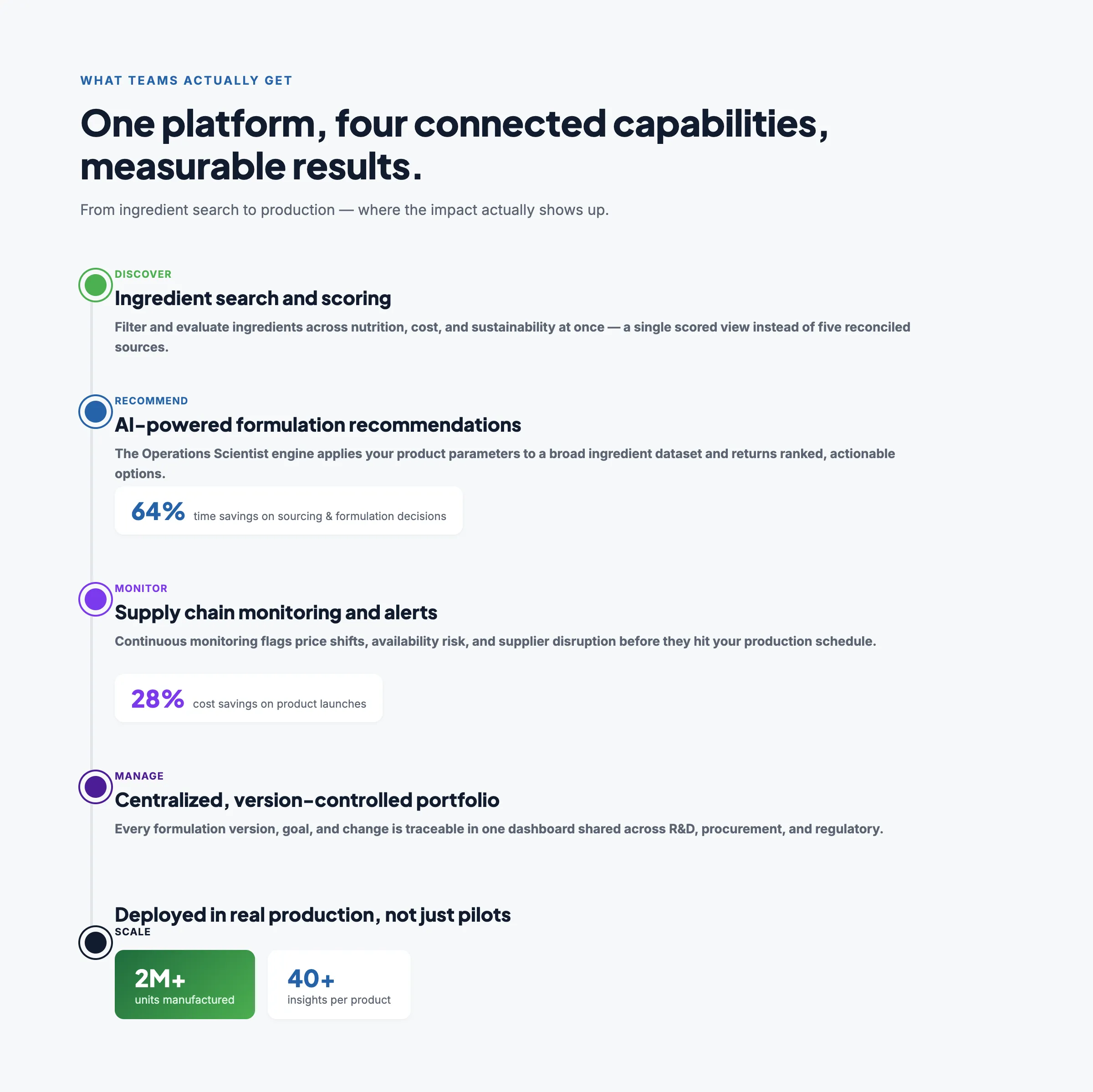
The core value proposition: cut the time your team spends on research and second-guessing, and replace it with a structured, data-backed decision workflow. According to Journey Foods' own benchmarks, teams using the platform report 64% time savings on sourcing and formulation decisions, 28% cost savings on product launches, and 40+ insights generated per product for development and monitoring.
Those numbers hit differently when your team is currently managing ingredient research across disconnected databases, email threads, and supplier PDFs.
Let me walk you through the features that actually drive value for technical teams.
The search function goes well beyond a basic ingredient database. You can filter and evaluate ingredients across three simultaneous dimensions: nutrition, cost, and sustainability — and each ingredient gets a scored profile, so you're not just finding options, you're comparing them against your specific product objectives.
This is where the platform earns its keep for food scientists and R&D leads. Instead of pulling data from five different sources and reconciling it manually, you get a single scored view that reflects your priorities. That's a meaningful shift in how formulation research actually gets done.
The platform's AI layer generates ingredient recommendations tied to specific product improvement goals. Trying to reduce cost without sacrificing nutritional profile? Swapping an ingredient for a cleaner-label alternative? The system surfaces options ranked by fit.
This isn't autocomplete. It's an Operations Scientist model — Journey Foods' term for the AI engine — that applies your product parameters to a broad ingredient dataset and returns actionable suggestions. For teams that have historically relied on individual expertise to drive these decisions, it adds a layer of systematic intelligence that doesn't walk out the door when someone leaves.
The broader shift this represents in food R&D is worth understanding — how supply chain intelligence is reshaping food innovation covers that ground in more detail.
This is the feature that separates Journey Foods from pure formulation tools. The platform monitors your ingredient supply chain continuously and sends alerts when conditions change — price shifts, availability risks, supplier disruptions.
For procurement leads and supply chain decision-makers, that's proactive risk management rather than reactive scrambling. You know about a problem before it hits your production schedule.
The dashboard gives your team a single view of every product in development: formulation versions, ingredient history, goal tracking, and analytics. Version control for formulations means you can trace every change, compare iterations, and put an end to the "which version is current?" problem that plagues teams on shared drives.
Portfolio-level management lets you set company-wide goals — sustainability targets, cost benchmarks, nutritional standards — and track progress across your entire product line, not just individual SKUs.
Journey Foods is built for teams, not individuals. R&D, procurement, regulatory, marketing — multiple stakeholders can work within the same product record, and every action is traceable. That matters for compliance, internal audits, and getting new team members up to speed without losing context.
It removes the communication bottlenecks that slow down cross-functional development. No more version conflicts. No more "I didn't know that changed."
The platform targets a specific type of organization. You'll get the most value from Journey Foods if you are:
The platform scales from emerging brands to multi-product enterprises, and the collaborative features and portfolio management tools become more valuable as team size and product complexity grow.
If you're a solo founder building your first product and you need basic nutrition labeling, this is probably more platform than you need right now. But if you're managing a team and a real product portfolio, the ROI math changes quickly.
The competitive landscape for food R&D software is fragmented. Different tools solve different parts of the problem:
ToolPrimary FocusKey Gap vs. Journey FoodsGenesis R&D / ESHANutrition labeling and complianceNo supply chain monitoring or AI recommendationsTrace OneRegulatory compliance and PLMLess focus on ingredient discovery and scoringHowGood (Latis)Sustainability scoringNarrower scope; not a full formulation platformTastewiseConsumer trend intelligenceConsumer-facing data, not formulation workflowMintel / SPINSMarket research and retail analyticsNo ingredient-level R&D or supply chain tools
The honest assessment: most alternatives solve one part of the problem well. Journey Foods is designed to connect ingredient discovery, formulation management, and supply chain monitoring in a single workflow. That integration is the actual value — not any single feature in isolation.
Journey Foods offers tiered pricing based on team size and feature access. The most current pricing is available at journeyfoods.io/pricing. For enterprise deployments and API access, a demo conversation is the right starting point — the book a demo page is the fastest path to a scoped proposal.
The platform has helped clients manufacture over 2 million units — not a vanity metric, but a reflection of the scale at which Journey Foods' ingredient intelligence and supply chain tooling operate in real production environments.
The 64% time savings figure is the one that resonates most with technical teams. Ingredient research is genuinely expensive when you factor in the hours food scientists spend pulling data, cross-referencing supplier specs, and building internal comparison documents. Compressing that cycle has direct implications for how many products your team can move through development in a given quarter.
Journey Foods has also received external recognition for its approach to food innovation — including recognition at the Anthem Awards, which reflects the platform's positioning at the intersection of technology and meaningful industry impact.
For teams thinking about sustainability alongside cost and nutrition, the platform's multi-dimensional scoring approach is directly relevant. The kind of supplier and sustainability intelligence it surfaces aligns with what better sustainability sourcing actually requires at the ingredient level.
Honest reviews include the limitations. Journey Foods is not:
Understanding what the platform doesn't do is as useful as knowing what it does. It's purpose-built for ingredient intelligence and formulation workflow, and it's most powerful when used for exactly that.
What is Journey Foods?
Journey Foods is an AI-powered software platform for food and CPG companies. It helps R&D teams, food scientists, and supply chain decision-makers discover ingredients, manage product formulations, and monitor supply chain risk — all from a single centralized platform.
Who is Journey Foods designed for?
The platform is built for CPG companies, food manufacturers, and ingredient suppliers — specifically R&D teams, food scientists, procurement leads, and supply chain managers who need structured, data-backed tooling for product development and sourcing decisions.
How does Journey Foods use AI in product development?
The platform's AI engine — called the Operations Scientist — generates ingredient recommendations based on your product objectives, scores ingredients across nutrition, cost, and sustainability dimensions, and surfaces supply chain alerts when conditions affecting your formulations change.
Does Journey Foods replace tools like Genesis R&D or ESHA?
Not directly. Genesis R&D and ESHA focus primarily on nutrition labeling and regulatory compliance. Journey Foods focuses on ingredient discovery, formulation management, and supply chain intelligence. Many teams use both types of tools for different stages of the development process.
What kind of results do teams typically see with Journey Foods?
According to Journey Foods' benchmarks, teams report 64% time savings on sourcing and formulation research, 28% cost savings on product launches, and access to 40+ data insights per product for development and monitoring.
Can Journey Foods handle multi-product portfolios?
Yes. The platform includes portfolio management features that let teams track multiple products simultaneously, set company-level goals across sustainability, cost, and nutrition, and monitor progress across an entire product line rather than managing SKUs in isolation.
How does Journey Foods handle supply chain monitoring?
The platform monitors ingredient supply chains continuously and sends proactive alerts when price shifts, availability risks, or supplier disruptions occur — giving teams time to respond before issues affect production schedules.
Journey Foods is purpose-built for the specific problem CPG and food manufacturing teams are navigating right now: too much ingredient data, too little structure, and supply chain risk that moves faster than manual monitoring can track.
If your team is still managing formulation research across spreadsheets, supplier emails, and disconnected databases, the 64% time savings claim will feel very real, very quickly. The AI-powered scoring and recommendations bring systematic intelligence to decisions that currently depend entirely on individual expertise. And the supply chain monitoring layer turns reactive sourcing into proactive risk management.
It's not the right tool for every team at every stage. But for CPG companies with active development pipelines and real supply chain complexity, it's worth a serious look.
Explore the platform and see what it can do for your team at Journeyfoods.io.
We'd love to hear from you! If you have questions about the platform or want to share how your team approaches ingredient research and formulation, throw them in the comments below.
Find us on Instagram, LinkedIn, and X/Twitter.