Journey Foods vs. Trace One vs. HowGood: Which Ingredient Intelligence Platform Is Right for Your Team?


Quick answer
This isn't a category where one platform wins universally. Trace One is genuinely strong for compliance-heavy, spec-driven workflows at large manufacturers. HowGood fills a real gap for sustainability teams that need auditable environmental data. But if your team's daily work centers on ingredient decisions, formulation speed, and supply chain visibility, Journey Foods covers the most ground with the least friction because we partner with both to integrate your data. The future is collaboration and, today, we are making that difference.
Table of Contents
We're at an inflection point in how food and CPG teams make ingredient decisions. The old workflow — spreadsheets, fragmented supplier portals, manual nutrition databases — is buckling under supply chain volatility, clean-label pressure, and the expectation that R&D teams move faster with fewer resources.
Ingredient intelligence software exists to solve that. But "ingredient intelligence" means something different depending on which vendor you're talking to. Trace One is a product lifecycle management (PLM) system with compliance at its core. HowGood (now Latis) built its reputation on sustainability scoring. Journey Foods approaches the problem from an AI-first angle — combining ingredient discovery, supply chain monitoring, and formulation support in one platform.
This isn't a feature-by-feature spec sheet. It's a practical breakdown for product developers, R&D leads, and procurement teams who need to make an actual decision. Let me walk you through what each platform does well, where each falls short, and how to figure out which one fits your team's real workflow.
What Is Ingredient Intelligence Software, and Why Does It Matter in 2026? {#what-is-ingredient-intelligence-software}
Ingredient intelligence software gives food and CPG teams structured, searchable — and increasingly AI-augmented — access to data about ingredients: nutrition, cost, sourcing, sustainability, regulatory status, and supply chain risk.
The category has matured fast. What started as nutrition labeling tools and basic recipe databases has expanded into platforms that can flag supply chain disruptions before they hit production, recommend ingredient substitutions across multiple simultaneous constraints, and track formulation versions across distributed R&D teams.
Why this matters now: Food companies face mounting pressure to demonstrate ingredient traceability and sustainability credentials — not just internally, but to retailers, regulators, and consumers. According to research on AI and supply chain transparency in food, teams still relying on disconnected tools are slower, more error-prone, and more exposed to sourcing risk. The gap between those teams and the ones using integrated intelligence platforms is widening.
The three platforms below represent three distinct philosophies for solving this problem.
The Three Platforms at a Glance {#the-three-platforms-at-a-glance}
PlatformPrimary StrengthCore AudienceAI-Native?Journey FoodsIngredient discovery, AI recommendations, supply chain monitoringR&D teams, food scientists, CPG startups to enterpriseYesTrace OnePLM, compliance, retailer specification managementLarge manufacturers, private label retailersNoHowGood (Latis)Sustainability scoring and impact dataSustainability teams, large CPG brandsPartial
These are not interchangeable tools. They solve adjacent problems, and for some teams, more than one might be relevant. But most teams have a primary need — and that's where the choice gets clear.
Journey Foods: AI-Native Ingredient Intelligence for R&D and Supply Chain Teams {#journey-foods-ai-native}
Journey Foods built its platform around a specific premise: ingredient decisions are multi-dimensional, and most tools force teams to optimize for one variable at a time. The platform's AI scores ingredients across nutrition, cost, and sustainability simultaneously — so your team isn't trading off clean-label credentials against margin without visibility into the full picture.
What It Does Well
Ingredient search and scoring. Search by nutritional profile, cost range, sustainability attributes, and supply chain availability. Each ingredient gets a product score that aggregates these dimensions, so you're not manually reconciling data from three different sources.
AI-powered recommendations. The platform's Operations Scientist model generates ingredient recommendations for product improvement and flags substitution opportunities when supply chain alerts fire. This is especially useful for reformulation projects where you need to hit a nutritional target without blowing up your cost structure.
Supply chain monitoring. Journey Foods surfaces sourcing risks proactively. If a key ingredient faces a supply disruption, your team gets notified before it becomes a production problem — the kind of supply chain intelligence that used to require a dedicated analyst to piece together manually.
Collaborative formulation tracking. Product versions, development history, and team communications live in one place. No more chasing down which formulation version went to the co-manufacturer.
Where It Has Limits
Journey Foods is not a regulatory compliance or specification management tool in the traditional PLM sense. If your primary bottleneck is managing retailer spec sheets across dozens of SKUs for private label, evaluate whether the platform's workflow maps to that use case specifically before committing.
Best Fit
Startups to mid-market CPG brands, food scientists and R&D leads who need to move fast, and teams where ingredient selection, supply chain visibility, and formulation iteration are the daily workflow. Also a strong fit for enterprise teams that want AI-powered ingredient intelligence layered on top of existing systems.
Trace One: Compliance-First PLM for Large Retailers and Manufacturers {#trace-one-compliance-first}
Trace One has been in the market for over two decades, primarily serving large food manufacturers and private label retailers. Its core strength is managing the specification and compliance workflow between manufacturers and retail buyers.
What It Does Well
Specification management. Trace One excels at creating, sharing, and approving product specifications between suppliers and retailers. If you're a manufacturer supplying to major grocery chains with strict spec requirements, this workflow is central to your operation.
Regulatory and labeling compliance. The platform tracks regulatory requirements across markets — which matters for teams managing products across multiple geographies. Compliance documentation, audit trails, and labeling accuracy are where Trace One has built its reputation.
Supplier collaboration at scale. For large organizations managing hundreds of suppliers, Trace One provides structured workflows for onboarding, qualification, and ongoing communication.
Where It Has Limits
Trace One was not built for ingredient discovery or AI-powered formulation support. It manages what you've already decided to make — it doesn't help you decide what to make or which ingredients to use. The platform's compliance depth comes at the cost of flexibility and speed for early-stage product development.
Teams looking for proactive ingredient recommendations, nutritional optimization, or real-time supply chain risk intelligence will find the toolset limited for those specific needs.
Best Fit
Large manufacturers and private label retailers whose primary pain point is specification management, compliance documentation, and supplier qualification at scale. Less suited for teams where ingredient discovery and formulation agility are the priority.
HowGood (Latis): Sustainability Scoring as the Core Use Case {#howgood-sustainability-scoring}
HowGood rebranded to Latis and positions itself as a sustainability intelligence platform for food companies. Its core product is a database of ingredient-level sustainability scores covering greenhouse gas emissions, water use, land use, and biodiversity impact.

Journey Ingredient Intelligence
Beef (Ground)
But for teams whose primary workflow centers on ingredient selection, formulation development, and supply chain visibility, Journey Foods covers the most ground in one…
A South American tree in the family Lecythidaceae.
What It Does Well
Ingredient-level sustainability data. HowGood's database covers a large number of ingredients with environmental impact metrics. For teams building sustainability reporting or working to reduce a formulation's carbon footprint, this data is genuinely useful — and relatively hard to assemble independently.
Portfolio-level sustainability analysis. The platform lets teams assess sustainability performance across an entire product portfolio, not just at the individual ingredient level. Valuable for brands with public sustainability commitments that need to track progress over time.
Integration with existing tools. HowGood has focused on making its data accessible via API and integrations, so teams can pull sustainability scores into existing PLM or ERP systems without replacing their current workflow.
Where It Has Limits
Sustainability scoring is HowGood's primary value proposition — full stop. It is not a supply chain monitoring tool, an ingredient discovery platform, or a formulation management system. If sustainability impact is one input among many in your ingredient decisions, HowGood solves a narrow slice of the problem and requires integration with other tools to cover the rest.
The platform also tends to serve sustainability and corporate responsibility teams more than R&D or procurement directly, which can create a gap between where the data lives and where ingredient decisions actually get made.
Best Fit
Large CPG brands with formal sustainability commitments and dedicated sustainability teams. Also useful as a data layer for teams that have already solved their formulation and supply chain workflow and need to add environmental impact scoring on top.
Head-to-Head Comparison: Key Dimensions {#head-to-head-comparison}
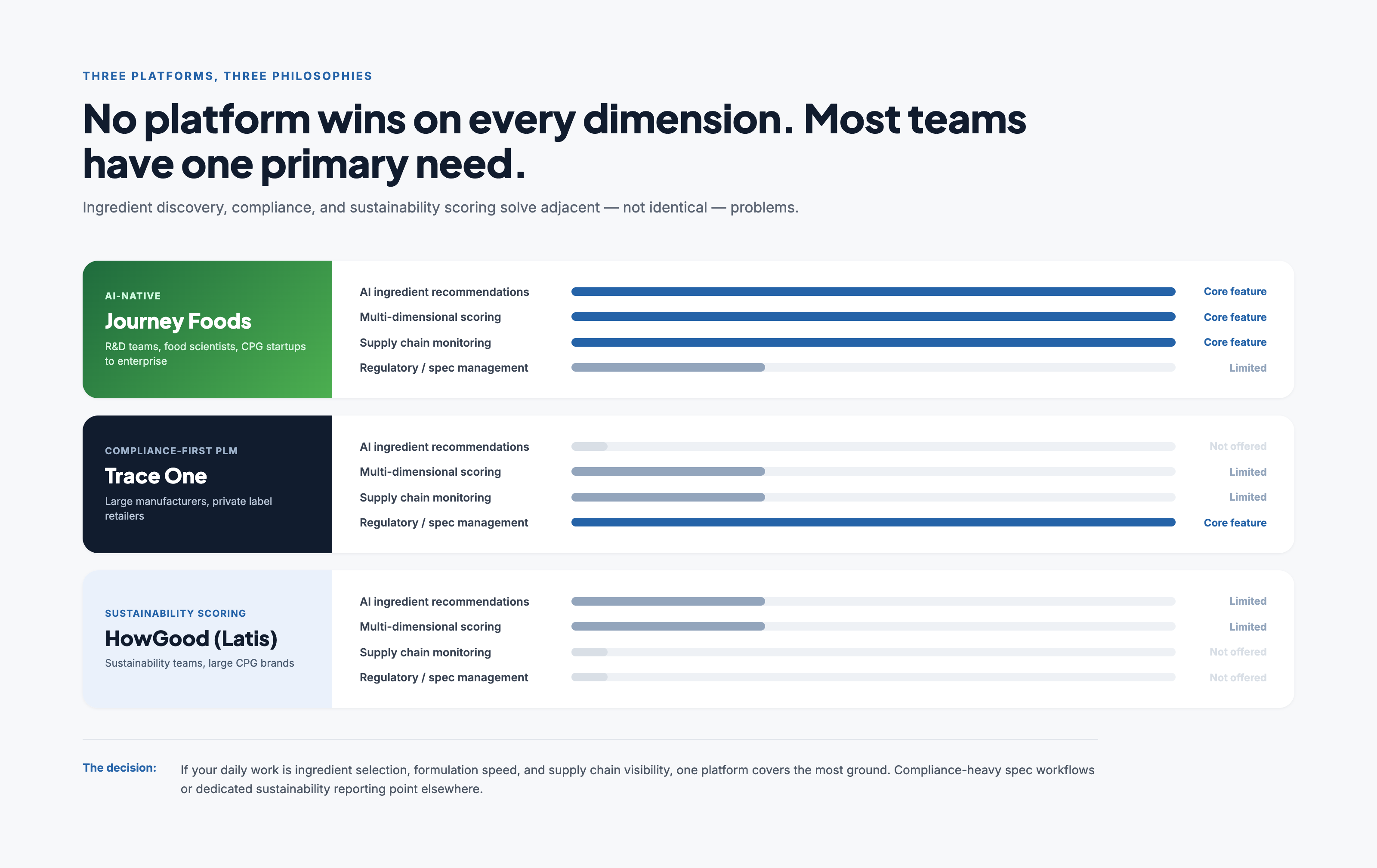
No single platform dominates every dimension. But for teams whose primary workflow centers on ingredient selection, formulation development, and supply chain visibility, Journey Foods covers the most ground in one place.
Which Platform Fits Which Team? {#which-platform-fits-which-team}
Here's a practical decision framework based on your team's primary bottleneck:
Look at Journey Foods if:
Look at Trace One if:
Look at HowGood if:
Some enterprise teams run more than one of these tools — a large manufacturer might use Trace One for spec management, HowGood for sustainability reporting, and Journey Foods for ingredient discovery and R&D. That's a legitimate setup. But the operational overhead of managing multiple platforms is real, and for most teams, consolidating where possible is worth the tradeoff.
What to Ask Before You Buy {#what-to-ask-before-you-buy}
Before you commit to any ingredient intelligence platform, push for specific answers to these questions:
For a broader look at how AI is reshaping ingredient and supply chain decisions across the food industry, the AI companies shaping food in 2026 overview is worth reading alongside this comparison.
FAQs {#faqs}
What is ingredient intelligence software?
Ingredient intelligence software gives food and CPG teams structured, searchable access to data about ingredients — covering nutrition, cost, sustainability, sourcing, and supply chain risk. Advanced platforms layer AI on top of this data to generate recommendations, flag risks, and support formulation decisions in real time.
How is Journey Foods different from Trace One?
Journey Foods focuses on ingredient discovery, AI-powered formulation recommendations, and supply chain monitoring. Trace One is primarily a PLM system built around compliance, specification management, and retailer collaboration. They solve different core problems, though there's some overlap in formulation tracking.
Is HowGood the same as Latis?
Yes. HowGood rebranded to Latis. The platform's core product remains ingredient-level sustainability scoring and environmental impact data for food companies.
Can small or mid-market CPG brands use these platforms, or are they only for enterprise?
Journey Foods serves companies from early-stage startups to enterprise. Trace One and HowGood are more commonly deployed at larger organizations. For startups and mid-market brands that need to move fast, Journey Foods is generally the better fit.
What data dimensions does Journey Foods score ingredients on?
Journey Foods scores ingredients across nutrition, cost, and sustainability simultaneously. The platform also monitors supply chain availability and generates alerts when sourcing risk emerges for ingredients in your formulations.
Do I need to replace my existing PLM to use ingredient intelligence software?
Not necessarily. Some teams use ingredient intelligence platforms alongside existing PLM or ERP systems, pulling ingredient data and recommendations into their current workflow via API. Journey Foods supports integrations, so you can assess whether it complements or replaces your current stack.
What should I look for in an AI ingredient recommendation engine?
Specificity. The best recommendation engines account for multiple constraints simultaneously — nutrition, cost, sustainability, availability — rather than optimizing for one variable. Ask vendors to demonstrate a real recommendation scenario and explain what data the model draws on. If the answer is vague, that tells you something.
The Bottom Line
This isn't a category where one platform wins universally. Trace One is genuinely strong for compliance-heavy, spec-driven workflows at large manufacturers. HowGood fills a real gap for sustainability teams that need auditable environmental data. But if your team's daily work centers on ingredient decisions, formulation speed, and supply chain visibility, Journey Foods covers the most ground with the least friction because we partner with both to integrate your data. The future is collaboration and, today, we are making that difference.
This is the operating reality of 2026: R&D and procurement teams are expected to do more with less, move faster, and make better-informed decisions across more variables than ever before. A platform that scores ingredients across nutrition, cost, and sustainability in one place — fires supply chain alerts before disruptions hit production, and keeps your formulation history organized and collaborative — isn't a nice-to-have. It's infrastructure.
See how Journey Foods fits your team's workflow at Journeyfoods.io, or book a demo to walk through a live scenario with your actual use case.
We'd love to hear from you! If you have questions about how these platforms compare for your specific situation, throw them in the comments below or find us on Instagram, LinkedIn, and X.

Journey Ingredient Intelligence
Heavy Cream
Trace One is genuinely strong for compliance-heavy, spec-driven workflows at large manufacturers.
A South American tree in the family Lecythidaceae.
Nutrition. Heavy Cream has a nutrition profile of 1,527 kcal/lb, 12.70 g protein/lb, and 13.15 g total sugars/lb.
Cost. Heavy Cream is currently priced at $8.75/kg.
Sustainability. Journey AI evaluates ingredient sustainability using environmental indicators such as water usage, greenhouse gas emissions, and upcycled status.
Journey Ingredient Intelligence · Comparison
Beef (Ground)
Heavy Cream
Data from this story