The Real Cost of Manual Ingredient Research: A Data-Backed Case for Automation


Quick answer
Most food R&D teams have a productivity problem they've stopped noticing. Ingredient research, supplier qualification, nutritional analysis, regulatory cross-referencing — none of it feels like waste because it's always been part of the job. But when you actually measure the hours, the error rates, and the downstream costs of slow or incomplete research, the picture shifts fast.
Table of Contents
Most food R&D teams have a productivity problem they've stopped noticing. Ingredient research, supplier qualification, nutritional analysis, regulatory cross-referencing — none of it feels like waste because it's always been part of the job. But when you actually measure the hours, the error rates, and the downstream costs of slow or incomplete research, the picture shifts fast.
This isn't a pitch for "going digital." It's a data-backed look at what manual ingredient research actually costs CPG companies right now — and what the ROI on automation looks like when you stop treating it as optional.
Let me walk you through it.
The Hidden Tax on Your R&D Team
Your food scientists and product developers are expensive hires. Their value is in formulation expertise, sensory judgment, and cross-functional problem-solving. But in most CPG environments, a significant chunk of their week goes to work that doesn't require any of that: searching supplier databases, reconciling spec sheets, manually tracking regulatory updates, chasing cost data from procurement.
This is the hidden tax. It doesn't show up as a line item. It shows up as slower launch timelines, missed market windows, and formulation decisions made on incomplete data because the full research would have taken another two weeks nobody had.
The food industry has hit an inflection point. The companies pulling ahead aren't necessarily the ones with bigger R&D budgets — they're the ones who've stopped paying that tax.
What Manual Research Actually Costs: Breaking Down the Numbers
Time: The Most Underestimated Line Item
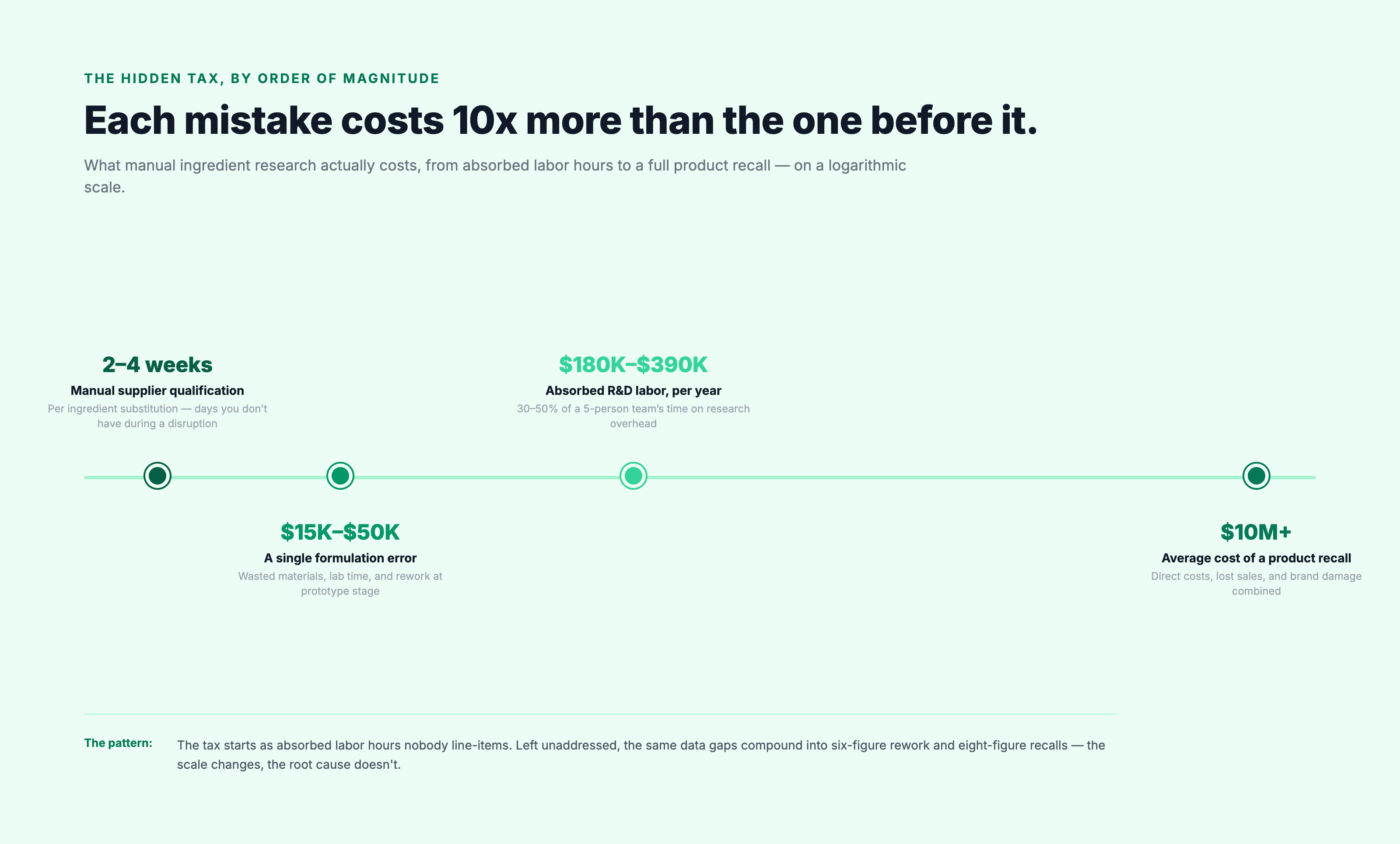
Industry benchmarks consistently show that R&D professionals spend 30–50% of their working time on information gathering rather than actual development work. For a team of five food scientists at a mid-market CPG company, that's roughly two to three full-time equivalents worth of capacity absorbed by research overhead every year.
Run that against average fully-loaded compensation for a senior food scientist — typically $90,000–$130,000 annually in North America — and you're looking at $180,000–$390,000 in annual labor cost going toward tasks that automation handles in seconds.
That's before you factor in opportunity cost. Every week a product stays in the research phase is a week it isn't generating revenue.
The Cost of a Wrong Decision
Manual research doesn't just cost time. It introduces error. When ingredient data comes from multiple disconnected sources — a supplier PDF here, a regulatory database there, a spreadsheet a colleague built two years ago — working from outdated or inconsistent information isn't a risk. It's a near-certainty over time.
A single formulation error that reaches the prototype stage can cost $15,000–$50,000 in wasted materials, lab time, and rework. A compliance gap discovered after launch is a different order of magnitude entirely.
The numbers tell the story: the average cost of a food industry product recall exceeds $10 million when you account for direct costs, lost sales, and brand damage. Most recalls trace back to upstream data problems — ingredient substitutions, mislabeled allergens, supplier changes that weren't caught in time. Manual research processes are structurally unable to monitor for these changes in real time.
Headcount You're Not Accounting For
Many CPG companies have quietly built shadow infrastructure around their research gaps: a regulatory affairs coordinator who manually monitors rule changes, a procurement analyst whose job is essentially maintaining a supplier spreadsheet, a project manager whose primary function is chasing status updates across teams.
These roles exist because the core R&D process doesn't surface the right information at the right time. They're workarounds, not solutions — and they add cost without adding formulation capability.
Where Manual Processes Break Down in Practice
Sourcing and Supplier Qualification
Finding a new ingredient supplier manually means navigating trade directories, requesting spec sheets, waiting on responses, and then comparing options across nutrition, cost, sustainability, and regulatory fit by hand. For a single ingredient substitution, this process routinely takes two to four weeks.
That timeline doesn't hold up under pressure. When a supply disruption hits — a crop failure, a geopolitical event, a sudden price spike — a team running manual sourcing processes doesn't have two weeks. They have days, sometimes hours.
Automated platforms that maintain live ingredient databases with scoring across nutrition, cost, and sustainability compress that decision window dramatically. The way supply chain intelligence is reshaping food innovation isn't theoretical — it's already operating at scale in companies that have made this infrastructure investment.
Regulatory and Label Compliance
Regulatory requirements change constantly across markets. Manual compliance monitoring means someone on your team owns the job of tracking FDA updates, EFSA guidance, country-specific labeling rules, and allergen declarations — and cross-referencing every active formulation against any change that lands.
In practice, this doesn't happen consistently. It happens when someone remembers to check, or when a customer complaint forces a review. That's a reactive posture in a regulatory environment that increasingly rewards proactive compliance.
Automated supply chain monitoring flags changes as they happen and surfaces the affected products in your portfolio. The shift from reactive to proactive isn't just operationally cleaner — it's a meaningful reduction in risk exposure.
Reformulation Under Pressure
Reformulation is where the cost of manual research compounds fastest. When a key ingredient becomes unavailable, too expensive, or flagged for regulatory reasons, your team needs alternatives that match the original on nutrition, functionality, cost, and consumer perception — all at once.
Manual research handles these dimensions sequentially, not in parallel. A food scientist searches for nutritional equivalents, checks cost, checks availability, then loops back to verify whether the cost-effective option actually works functionally. Each loop takes days.
Automated ingredient scoring evaluates all dimensions simultaneously, surfaces ranked alternatives, and flags supply chain risks before they become emergencies. The difference in reformulation speed is measured in weeks.
What Automation Actually Changes: Food R&D Automation ROI in Real Terms
The ROI on food R&D automation isn't speculative. It shows up in three measurable places:
1. Launch velocity. Faster ingredient research means faster iteration cycles. Teams that have automated their ingredient discovery and qualification processes report significant reductions in time-to-prototype. Journey Foods clients have seen 64% time savings for teams and decision-makers — time that goes directly back into development work.
2. Cost per launch. Automation reduces the labor cost of research, the cost of rework from bad data, and the cost of reactive reformulation. Journey Foods data shows an average of 28% cost savings for clients, reflecting both direct labor reduction and better upstream decision-making.
3. Portfolio quality. When your team spends less time on research overhead, they spend more time on formulation quality. Products launched with better ingredient data are more likely to hit nutritional targets, meet clean-label standards, and clear regulatory review on the first pass.
These aren't soft benefits. They're the kind of numbers that justify a platform investment within a single budget cycle.
For a broader look at how AI is being applied across food industry R&D, the leading AI companies in food landscape has expanded significantly, with platforms now covering everything from ingredient discovery to supply chain risk monitoring.
The Compounding Advantage: Why Early Movers Pull Ahead
There's a compounding dynamic that a single-year ROI calculation won't capture. Teams that automate their ingredient research build institutional knowledge faster. Every formulation decision, every supplier evaluation, every regulatory check gets captured in a centralized system — not buried in someone's inbox or a shared drive folder half the team can't locate.
Over time, that creates a searchable, traceable development history that new team members can actually use. It reduces the knowledge loss that happens when experienced scientists leave. And it gives leadership real visibility into the portfolio — something manual processes simply can't provide.
This is the difference between a one-time efficiency gain and a structural capability advantage. The companies building that advantage now will be materially harder to catch in three years.
The broader shift toward AI-driven transparency in ingredients and supply chains is accelerating this dynamic. Transparency isn't just a consumer demand anymore — it's becoming a supply chain requirement, and teams without automated traceability will struggle to meet it.
How to Evaluate an Automation Platform for Your R&D Team
Not all automation platforms solve the same problems. When you're evaluating options, these are the questions that actually matter:
Journey Foods' platform addresses all of these directly — ingredient search and scoring across nutrition, cost, and sustainability; AI-powered recommendations; supply chain monitoring with proactive alerts; and a centralized dashboard built for collaborative, traceable development. Explore the full feature set at journeyfoods.io/product.
FAQs
What is food R&D automation ROI, and how is it measured?
Food R&D automation ROI measures the financial return from replacing manual research tasks with automated systems. It's calculated by comparing the cost of the platform against savings in labor time, reduced rework costs, faster time-to-market, and lower risk of costly errors — reformulation failures, compliance gaps, and the like.
How much time does manual ingredient research actually take?
Industry benchmarks put it at 30–50% of working time spent on information gathering rather than formulation work. For a team of five, that's the equivalent of two to three full-time employees absorbed by research overhead every year.
What are the biggest risks of relying on manual ingredient research?
Three main ones: working from outdated or inconsistent data that leads to formulation errors; missing regulatory changes that create compliance exposure; and slow supplier qualification that leaves teams unable to respond quickly when supply chains shift.
How does automated ingredient research reduce product launch costs?
It cuts labor hours spent on research, reduces rework from bad data, speeds up reformulation when ingredients need to change, and lowers the risk of compliance failures that require costly post-launch corrections. Journey Foods clients report an average of 28% cost savings on product launches.
What should a food R&D team look for in an automation platform?
A platform that covers the full workflow in one place, uses current supplier and ingredient data, supports cross-functional collaboration, scores ingredients across nutrition, cost, and sustainability simultaneously, and maintains version history for traceability.
Is food R&D automation only viable for large CPG companies?
No — and the proportional benefit is often higher for smaller teams. A five-person R&D team recovering 30% of their time is a significant capability gain regardless of company size. Smaller teams have less slack to absorb research overhead, which makes automation more impactful, not less.
How does supply chain monitoring fit into R&D automation?
It's a core component, not a separate function. When ingredient availability, pricing, or regulatory status changes, that information needs to reach your formulation team immediately — not after a quarterly supplier review. Integrated monitoring keeps your active formulations current without requiring manual checks.
The Case Is Already Made
This isn't startup experimentation anymore. Automated ingredient research and supply chain intelligence are operating at enterprise scale across CPG, and the companies still running manual processes are paying a real, measurable cost — in labor, in launch speed, in risk exposure, and in the compounding disadvantage of not building institutional knowledge.
The ROI math isn't complicated. The question is whether your team is ready to stop paying the tax.
Explore what automation looks like in practice at journeyfoods.io — or book a demo to see how the platform maps to your specific R&D workflow.
We'd love to hear from you! If you have questions or want to share how your team is handling ingredient research today, throw them in the comments below.
Find us on Instagram, LinkedIn, and X/Twitter.
As published
$15,000
Data from this story
Shareable Journey Intelligence
The Real Cost of Manual Ingredient Research: A Data-Backed Case for Automation
Industry Insights
$15,000
A single formulation error that reaches the prototype stage can cost $15,000–$50,000 in wasted materials, lab time, and rework.
$10
The numbers tell the story: the average cost of a food industry product recall exceeds $10 million when you account for direct costs, lost sales, and brand damage.