


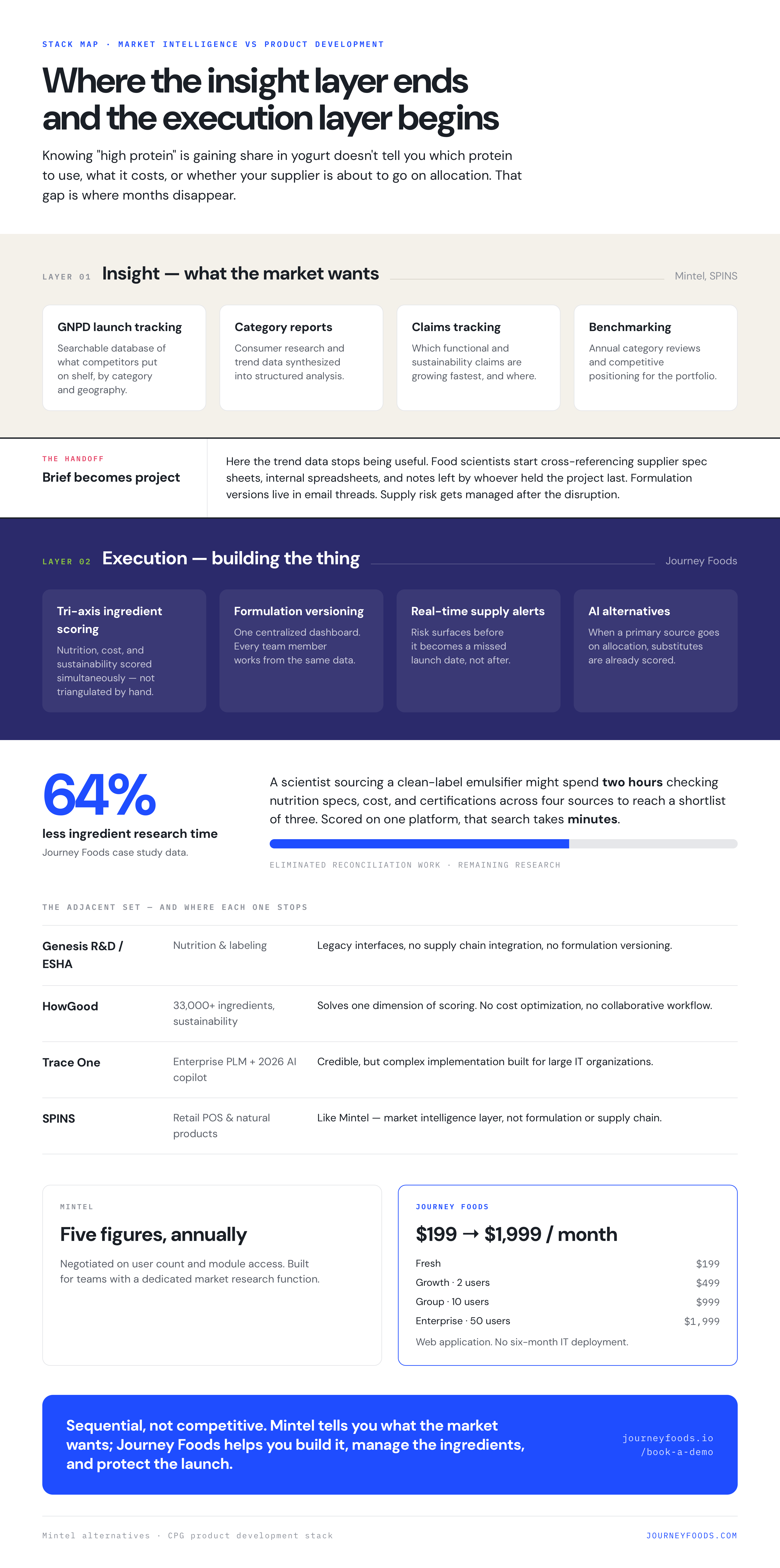
Trend intelligence is not product development. Knowing that "high protein" is gaining share in the yogurt category doesn't tell you which protein ingredient to use, what it costs, how sustainable it is, or whether your primary supplier is about to go on allocation. That gap—between market insight and operational execution—is where CPG product teams lose months.
This article breaks down what Mintel actually does, where it stops, and what your team needs once the goal shifts from monitoring the market to building and launching a product.
Mintel is a market intelligence platform. That's its job, and within that scope it does it well.
The GNPD tracks new product launches across categories and geographies, giving R&D and marketing teams a searchable database of what competitors are putting on shelf. Category reports synthesize consumer research and trend data into structured analysis. Claims and attribute tracking shows which functional or sustainability claims are growing fastest—useful when you're deciding how to position a new SKU.
For early-stage ideation, competitive benchmarking, or annual category reviews, Mintel provides real signal. A senior R&D manager can walk into a portfolio review with data showing that immunity claims in kids' snacks grew 18 percent year over year, and that's a legitimate input to a product strategy conversation.
The limitation isn't that Mintel is bad at what it does. The limitation is that what it does ends at the insight layer.
Once you decide to build a product, Mintel's role is essentially over.
It doesn't score ingredients across nutrition, cost, and sustainability. It doesn't version-control your formulations so your team is always working from the same document. It doesn't send a real-time alert when a key ingredient faces a supply disruption. It doesn't suggest an alternative when your primary source goes on allocation two weeks before a launch deadline.
These aren't minor gaps. They're the operational core of product development.
The typical workaround looks like this: a food scientist pulls trend data from Mintel, then manually cross-references ingredient options across supplier spec sheets, internal spreadsheets, and whatever notes a previous team member left behind. Formulation versions live in email threads. Supply chain risk gets managed reactively—usually after a disruption has already hit the timeline.
That workflow is fragile and slow. It's also the default for most mid-market CPG teams right now.
Platforms built specifically for food and beverage product development operate at the execution layer, not the intelligence layer. That distinction matters.
Journey Foods is designed for the work that happens after trend discovery: ingredient evaluation, formulation development, supply chain management, and team collaboration. The Operations Scientist AI scores ingredients simultaneously across nutrition, cost, and sustainability—so your team isn't manually triangulating three separate data sources to make a single ingredient decision.
Formulations are tracked with version control in a centralized dashboard. Every team member works from the same data. When a supply chain risk surfaces, the platform sends a real-time alert and surfaces AI-driven ingredient alternatives before the disruption becomes a missed launch.
That operational focus is what separates ingredient data platforms from market intelligence tools. They're solving different problems at different stages of the product lifecycle.
Journey Foods' own case study data shows a 64 percent reduction in ingredient research time for teams using the platform. That figure is worth unpacking because it shows exactly where time disappears in a fragmented workflow.
When ingredient data lives across supplier portals, internal spreadsheets, and a market intelligence database, every formulation decision requires manual reconciliation. A food scientist searching for a clean-label emulsifier might spend two hours cross-checking nutrition specs, cost data, and sustainability certifications across four separate sources before landing on a shortlist of three candidates.
On a platform where ingredients are scored across all three dimensions simultaneously, that same search takes minutes. Multiply that across a product portfolio with dozens of active formulations and the time savings compound fast.
The 64 percent reduction isn't about working faster on the same task. It's about eliminating reconciliation work that shouldn't exist in the first place. You can explore the full case study and related supply chain research in the Journey Foods white paper library.
Mintel isn't the only adjacent tool CPG teams consider when evaluating their product development stack. A quick look at the broader landscape helps clarify where each fits.
Genesis R&D and ESHA handle nutrition analysis and regulatory labeling. Useful for compliance work, but both carry legacy interfaces, have no supply chain integration, and don't support formulation versioning or ingredient discovery at scale.
HowGood covers sustainability data for more than 33,000 ingredients—genuinely valuable, but it doesn't address cost optimization or collaborative development workflows. It solves one dimension of the ingredient scoring problem.
Trace One has strong PLM heritage and introduced an AI copilot in 2026. It's a credible enterprise option, but it requires complex implementation and is built for large CPG organizations with significant IT resources. A two-person R&D team at a mid-market brand isn't the target customer.
SPINS provides retail point-of-sale data and natural products market intelligence. Like Mintel, it operates at the market intelligence layer—not the formulation or supply chain layer.
None of these platforms combines ingredient intelligence, formulation versioning, and real-time supply chain alerts in one workspace built specifically for food and beverage teams. That combination is the gap Journey Foods occupies.
Yes—and for some teams, that's the right answer.
If your organization runs regular category reviews, tracks competitive launches, or uses consumer research to inform innovation pipelines, Mintel serves a real purpose at the front end of that process. Trend discovery and market benchmarking are legitimate inputs to a product brief.
Journey Foods takes over the moment a product brief becomes an active formulation project. Ingredient selection, cost modeling, sustainability scoring, formulation versioning, supplier risk monitoring, and team collaboration all live in the platform from that point forward.
Think of it as sequential rather than competitive. Mintel tells you what the market wants. Journey Foods helps you build it, manage the ingredients, and protect the launch from supply chain disruption.
Teams that try to use Mintel as a substitute for operational product development tooling are asking it to do something it was never designed to do. The reverse is equally true: Journey Foods doesn't replace market intelligence. It replaces the spreadsheets, email threads, and manual data reconciliation that slow down execution after the strategy is set.
Mintel enterprise licensing typically runs well into five figures annually, with pricing negotiated based on user count and module access. The platform is built for large teams with dedicated market research functions.
Journey Foods pricing starts at $199 per month for the Fresh tier. The Growth tier is $499 per month for two users. Group is $999 per month for ten users. Enterprise at $1,999 per month supports fifty users and includes product optimization AI, customer reporting, and product customizations. Custom enterprise pricing is available for larger organizations.
There's no six-month IT project to get started. The platform is a web application, and teams are operational without the deployment complexity that comes with enterprise PLM systems.
If your current product development workflow lives in spreadsheets and your supply chain risk management is reactive, the ROI calculation is straightforward. Book a demo to see how the platform handles your specific formulation and supply chain use cases.
Is Mintel a formulation tool?
No. Mintel is a market intelligence platform. It tracks new product launches, consumer trends, and category data through tools like the GNPD. It doesn't score ingredients, version-control formulations, or monitor supply chain risk. It operates at the insight layer, not the execution layer.
Can Journey Foods replace Mintel?
Not if your team relies on Mintel for competitive launch tracking, consumer research, or category trend reports. Journey Foods is built for ingredient management, formulation development, and supply chain operations. The two platforms serve different stages of the product lifecycle, and many teams use both.
What does Journey Foods cost compared to Mintel?
Journey Foods starts at $199 per month and scales to $1,999 per month for enterprise teams. Mintel enterprise licensing is typically negotiated at significantly higher annual figures. The Growth tier at $499 per month makes Journey Foods accessible to two-person R&D teams—well below the cost of most enterprise market intelligence subscriptions.
How fast is Journey Foods implementation?
The platform is a web application with no complex IT deployment required. Teams get operational quickly, without the multi-month implementation process that enterprise PLM systems typically demand.
Do I need both Mintel and Journey Foods?
It depends on your team's role. If you run category strategy, competitive benchmarking, or consumer research, Mintel provides value at the front end of innovation. Journey Foods handles everything from ingredient selection through formulation management and supply chain monitoring. Teams that do both types of work often find the combination useful rather than redundant.
What makes Journey Foods different from other ingredient platforms?
It's the only platform in the current competitive set that scores ingredients across nutrition, cost, and sustainability simultaneously, sends real-time supply chain alerts with AI-driven alternatives, and supports collaborative formulation versioning in one workspace. That combination eliminates the manual reconciliation work that accounts for most of the time lost in a typical product development cycle.
Mintel is a strong tool for what it does. If your team needs to understand market trends, track competitor launches, or benchmark claims across categories, it earns its place in the stack.
But if your product development workflow is slowing down because ingredient data is scattered, formulation versions are out of sync, or supply chain disruptions keep catching you off guard, market intelligence isn't the fix. You need a platform built for execution.
That's the problem Journey Foods solves. Learn more at journeyfoods.io.