.svg)
.svg)
.svg)
.svg)


.svg)
Sex coffee is having a moment. The name is provocative by design — but the formulation logic behind it is worth taking seriously, especially if you're an R&D lead tracking functional beverage trends and trying to separate signal from noise.
Here's what it is, what's driving it, and what the ingredient stack tells you about where functional coffee is heading.
Quick Answer
Sex coffee is a functional beverage that combines brewed coffee with adaptogens, herbal libido-support ingredients, and performance-focused compounds. It sits at the intersection of the biohacking trend, the functional beverage boom, and consumer demand for products that do more than caffeinate. The ingredient list varies widely by brand, but the core logic is consistent: stack stimulant energy with targeted botanical support.
Key Takeaways
Sex coffee is a category of functional coffee products marketed around libido support, hormonal balance, and sexual performance. Not a single product — a format. You'll find it as instant blends, ready-to-drink cans, and add-in powders.
The name is a consumer-facing hook. The actual product is a functional beverage with a specific botanical stack layered on top of a coffee base. Some formulations lean heavily into the adaptogen angle. Others position closer to pre-workout with a hormonal support claim. The category line is blurry, which is part of what makes it interesting from a formulation standpoint.
What's consistent: these products target consumers who want their morning coffee to do more. Energy, focus, and libido support in one cup. The "sex" framing is the marketing layer. The ingredient science is what determines whether a product survives beyond the initial hype cycle.
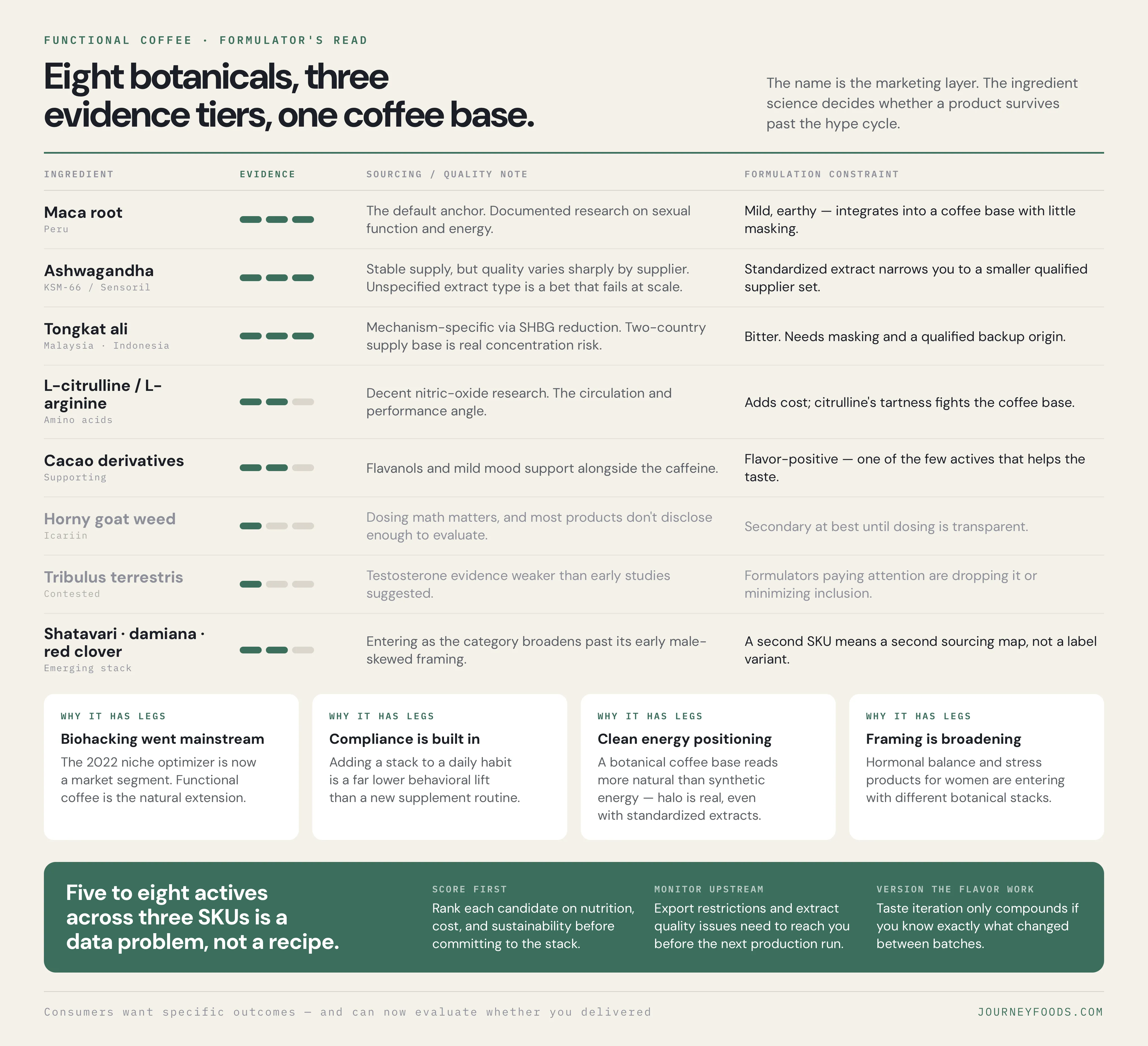
The ingredient stack varies, but a handful of botanicals show up consistently across formulations.
Maca root is the most common anchor. Peruvian in origin, it has documented research behind its effects on sexual function and energy. Its mild, earthy flavor integrates reasonably well into a coffee base — which is a big part of why it became the default starting point for this category.
Ashwagandha appears in most serious formulations. Strong research base around stress reduction and testosterone support. Supply chain is relatively stable, but ingredient quality varies significantly between suppliers. KSM-66 and Sensoril are the two standardized extracts with the most clinical backing. Formulations that don't specify the extract type are making a quality bet that may not hold at scale.
Tongkat ali (Eurycoma longifolia) is gaining ground as a primary active. More mechanism-specific than ashwagandha — it's associated with free testosterone support through SHBG reduction. The research is credible enough that it's moved from fringe supplement to mainstream functional ingredient in the last two years. That's not hyperbole. The sourcing geography is worth noting: Malaysia and Indonesia dominate supply, which creates concentration risk.
Horny goat weed (epimedium) shows up in some formulations. The active compound is icariin, and the dosing math matters — most products don't disclose enough to evaluate efficacy.
Tribulus terrestris is common but increasingly contested. The clinical evidence for testosterone effects is weaker than early studies suggested. Formulators paying attention are either dropping it or keeping it as a low-inclusion secondary ingredient.
L-arginine and L-citrulline appear in formulations that lean into the circulation and performance angle. Both amino acids have decent research behind nitric oxide support. They add cost and affect flavor — citrulline in particular has a distinct tartness that needs masking in a coffee base.
Cacao and dark chocolate derivatives show up as supporting ingredients in some blends, contributing flavanols and mild mood support alongside the caffeine.
The honest read: this ingredient category is a mix of well-supported botanicals, legacy supplement ingredients with weaker evidence, and a few trend-driven additions that are more marketing than mechanism. Knowing which is which matters before you commit to a formulation.
Functional beverages have been growing for years. What's different about sex coffee is the convergence of a few durable consumer signals.
Biohacking went mainstream. The consumer who was optimizing sleep, stress, and testosterone in 2022 as a niche behavior is now a significant market segment. Functional coffee is a natural extension of that mindset — same morning ritual, upgraded outcome.
Coffee is the perfect delivery vehicle. It's already a daily habit for most of the target demographic. Adding a functional stack to something people already drink every day is a lower behavioral lift than introducing a new supplement routine. Compliance is built in.
The "clean energy" positioning resonates. Consumers are skeptical of energy drinks with long synthetic ingredient lists. A coffee base with botanical adaptogens reads as more natural — even when the formulation includes standardized extracts that are anything but simple. The clean-label halo is real, and it's driving purchasing decisions.
The gender-neutral framing is expanding. Early sex coffee products leaned heavily male. The category is broadening. Products targeting hormonal balance, libido, and stress for women are entering the space, often with different botanical stacks — shatavari, damiana, and red clover showing up alongside the maca base.
This isn't a flash trend. It's a category with durable consumer logic. The question for formulators isn't whether to pay attention — it's how to build something that holds up.
Sex coffee formulations typically involve five to eight active botanicals, each with their own sourcing geography, quality variability, cost profile, and sustainability footprint. Managing that across a single formulation is hard. Managing it across multiple SKUs — a men's version, a women's version, a stimulant-free variant — is a data problem at scale.
The teams that struggle here are the ones still running ingredient research in spreadsheets and sourcing decisions through email chains. When tongkat ali prices spike because of Malaysian export restrictions, or when a specific ashwagandha extract supplier has a quality issue, you need to know immediately — and you need an alternative already scored against your nutrition, cost, and sustainability criteria before your next production run.
The difference between a generic ashwagandha powder and KSM-66 isn't just quality — it's supply chain specificity. You're dependent on a smaller set of qualified suppliers. That concentration creates risk. Real-time supply chain monitoring matters more in this category than in a commodity ingredient formulation.
Consumers buying sex coffee are reading labels. They're looking up ingredients. They're skeptical of proprietary blends that obscure dosing. Formulators who build with full ingredient transparency — disclosed extract ratios, sourced botanical origins, clean processing — will have a structural advantage as the category matures.
The clean-label formulation principles that apply across functional food apply directly here. Consumer trust built on a transparent label is harder to replicate than any single ingredient.
Maca has a distinct flavor. Tongkat ali is bitter. L-citrulline is tart. You're building on a coffee base that already has strong flavor compounds. Getting the active dosing right is only half the problem — the final product also has to taste like something people will drink every day. That requires iteration, and iteration requires version-controlled formulation records so you know exactly what changed between batches.
Sex coffee is part of a broader pattern: consumers want products that target specific outcomes, not just general wellness. The same logic driving this category is driving functional sleep beverages, cognitive performance drinks, and stress-support waters. The formulation skills and ingredient intelligence infrastructure you build for one of these categories transfers directly to the others.
The functional ingredient formulation work happening in adjacent spaces draws from the same botanical ingredient pool. The supply chain and scoring infrastructure you need is the same.
Here's the practical problem. You're evaluating maca root from three suppliers. One is cheaper. One has a better sustainability profile. One has a stronger nutrition spec. You need to know how each scores across all three dimensions before you make a sourcing decision — and you need that fast enough to actually act on it.
That's the gap ingredient intelligence platforms are built to close. Journey Foods' Operations Scientist AI engine scores ingredients across nutrition, cost, and sustainability simultaneously, surfaces alternatives when a preferred ingredient has supply risk, and keeps formulation records version-controlled so your team isn't rebuilding context every time something changes. More on how the platform approaches this at journeyfoods.io.
For a category like sex coffee — complex ingredient stack, geographically concentrated supply chains, high clean-label pressure — multi-criteria scoring isn't a nice-to-have. It's how you avoid expensive mistakes.
We've also written directly about what sex coffee is and how it fits into the morning ritual trend if you want the consumer-facing angle alongside this formulator's view.
Sex coffee is a real category with durable consumer logic and a genuinely complex formulation challenge. The brands that win here won't be the ones with the most provocative name. They'll be the ones with the most rigorous ingredient intelligence, the cleanest labels, and the supply chain stability to deliver consistent product at scale.
For R&D leads and food scientists, the trend is worth watching not just for what it is, but for what it represents: a consumer base that's increasingly specific about what they want their food and beverages to do — and increasingly capable of evaluating whether a product actually delivers.
Build accordingly.
What is sex coffee?
Sex coffee is a category of functional coffee products that combine a coffee base with botanical ingredients associated with libido support, hormonal balance, and sexual performance. Common ingredients include maca root, ashwagandha, tongkat ali, and L-arginine. Available in instant powder, ready-to-drink, and add-in formats.
What ingredients are typically in sex coffee?
The most common are maca root, ashwagandha (often as a standardized extract like KSM-66 or Sensoril), tongkat ali, tribulus terrestris, horny goat weed (epimedium/icariin), and amino acids like L-arginine or L-citrulline. Formulations vary significantly by brand and target demographic.
Does sex coffee actually work?
Some core ingredients have credible research behind them. Maca root, ashwagandha, and tongkat ali all have peer-reviewed studies supporting their mechanisms. Efficacy in any specific product depends heavily on extract quality, dosing levels, and bioavailability — factors that vary widely across brands and are often obscured by proprietary blend labeling.
Is sex coffee a clean-label product?
Depends on the formulation. Some products use standardized botanical extracts with disclosed dosing and minimal additives, which aligns with clean-label principles. Others use proprietary blends that don't disclose ingredient ratios — an increasingly significant consumer trust issue as the category matures.
What are the formulation challenges in making sex coffee?
The main challenges are taste masking (several active botanicals are bitter or earthy), supply chain stability for geographically concentrated ingredients like tongkat ali and maca, extract quality standardization, and balancing efficacy dosing against cost targets. Managing five to eight active ingredients simultaneously across multiple SKUs requires more than a spreadsheet.
Why is sex coffee trending in 2026?
The trend reflects biohacking moving mainstream, the functional beverage category expanding, and consumer demand for products that target specific outcomes rather than general wellness. Coffee is an ideal delivery vehicle because it's already a daily habit for the target demographic — the behavioral barrier to adoption is low.
How should CPG formulators approach the sex coffee category?
Start with ingredient intelligence before committing to a stack. Score candidate ingredients across nutrition, cost, and sustainability. Prioritize standardized extracts with documented clinical backing over generic botanicals. Build supply chain monitoring into your workflow from day one, given the geographic concentration of key ingredients. And design for clean-label transparency — the consumer buying into this category will read your label.