The R&D Director's Guide to Evaluating Ingredient Intelligence Platforms in 2026


Quick answer
You're not short on options. The food tech platform market has expanded considerably, and every vendor is pitching the same outcomes: faster formulation, smarter sourcing, better supply chain visibility. After a few demos, the decks start to blur.
So what actually separates a platform worth buying from one that creates new problems? That's what this guide answers.
This is written for R&D Directors and senior food scientists who are actively evaluating — not just browsing. You already know your pain points. Ingredient research that consumes half your week. Formulation versions scattered across email threads and personal drives. A supplier disruption that blindsided your team because no one was watching the right signals. You need a platform that solves those problems on day one, not after a six-month implementation.
What follows: five criteria that actually matter, a scoring matrix you can use in your evaluation, and the questions that will expose whether a vendor delivers or just demos well.
Criterion 1: Scoring Depth Across Multiple Dimensions
Most platforms optimize for one axis. Nutrition analysis tools give you a strong nutrient profile but tell you nothing about cost or sourcing risk. Sustainability platforms score environmental impact but can't tell you whether a substitution will blow your margin. That single-axis approach forces your team to triangulate across three or four separate tools — which is exactly the friction that slows development cycles.
What you want is simultaneous scoring across nutrition, cost, and sustainability at the ingredient level. When you search for a protein source, all three dimensions should appear in a single record. Not a nutrition score you then cross-reference against a supplier spreadsheet and a separate sustainability database.
Questions to ask vendors:
A platform that scores on a single axis is a specialized tool. That's fine if that's what you need. But don't let a vendor call it ingredient intelligence if it only answers one question.
Criterion 2: Supply Chain Integration and Proactive Alerts
Supply chain visibility is where most platforms fall short. They store ingredient data. They don't monitor it. That distinction matters enormously when a key supplier goes on allocation or a raw material price spikes without warning.
The standard to hold vendors to is proactive alerts, not reactive reporting. Your team shouldn't have to log in and check a dashboard to discover a risk. The platform should surface that risk before it hits your margin or forces a last-minute reformulation.
Specifically, evaluate:
That last point is where intelligence separates from notification. Any system can flag a problem. A genuine ingredient intelligence platform tells you what to do about it.
For R&D Directors managing 50 or more SKUs across multiple suppliers, this isn't a nice-to-have. It's the difference between a manageable disruption and a failed launch.
Criterion 3: Collaboration Features and Formulation Version Control
Here's a problem that almost never comes up in vendor demos: what happens when your best food scientist leaves?
If your formulation knowledge lives in that person's head, their personal spreadsheets, and a chain of supplier emails, you are one resignation away from a serious operational problem. This isn't hypothetical — it's one of the most common purchase triggers for teams that finally move off spreadsheets.
A credible ingredient intelligence platform gives your team a single ingredient record that everyone works from, with version control for formulations and full visibility into who changed what and when. That means:
When evaluating this criterion, ask vendors to walk you through a real scenario: a formulation change triggered by a supply disruption, tracked through version history, with visibility across two or more team roles. If they can't demo that cleanly, the collaboration feature is likely surface-level.
This is also where 10 questions to ask before choosing a food formulation software platform becomes a useful pre-evaluation checklist — especially for teams that haven't formally evaluated this category before.
Criterion 4: Implementation Speed and Day-One Usability
Enterprise PLM platforms like Trace One are built for large organizations with dedicated IT resources and six-month implementation timelines. If you're a mid-market CPG team with 50 to 500 employees, that model doesn't fit your reality. You need a platform that's operational on day one, not after a multi-month onboarding engagement.
The right questions here are blunt:
A formulator-first platform is built so your food scientists can use it without filing IT tickets. Web-based access, intuitive search, and clean data import matter more than feature depth if your team never gets past the setup phase.
Watch for vendors who answer implementation questions with "it depends on your environment." That's a reasonable answer for an ERP. For an ingredient intelligence platform serving R&D teams, it's a warning sign.
Criterion 5: Pricing Transparency and Total Cost of Ownership
Opaque pricing is a red flag at the evaluation stage. If a vendor won't publish pricing or refuses to give you a range without a sales call, you're likely looking at an enterprise-only product calibrated for large organizations. That's fine if you are one. It's a problem if you're not.
For mid-market teams, the realistic budget range for this category runs from $15,000 to $80,000 annually. Within that range, evaluate:
Platforms that publish pricing publicly signal confidence in their value proposition — and respect for your time. That transparency also makes it easier to build the internal business case for VP or CFO sign-off, which is the approval step most R&D Directors face before a purchase clears.
The Ingredient Intelligence Platform Scoring Matrix
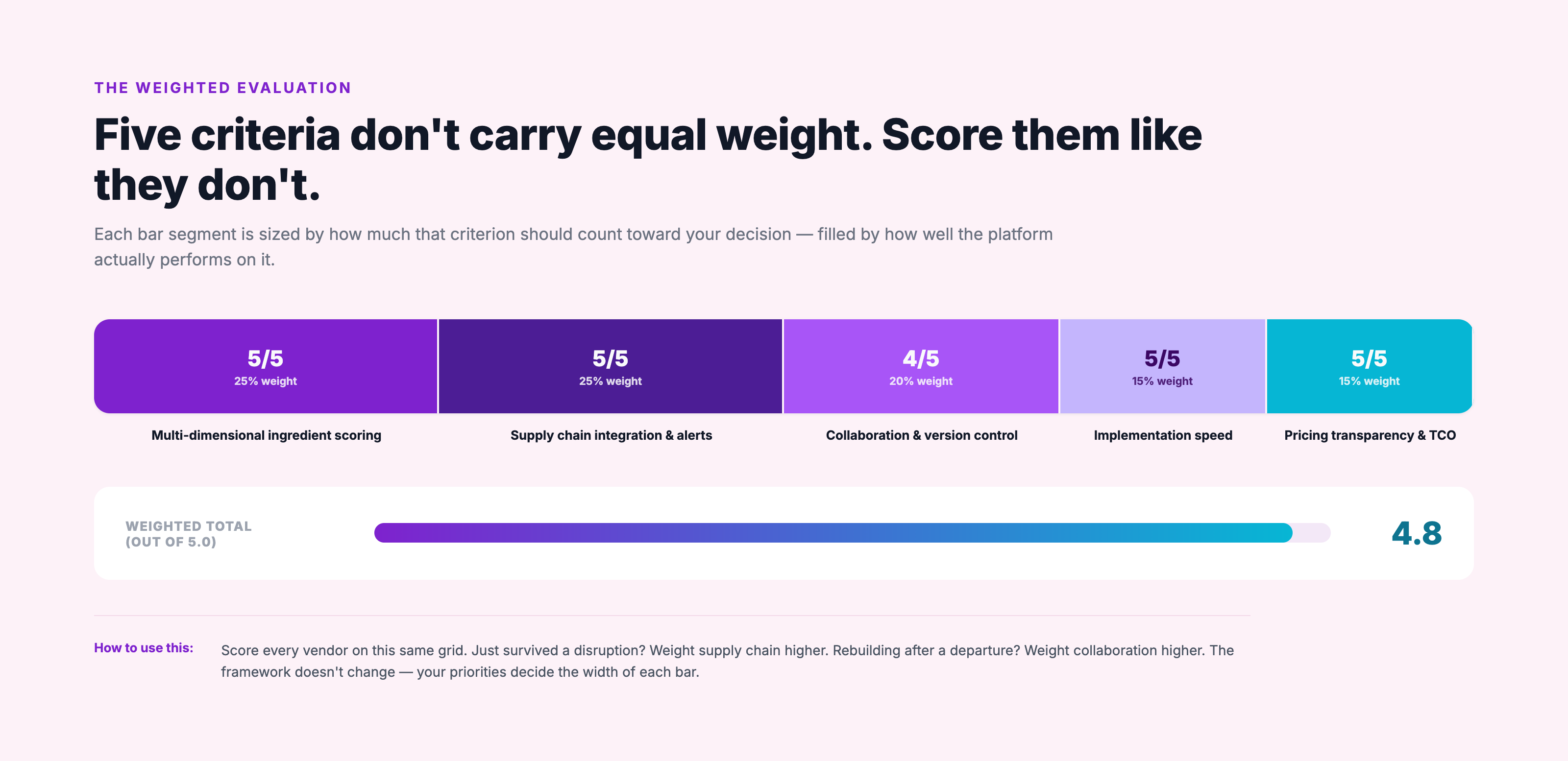
Use this framework to score vendors across the five criteria. Rate each on a 1 to 5 scale, then weight by priority for your team.
CriterionWeightVendor AVendor BVendor CMulti-dimensional ingredient scoring25%Supply chain integration and proactive alerts25%Collaboration and version control20%Implementation speed and day-one usability15%Pricing transparency and TCO15%Weighted Total100%
Adjust the weights based on your team's current pain points. Just survived a supply disruption? Weight supply chain integration higher. Rebuilding after a key team member departure? Collaboration and version control should carry more.
How Journey Foods Fits This Framework
Journey Foods is built specifically around the criteria above. The Operations Scientist AI scores ingredients simultaneously across nutrition, cost, and sustainability — so your team sees all three dimensions in a single record rather than triangulating across separate tools. Supply chain monitoring surfaces proactive alerts before a disruption reaches your production line. Formulation version control and a centralized dashboard give your entire team visibility from one shared ingredient record.
The platform is web-based and formulator-first, designed to be operational without an IT implementation project. Pricing starts at $199 per month for a single user and scales to $1,999 per month for a 50-user Enterprise plan — all published publicly. Teams using the platform have reported a 64 percent reduction in ingredient research time, which is the kind of outcome that makes the internal business case straightforward.
Partners include Kroger, NASA, SAP, the World Economic Forum, and Canada PIC.
If you're evaluating ingredient intelligence platforms right now, the food product development platform evaluation guide for 2026 covers the broader product development software landscape and is worth reading alongside this guide. For a closer look at how AI is reshaping the category, the leading AI companies in the food industry roundup provides useful context on where the market is heading.
Explore the platform and book a demo at journeyfoods.io.
What the Competitive Landscape Actually Looks Like in 2026
Knowing where each vendor sits helps you avoid evaluating tools against the wrong criteria.
Genesis R&D and ESHA are nutrition analysis and food labeling tools. They're good at what they do. They don't offer supply chain integration, multi-dimensional ingredient scoring, or collaborative formulation workflows. If your primary need is nutrition label compliance, they're worth evaluating. If you need ingredient intelligence, they're in a different category.
HowGood covers sustainability scoring for more than 33,000 ingredients with Carbon Trust verification. That depth is genuinely useful for sustainability-focused R&D work. It doesn't address cost optimization or nutrition scoring, and has no formulation or collaboration features.
Trace One is a PLM platform built for large enterprises. Strong compliance and PLM capabilities, but it requires complex implementation, carries enterprise-only pricing, and offers limited real-time supply chain intelligence. Not built for mid-market teams.
Tastewise predicts consumer trends using AI. Useful for innovation pipeline work. No formulation tools, no supply chain alerts, no ingredient-level scoring.
Mintel and SPINS provide market research and retail data. Valuable strategic inputs. No ingredient or formulation capability.
The gap in the market is a platform that combines multi-criteria ingredient scoring, supply chain monitoring, and collaborative formulation management in one workspace — at a price point accessible to mid-market teams. That's the category Journey Foods occupies. When you're building your evaluation shortlist, that combination is what you're looking for.
For context on the ingredient trends your R&D team should be tracking this year, 5 ingredient trends CPG R&D teams are tracking in 2026 is a useful parallel read.
FAQs
What is an ingredient intelligence platform?
An ingredient intelligence platform is a software tool that helps food and CPG product teams search, evaluate, and manage ingredients across multiple dimensions — typically nutrition, cost, and sustainability. More advanced platforms also include formulation version control, supply chain monitoring, and collaborative workflows so R&D, procurement, and regulatory teams work from a shared data source.
How is an ingredient intelligence platform different from nutrition analysis software?
Nutrition analysis software like Genesis R&D or ESHA focuses on nutrient profiling and label compliance. Ingredient intelligence platforms cover a broader scope: cost and sustainability scoring, supplier risk monitoring, and formulation management. The two categories serve different needs, and some teams use both.
What should R&D Directors prioritize when evaluating these platforms?
The five criteria that matter most are multi-dimensional ingredient scoring, supply chain integration with proactive alerts, collaboration features and formulation version control, implementation speed, and pricing transparency. The relative weight of each depends on your team's current pain points.
How long does it take to implement an ingredient intelligence platform?
It varies significantly by vendor. Enterprise PLM platforms can require six months or more. Platforms built specifically for food R&D teams — designed to be formulator-first — should be operational within days, not months. Ask vendors to walk you through a realistic onboarding scenario for a team migrating from spreadsheets.
What does ingredient intelligence software typically cost?
Pricing in this category ranges widely. Mid-market platforms publish pricing starting around $199 per month per user, scaling to $1,999 per month for larger team plans. Enterprise PLM platforms typically don't publish pricing and are calibrated for organizations with dedicated IT and procurement resources. Total cost of ownership should include onboarding, any implementation services, and API or integration fees.
Can ingredient intelligence platforms integrate with existing systems?
The better platforms support API access and third-party integrations. Before committing, confirm which integrations are available on your pricing tier, what the API documentation looks like, and whether integration setup requires IT resources or can be handled directly by your R&D team.
How do I build an internal business case for this type of software?
Start with a quantified pain point: hours spent on ingredient research per week, the cost of a recent supply disruption, or the risk exposure from having formulation knowledge held informally by one team member. Pair that with published pricing from the vendors you're evaluating, and map the outcome to a measurable improvement. A 64 percent reduction in ingredient research time, for example, translates directly into R&D capacity that can be redirected toward new product development.
The evaluation process for ingredient intelligence platforms isn't complicated once you know what criteria actually matter. Scoring depth, supply chain integration, collaboration, implementation speed, and pricing transparency will tell you most of what you need to know. Use the scoring matrix, run vendors through the hard questions, and don't let a polished demo substitute for a realistic onboarding scenario.
Ready to see how Journey Foods performs against this framework? Book a demo at journeyfoods.io.
As published
$15,000
Data from this story
Shareable Journey Intelligence
The R&D Director's Guide to Evaluating Ingredient Intelligence Platforms in 2026
Industry Insights
$15,000
For mid-market teams, the realistic budget range for this category runs from $15,000 to $80,000 annually .
$199
Pricing starts at $199 per month for a single user and scales to $1,999 per month for a 50-user Enterprise plan — all published publicly.