
.svg)
.svg)
.svg)
.svg)


.svg)
Reformulation is one of the most operationally risky things a CPG team can do. You're touching a product that already works, already ships, and already has a customer base expecting consistency. One wrong swap and you're dealing with a texture failure at scale, a label that no longer clears regulatory review, or a supplier who can't match the spec of the ingredient you just discontinued.

.svg)
And yet reformulation is constant. Cost pressure forces it. Supply disruptions demand it. Clean label mandates accelerate it. Regulatory changes require it. The question isn't whether your team will reformulate — it's whether you'll do it in a way that protects production continuity and margin.
This guide covers how experienced CPG R&D and procurement teams approach ingredient swaps systematically: how they evaluate candidates, sequence decisions, manage supplier transitions, and avoid the production surprises that turn a routine reformulation into a recall.
Most reformulation failures don't happen at the production line. They happen weeks earlier, in the decision-making process.
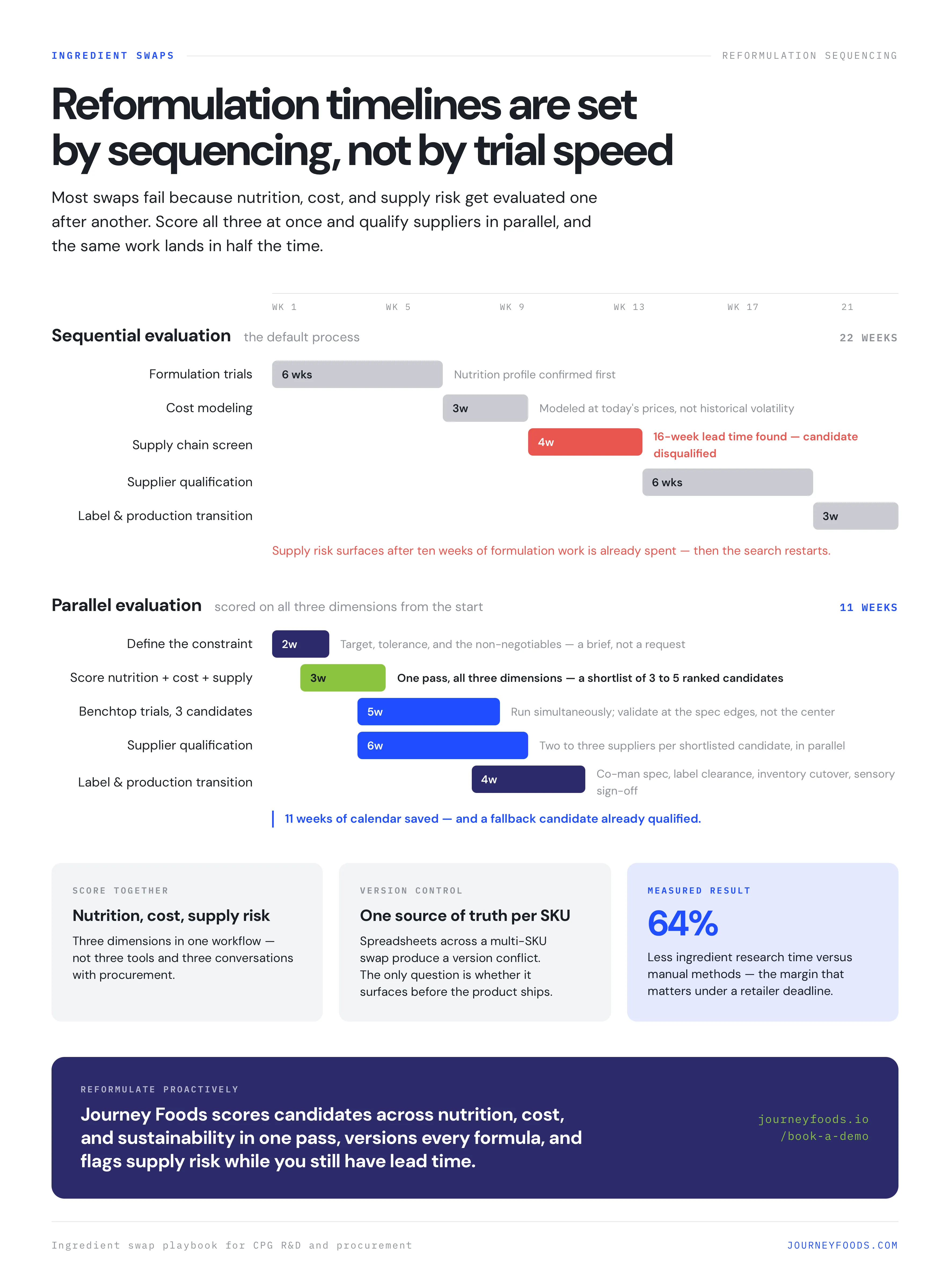
The most common failure mode is evaluating ingredient swaps in isolation. A formulator finds a viable functional replacement, confirms the nutrition profile holds, and moves it forward — then procurement discovers the new ingredient has a 16-week lead time. Or the co-manufacturer's line can't handle the new viscosity. Or the cost looks right at current commodity prices but swings 30% when you model it against the supplier's historical volatility.
Every one of those variables is knowable before you commit. The problem is that most teams evaluate them sequentially rather than simultaneously, which makes late-stage surprises almost inevitable.
The second failure mode is version control. When a reformulation touches multiple SKUs, the number of active formulation versions multiplies fast. Without a single source of truth, teams end up running trials on outdated specs, submitting label changes against the wrong base formula, or handing off to production with conflicting documents.
If your team is still managing this in spreadsheets and email threads, the risk isn't hypothetical. It's already embedded in your process.
Before you pull a single candidate ingredient, be precise about what you're actually optimizing for. "We need to replace X" is not a brief. A useful reformulation brief answers:
The more specific your brief, the faster you can disqualify candidates that won't work. Speed in reformulation comes from eliminating options quickly — not from evaluating everything.
The most expensive habit in reformulation is evaluating ingredient candidates one dimension at a time. Nutrition first, then cost, then supply chain. By the time you reach supply chain, you've already invested formulation time in an ingredient with a single-source supplier in a region with active disruption.
The right approach is to score candidates simultaneously across nutrition, cost, and supply chain risk from the start. That requires access to data on all three dimensions in the same workflow — not across three different tools or three separate conversations with procurement.
For teams using Journey Foods, the Operations Scientist AI engine does exactly this: it scores ingredients across nutrition, cost, and sustainability criteria in one pass and surfaces alternatives ranked against your specific formulation goals. Teams using this approach cut ingredient research time by 64% compared to manual methods — which matters most when you're under timeline pressure from a supply disruption or a retailer deadline.
The output of this step should be a shortlist of three to five candidates with documented scores across all relevant dimensions. Not a single "best" option. You need fallbacks.
Functional validation is where reformulation projects slow down the most, and rightly so. A candidate that scores well on paper still needs to perform in your specific formula, at your processing conditions, at your scale.
A few principles experienced formulators apply here:
Run benchtop trials in parallel, not series. If you have three candidates, trial them simultaneously rather than waiting for candidate one to fail before starting candidate two. This compresses the timeline significantly.
Test at the edges, not just the center. Your formula will encounter temperature variation, humidity variation, and ingredient lot variation in production. Validate at the boundaries of your spec, not just the nominal target.
Document everything with version control. Every trial result, every spec adjustment, every sensory note belongs in a versioned formulation record. If your team is working from shared documents with no version history, you will eventually submit the wrong spec to production. It's a matter of when, not if.
This is also the stage where clean label considerations typically surface. If you're replacing a synthetic additive or a legacy preservative, the functional replacement landscape is narrower than it looks at first. The clean label formulation guide covers the tradeoffs between performance and label positioning in practical terms.
One of the most consistent mistakes in reformulation is treating supplier qualification as a post-formulation step. By the time you've confirmed a candidate ingredient works, you want a qualified supplier ready to move — not a six-week qualification process standing between you and a production date.
Supplier qualification for a reformulation swap should cover:
Running supplier qualification in parallel with formulation trials means that when your bench trial confirms a winner, you're not starting supplier conversations from scratch. You're choosing from a pre-qualified list.
A reformulation that works on the bench and in the pilot plant can still cause problems at scale if the production transition isn't managed deliberately. The formula change is one piece. The production change is another.
Before you schedule the first production run with the new ingredient, confirm:
Co-manufacturer alignment. Does your co-man have the new ingredient spec? Have they reviewed any changes to mixing order, processing parameters, or cleaning protocols? If you're working with a co-man, assume nothing is communicated until it's confirmed in writing.
Label and regulatory clearance. If the swap changes your nutrition facts panel, ingredient statement, or any label claim, that change needs to clear before the new formula ships. Build this review into your timeline — not as an afterthought.
Inventory transition plan. You likely have existing inventory of the old ingredient. How are you managing the cutover in production scheduling? A clear transition date with documented lot tracking prevents mixed-formula inventory from reaching retail.
Sensory sign-off. Internal sensory approval is not the same as consumer acceptance. If the swap produces a perceptible sensory change, plan for a consumer test before you commit to full-scale production.
Reactive reformulation is the most expensive kind. You're reformulating because a supplier just told you they can't deliver, or because a commodity price spike just blew your margin model. You're working under time pressure, with fewer options and less negotiating leverage.
Proactive reformulation is the opposite. You see a supply risk developing, you have time to evaluate alternatives before the disruption hits, and you can run trials and qualify suppliers without a production deadline forcing your hand.
The difference between reactive and proactive reformulation is almost entirely a function of how early you get supply chain signals. Teams that monitor supplier status, commodity price trends, and ingredient availability in real time have lead time to act. Teams that find out about supply problems when a supplier calls have none.
Real-time supply chain alerts are one of the core capabilities that separate modern formulation platforms from legacy tools. If your current stack doesn't surface proactive risk signals, you're always going to be reformulating under pressure. For teams tracking ingredient cost volatility specifically, the food ingredient cost optimization guide covers how CPG teams approach cost-driven reformulation decisions with more structure.
Single-SKU reformulation is manageable with discipline. Multi-SKU reformulation across a portfolio is where version control becomes non-negotiable.
When a reformulation touches five or ten SKUs simultaneously, you need to track which version of each formula is in trial, which is approved for production, which is pending label review, and which is the current commercial spec. If that information lives in different spreadsheets owned by different people, you will have a version conflict at some point. The only question is whether it surfaces before or after the product ships.
Version-controlled formulation management means every change is logged, every version is accessible, and every team member is working from the same current record. It also means that when a team member leaves or changes roles, the institutional knowledge doesn't walk out with them — a risk most CPG teams underestimate until it actually happens.
Several forces are driving reformulation activity at higher rates right now than in previous years:
Cost-driven reformulation remains the most common trigger. Commodity volatility in cocoa, seed oils, and certain protein sources is pushing teams to evaluate lower-cost alternatives without sacrificing functional performance or label positioning.
Clean label pressure continues to narrow the acceptable ingredient list for retail-facing brands. Synthetic preservatives, artificial colors, and certain emulsifiers are under increasing retailer scrutiny — which means reformulation is often required just to maintain shelf placement, not improve it.
Protein diversification is creating reformulation complexity in the better-for-you and functional food categories. Teams working with novel protein sources are navigating ingredient interactions, processing sensitivities, and regulatory status simultaneously. The 5 ingredient trends CPG R&D teams are tracking in 2026 covers the specific ingredient categories where reformulation pressure is highest right now.
Antioxidant and preservative reformulation is worth calling out specifically. BHT is under active reformulation pressure across snack, bakery, and cereal categories. If your formulas still rely on it, the BHT alternatives guide covers the functional replacements your team should be evaluating.
The teams that handle reformulation well aren't necessarily faster at running trials. They're faster at making decisions because they have better information earlier in the process.
That means:
None of this requires a six-month PLM implementation. The teams doing this well are using purpose-built tools that fit into how food scientists actually work — not enterprise software designed for IT departments.
If you want to see how Journey Foods handles formulation versioning, ingredient scoring, and supply chain monitoring in one platform, book a demo at journeyfoods.io/book-a-demo. Or explore the platform at journeyfoods.io.
What is the most common reason CPG reformulation projects fail?
Most reformulation failures trace back to evaluating ingredient candidates one dimension at a time — nutrition first, then cost, then supply chain. By the time teams reach supply chain qualification, they've already invested significant formulation time in a candidate that has supply risk or cost volatility that disqualifies it. Evaluating all three dimensions simultaneously from the start prevents this.
How do you manage formulation versioning across multiple SKUs during a reformulation?
Version-controlled formulation management means every change is logged with a timestamp, every version is accessible to the full team, and there's a clear record of which version is in trial, approved, or currently in production. Without this, multi-SKU reformulation almost always produces version conflicts that surface at the worst possible time — usually at the production stage.
When should supplier qualification happen in a reformulation project?
Supplier qualification should run in parallel with formulation trials, not after them. If you wait until a candidate ingredient is confirmed to start supplier conversations, you add weeks to your timeline and lose negotiating leverage. Pre-qualifying two or three suppliers for each shortlisted candidate means you can move immediately once formulation validation is complete.
What's the difference between reactive and proactive reformulation?
Reactive reformulation happens under pressure: a supplier can't deliver, a commodity price spikes, or a retailer flags an ingredient. Proactive reformulation happens when you see a risk signal early enough to evaluate alternatives, run trials, and qualify suppliers before the disruption hits. The difference is almost entirely determined by how early your team receives supply chain intelligence.
How do you handle the production transition when switching to a new ingredient?
The production transition requires co-manufacturer alignment on the new spec, label and regulatory clearance if the nutrition facts or ingredient statement changes, a clear inventory cutover plan to prevent mixed-formula production, and sensory sign-off at scale. Each of these is a separate workstream that needs to be managed deliberately — not assumed to happen automatically once the formula is approved.
How does clean label pressure affect reformulation complexity?
Clean label reformulation is more constrained than cost-driven reformulation because the acceptable replacement ingredient list is narrower. Synthetic preservatives, artificial colors, and certain emulsifiers often have functional replacements that require processing adjustments or carry higher costs. Teams need to evaluate functional performance, cost impact, and label positioning simultaneously rather than treating clean label as a simple swap.
What tools do CPG teams use to manage reformulation projects?
The most effective teams use purpose-built formulation management platforms rather than spreadsheets or generic project management tools. Key capabilities include version-controlled formulation records, multi-criteria ingredient scoring, real-time supply chain alerts, and collaborative team workflows. Journey Foods combines these capabilities in a single workspace designed specifically for food and CPG R&D teams — explore the platform here.
Journey Foods Team News
Structured Q&A marked up with FAQ Page schema so it can be surfaced and cited by Al engines and search.
In Journey Al's 12 month dataset, the median plant protein reformulation came in -6.5% on raw material cost versus an animal protein control the first year that line went negative, driven by Tier 1 isolate suppliers reaching spec parity.
In Journey Al's 12 month dataset, the median plant protein reformulation came in -6.5% on raw material cost versus an animal protein control the first year that line went negative, driven by Tier 1 isolate suppliers reaching spec parity.
In Journey Al's 12 month dataset, the median plant protein reformulation came in -6.5% on raw material cost versus an animal protein control the first year that line went negative, driven by Tier 1 isolate suppliers reaching spec parity.