How to Reduce CPG Product Launch Risk Using Ingredient Data Before Pilot Production


Quick answer
Most CPG product launches don't fail in market. They fail before the first pilot batch runs.
The decisions that sink a launch happen weeks or months earlier — when ingredient choices get locked in without complete data. A supplier goes on allocation. A cost assumption from a spreadsheet turns out to be six months stale. A clean-label claim falls apart because nobody checked the full additive profile of a "natural" flavoring. By the time pilot production surfaces the problem, the timeline is already blown.
CPG product launch risk is largely an ingredient data problem. And it's solvable before you ever touch a pilot batch.
Quick Answer
Ingredient data gaps are the leading cause of late-stage CPG launch failures. The fix is front-loading supplier qualification, cost modeling, and supply chain risk assessment into the formulation phase — before pilot production begins. Teams that do this systematically shorten their launch cycles and avoid the reformulation loops that kill margins and timelines.
Key Takeaways:
Why Ingredient Data Gaps Kill Launches Late
Food scientists and R&D leads know this pattern. A formulation looks strong on paper. Nutrition profile is solid. The cost model works. Then pilot production starts and the problems surface fast.
Your primary protein ingredient is on allocation. The flavoring system that passed internal sensory review contains a compound that triggers a label disclosure you didn't plan for. The cost estimate was built on spot pricing from eight months ago, and the actual landed cost is 22% higher.
None of these are pilot production failures. They're ingredient intelligence failures that got deferred to pilot production.
The reason this keeps happening is structural. Most mid-market CPG R&D teams evaluate ingredients across three dimensions — just not simultaneously. Nutrition data lives in one tool. Cost modeling lives in a spreadsheet. Supply chain status gets checked by emailing a supplier rep and waiting. When these data streams don't talk to each other, the gaps between them are where launch risk hides.
The Pre-Pilot Ingredient Data Checklist
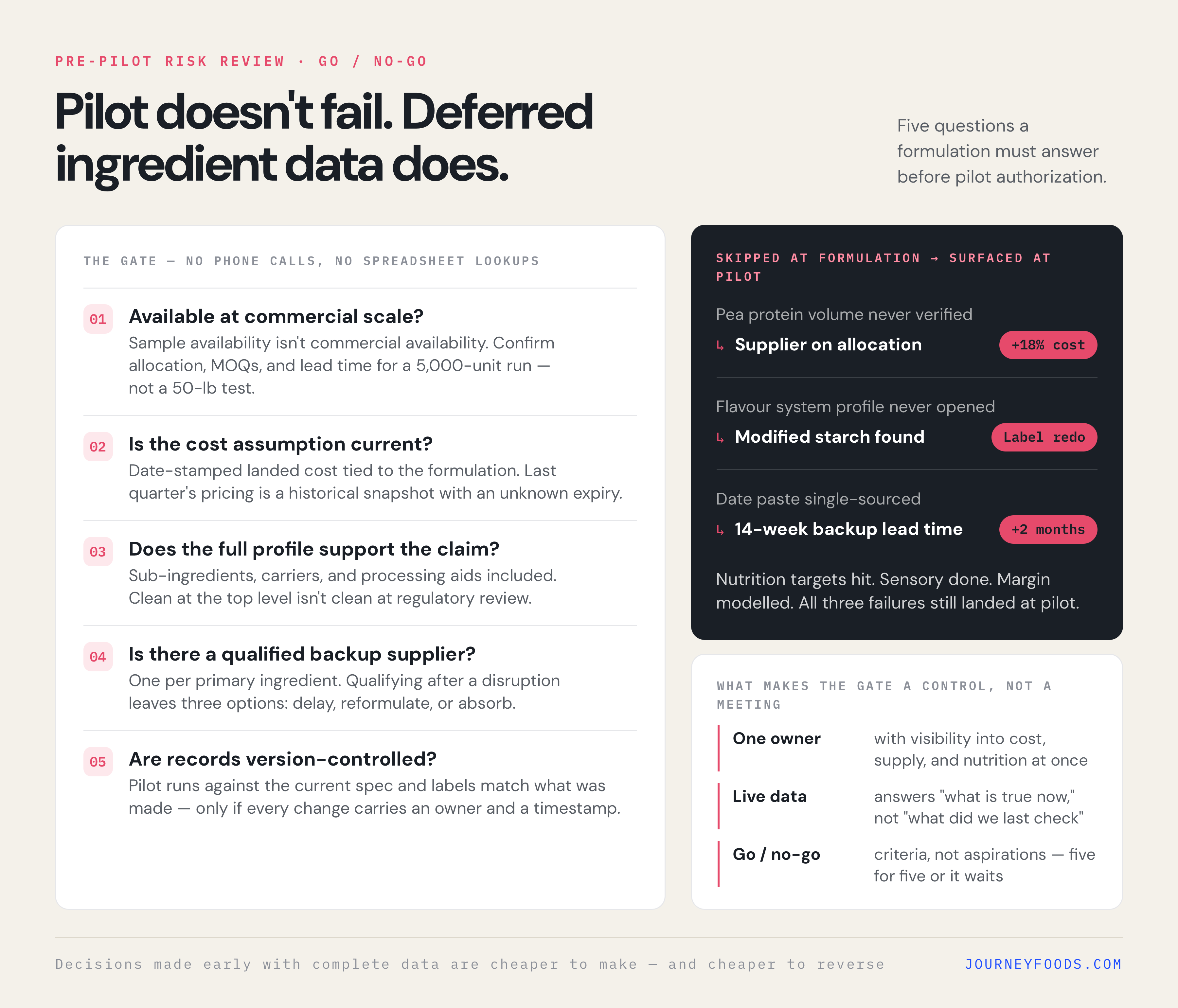
Before a formulation moves to pilot, your ingredient data should answer five questions with confidence. If any of them require a phone call, an email chain, or a manual spreadsheet lookup, you have a risk exposure.
1. Is the Ingredient Available at Scale?
Pilot batches use small quantities. Commercial production does not. An ingredient that's available for a 50-pound test run may face allocation constraints, minimum order quantities, or lead time requirements that don't surface until you're ordering for a 5,000-unit run.
Supplier qualification at the formulation stage means confirming commercial availability — not just sample availability. That requires visibility into current supply chain status, not a six-month-old sourcing document.
2. Is the Cost Assumption Current?
Commodity ingredient costs move. Tariff pressure in 2026 has made this more acute for teams sourcing across borders. A cost model built on last quarter's pricing can be materially wrong by the time you're quoting a co-manufacturer.
Static cost assumptions are one of the most common sources of margin erosion at launch. The fix is real-time cost data tied directly to your formulation — not a separate spreadsheet that someone updates manually when they remember to.
3. Does the Full Ingredient Profile Support Your Label Claims?
Clean-label claims are increasingly specific. "No artificial flavors" means something precise. So does "non-GMO," "organic," and "free from." The risk lives in compound ingredients, flavoring systems, and processing aids that carry sub-ingredients not obvious from a supplier spec sheet.
R&D leads who've been burned by this know the drill: a flavoring system that looks clean at the top level contains a carrier or anti-caking agent that triggers a disclosure. You find out at regulatory review, not at formulation. Front-loading full ingredient profile analysis — including sub-ingredients and processing aids — is the only way to close this gap before pilot.
4. Do You Have a Qualified Backup Supplier?
Single-source ingredients are a launch liability. If your primary supplier goes on allocation, hits a quality hold, or raises prices 15%, your options without a pre-qualified backup are: delay, reformulate, or absorb the cost. All three hurt.
Supplier qualification takes time. Doing it reactively — after a disruption — is the most expensive version of the process. Building backup sourcing into the formulation stage, when you still have runway, is the version that doesn't blow timelines.
5. Are Your Formulation Records Version-Controlled?
This one sounds administrative. It isn't. Version control failures are a significant source of launch risk, particularly for teams managing multiple active formulations simultaneously.
When ingredient substitutions, cost adjustments, or regulatory changes get made without a clean audit trail, teams lose track of which version is current. Pilot production runs against the wrong spec. Labeling gets built from a version that doesn't match what was manufactured. These aren't hypothetical scenarios — they're documented failure modes for teams running formulation management in shared spreadsheets.
Where Single-Dimension Tools Create Compounding Risk
Most ingredient research tools solve one problem well. Nutrition calculators give you accurate label data. Sustainability platforms give you environmental impact scores. Supplier databases give you sourcing options. But they don't talk to each other.
The compounding risk: an ingredient that scores well on nutrition may score poorly on cost, or carry supply chain fragility that never shows up in the nutrition tool. When you're evaluating ingredients in separate systems, you're making decisions with partial information. The integration step — where someone manually reconciles data from three different sources — is where errors get introduced and where the most important trade-offs get missed.
This is the structural problem that AI-powered ingredient management platforms for CPG companies are designed to address. Simultaneous scoring across nutrition, cost, and sustainability in a single workflow changes the risk profile of ingredient decisions at the formulation stage.
How to Build a Pre-Pilot Risk Review Into Your R&D Process
The goal is a structured checkpoint before any formulation moves to pilot. This doesn't require a new team or a major process overhaul — it requires a defined set of data requirements that must be met before pilot authorization.
Define the Data Requirements Upfront
Every formulation moving to pilot should have confirmed data on: current ingredient cost with a date stamp, supply chain availability at commercial scale, full ingredient profile including sub-ingredients, at least one qualified backup supplier per primary ingredient, and label claim compliance verified against the full ingredient profile.

Journey Ingredient Intelligence
Date
Define the Data Requirements Upfront Every formulation moving to pilot should have confirmed data on: current ingredient cost with a date stamp, supply chain availabil…
A South American tree in the family Lecythidaceae.
Nutrition. Date has a nutrition profile including 1279 kcal/lb calories, 11.11 g/lb protein, 36.29 g/lb fiber, and 287.35 g/lb total sugars.
Cost. Date is currently priced at $16.64/kg.
Sustainability. Journey AI evaluates ingredient sustainability using environmental indicators such as water usage, greenhouse gas emissions, and upcycled status.
These aren't aspirational. They're go/no-go criteria.
Assign Ownership
In most mid-market CPG teams, ingredient research, cost modeling, and supply chain tracking are distributed across food scientists, procurement leads, and operations. The pre-pilot review only works if one person or function owns the checkpoint and has visibility into all three data streams.
Without unified data access, the review becomes a coordination exercise rather than a risk assessment. Someone emails procurement for cost data. Someone else checks with the supplier rep on availability. The answers come back at different times, in different formats, and the synthesis is manual.
Use Real-Time Data, Not Static Documents
The pre-pilot review is only as good as the data behind it. Supplier spec sheets from six months ago, cost models built on last quarter's pricing, and supply chain assessments based on a sourcing call from three weeks ago are not real-time data. They're historical snapshots with unknown expiration dates.
Real-time supply chain alerts and live cost data change the nature of the pre-pilot review. Instead of asking "what did we know when we last checked," you're asking "what is true right now." That's a different question — and it's the one that actually reduces launch risk.
The Cost of Getting This Wrong
Late-stage reformulation is expensive in ways that go beyond direct costs. When a formulation fails at pilot because of an ingredient issue that could have been caught at the research stage, you're not just paying for the reformulation. You're paying for the launch timeline delay, the rescheduled co-manufacturer capacity, the revised packaging and labeling, and the opportunity cost of R&D time being redirected from new product development to fixing a preventable problem.
Food ingredient cost optimization research consistently shows that cost decisions made at the formulation stage have a larger impact on product margin than decisions made at any later stage. The same logic applies to risk. Decisions made early, with complete data, are cheaper to make — and cheaper to reverse if they turn out to be wrong.
What This Looks Like in Practice
Consider a mid-market CPG brand developing a new protein bar. The R&D team has a formulation that hits their nutrition targets. Sensory testing is done. The cost model, built in a spreadsheet, shows acceptable margins.
What they haven't done: verified that their primary pea protein supplier can fulfill commercial volumes at the modeled price point. Checked whether the flavoring system's full ingredient profile is compatible with their clean-label positioning. Identified a backup supplier for the date paste, which has had supply volatility over the past 18 months.
Pilot production starts. The pea protein supplier is on allocation and the available alternative costs 18% more. The flavoring system contains a modified starch that requires a label disclosure. The date paste lead time from the backup supplier is 14 weeks — which pushes the launch date by two months.
None of these were pilot production failures. They were ingredient data failures that arrived at pilot production.
The case study on cutting ingredient research time by 64% shows what changes when teams have unified ingredient intelligence at the formulation stage. The time savings are real, but the more important outcome is the risk that gets caught before it becomes expensive.
How Journey Foods Addresses Pre-Pilot Risk
Journey Foods is built around this specific problem. The Operations Scientist AI engine scores ingredients simultaneously across nutrition, cost, and sustainability — so R&D leads see the full picture of an ingredient decision in one place, rather than reconciling data from separate tools.
Real-time supply chain alerts surface availability changes, supplier disruptions, and cost shifts as they happen. Not when someone thinks to check. Version control for formulations is native to the platform, which closes the audit trail gap that creates pilot production errors.
For teams tracking ingredient trends in 2026, the ingredient intelligence layer also surfaces emerging supply chain risks and cost pressures tied to specific ingredient categories — before they become sourcing emergencies.
The platform is designed for mid-market CPG teams managing 3 to 15 active formulations simultaneously. No IT implementation required. It works across R&D, procurement, and operations in a shared workspace — which is the cross-functional visibility that makes a pre-pilot review function as an actual risk control rather than a coordination exercise.
If you're evaluating whether a more structured pre-pilot process is worth building, start with one question: what did your last late-stage reformulation actually cost? Not just the direct costs. The full cost — timeline delay, team time, the launch opportunity that got pushed. That number is usually the business case.
Book a demo at journeyfoods.io/book-a-demo or explore the platform at journeyfoods.io.
FAQs
What is CPG product launch risk in the context of ingredient data?
CPG product launch risk is the probability that a product fails to reach market on time, on budget, or with the intended formulation. Ingredient data gaps — outdated cost assumptions, unverified supplier availability, incomplete label compliance checks — are among the most common and preventable sources of that risk.
At what stage should ingredient risk assessment happen?
Before pilot production. Ingredient issues caught at the formulation stage cost significantly less to resolve than issues caught at pilot or post-pilot. The goal is a defined pre-pilot checkpoint where cost, supply chain availability, label compliance, and backup sourcing are confirmed before the formulation advances.
Why do spreadsheet-based workflows increase launch risk?
Spreadsheets create version control failures, introduce manual reconciliation errors, and can't provide real-time data. When ingredient cost, supply chain status, and nutrition data live in separate documents, the synthesis step is where errors and blind spots get introduced. Unified platforms eliminate that manual reconciliation step entirely.
What is the most common ingredient data failure mode at pilot production?
Cost assumptions built on stale data and single-source ingredients without qualified backups. Both are preventable — with real-time cost data and supplier qualification done at the formulation stage rather than reactively after a disruption.
How does real-time supply chain data reduce launch risk?
Real-time alerts surface allocation issues, supplier disruptions, and cost changes as they occur — giving R&D and procurement teams time to identify and qualify alternatives before a disruption becomes a launch delay. Static sourcing documents don't provide that signal until it's too late to act without a timeline impact.
What is simultaneous ingredient scoring and why does it matter for launch risk?
Simultaneous scoring evaluates an ingredient across nutrition, cost, and sustainability in a single query rather than requiring separate lookups across separate tools. It matters because an ingredient that scores well on one dimension may create problems on another. Seeing all three dimensions at once prevents decisions that optimize for one variable while creating hidden risk in another.
How does version control for formulations reduce pilot production errors?
Version control creates an auditable record of every change made to a formulation — ingredient substitutions, quantity adjustments, specification updates. Without it, pilot production can run against an outdated spec, and labeling can be built from a version that doesn't match what was manufactured. Both are preventable with native version control built into the formulation management workflow.

Journey Ingredient Intelligence
Pea Protein
What they haven't done: verified that their primary pea protein supplier can fulfill commercial volumes at the modeled price point.
A South American tree in the family Lecythidaceae.
Nutrition. Pea Protein has a nutrition profile including 1602 kcal/lb calories, 354.26 g/lb protein, 14.06 g/lb fiber, and 0.00 g/lb total sugars.
Cost. Pea Protein is currently priced at $29.74/kg.
Sustainability. Journey AI evaluates ingredient sustainability using environmental indicators such as water usage, greenhouse gas emissions, and upcycled status.
As published
22%
Supplier highlight
1
Lists Food Ingredients, Citric acid, Sunflower lecithin, Tapioca starch on the market graph.
View 1 dataSupplier highlight
1 Dressing ApS
Lists Ingredients, Citric acid, Sunflower lecithin, Tapioca starch on the market graph.
View 1 Dressing ApS dataSupplier highlight
100% ITALIA SRL
Lists Ingredients, Citric acid, Sunflower lecithin, Tapioca starch on the market graph.
View 100% ITALIA SRL dataJourney Ingredient Intelligence · Comparison
Date
Pea Protein
Data from this story
Shareable Journey Intelligence
How to Reduce CPG Product Launch Risk Using Ingredient Data Before Pilot Production
Formulation & R&D
22%
The cost estimate was built on spot pricing from eight months ago, and the actual landed cost is 22% higher.
15%
If your primary supplier goes on allocation, hits a quality hold, or raises prices 15%, your options without a pre-qualified backup are: delay, reformulate, or absorb the cost.