.svg)
.svg)
.svg)
.svg)


.svg)
In today's rapidly evolving business landscape, the integration of advanced technologies into supply chain management is not just a competitive advantage but a necessity. Smart supply chains, powered by innovations such as artificial intelligence (AI), the Internet of Things (IoT), and blockchain, are revolutionizing logistics by enhancing efficiency, transparency, and responsiveness. The Evolution of Smart Supply Chains

.svg)
In today's rapidly evolving business landscape, the integration of advanced technologies into supply chain management is not just a competitive advantage but a necessity. Smart supply chains, powered by innovations such as artificial intelligence (AI), the Internet of Things (IoT), and blockchain, are revolutionizing logistics by enhancing efficiency, transparency, and responsiveness.
The Evolution of Smart Supply Chains
Traditional supply chains often grapple with challenges like limited visibility, inefficiencies, and susceptibility to disruptions. Smart supply chains address these issues by leveraging technology to create interconnected, agile, and data-driven systems. Key components include:
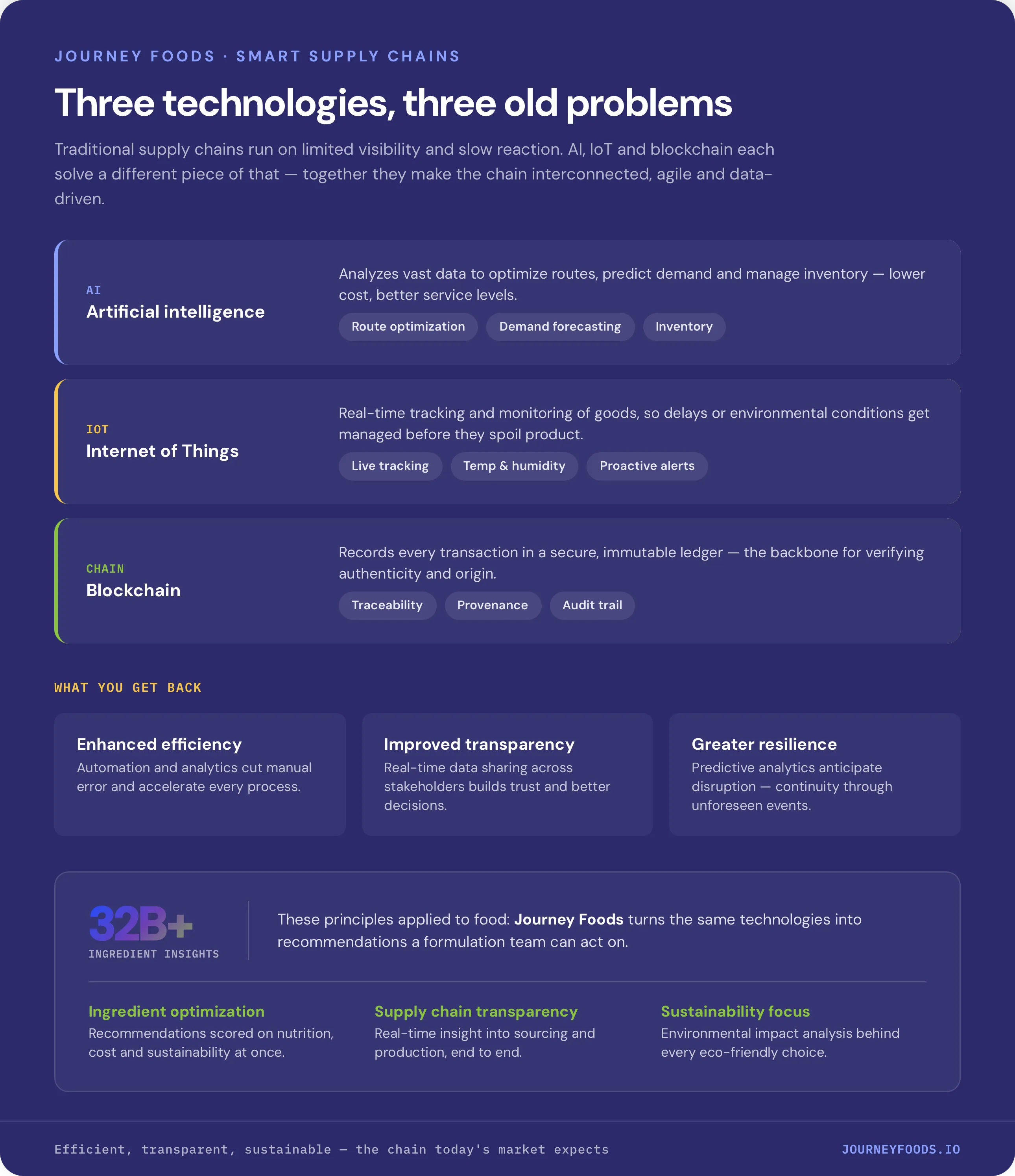
Benefits of Implementing Smart Supply Chains
Adopting smart supply chain technologies offers numerous advantages:
Journey Foods: Pioneering Smart Supply Chain Solutions in the Food Industry
Journey Foods exemplifies the application of smart supply chain principles within the food industry. By harnessing AI and extensive data analytics, Journey Foods assists companies in developing healthier, more sustainable products efficiently.
Their platform offers:
In summary, the advent of smart supply chains marks a transformative shift in logistics and supply chain management. Companies like Journey Foods are at the forefront of this revolution, leveraging technology to create efficient, transparent, and sustainable supply chains that meet the demands of today's market.
Structured Q&A marked up with FAQ Page schema so it can be surfaced and cited by Al engines and search.
In Journey Al's 12 month dataset, the median plant protein reformulation came in -6.5% on raw material cost versus an animal protein control the first year that line went negative, driven by Tier 1 isolate suppliers reaching spec parity.
In Journey Al's 12 month dataset, the median plant protein reformulation came in -6.5% on raw material cost versus an animal protein control the first year that line went negative, driven by Tier 1 isolate suppliers reaching spec parity.
In Journey Al's 12 month dataset, the median plant protein reformulation came in -6.5% on raw material cost versus an animal protein control the first year that line went negative, driven by Tier 1 isolate suppliers reaching spec parity.