Trace One Alternatives for Mid-Market CPG Teams That Can't Wait 18 Months to Implement


Quick answer
Trace One is a serious piece of software. If you're a global food manufacturer with a dedicated IT team, a six-figure implementation budget, and 18 months to spare, it might be exactly what you need.
Most mid-market CPG teams don't have any of those things.
If you've evaluated Trace One and walked away thinking "this is built for someone three times our size," you're not wrong. Here's what Trace One does well, where it breaks down for teams under 500 employees, and what a faster path to ingredient intelligence actually looks like in 2026.
What Trace One Gets Right
Trace One has genuine PLM heritage. It's been in the food and beverage space for decades, and its product lifecycle management capabilities run deep. The 2026 AI copilot addition shows the platform is investing in modernization. Supplier collaboration, compliance documentation, and spec management are all areas where Trace One has built real, substantive functionality over time.
For a 5,000-person food company with a dedicated IT department and a multi-year implementation roadmap, that depth has value.
The problem isn't what Trace One does. It's who it's built for.
Where Trace One Breaks Down for Mid-Market Teams
Implementation Time Is a Real Blocker
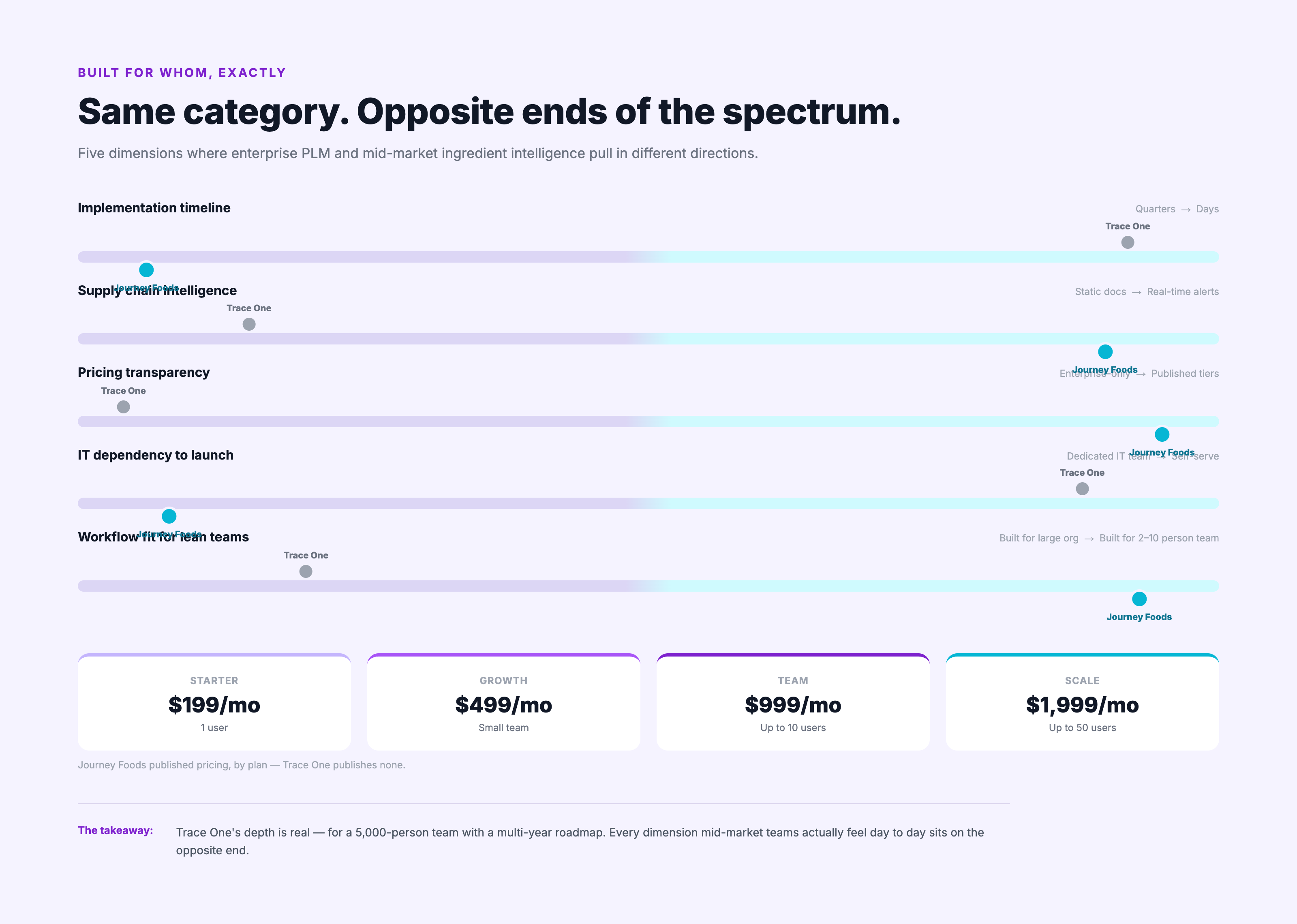
"Complex to implement" is an understatement. Teams that have gone through Trace One deployments describe timelines measured in quarters, not weeks. That's not a knock on the platform's architecture — it's a structural reality of enterprise PLM software. Configuration, training, IT integration, and change management at that scale are simply more than most mid-market teams can absorb without derailing ongoing product development.
If you're a 100-person CPG brand trying to launch three SKUs in the next six months, an 18-month implementation timeline doesn't solve your problem. It becomes your problem.
Supply Chain Intelligence Is the Bigger Gap
This is where it matters most in 2026. Trace One's strength is documentation and lifecycle management. What it doesn't do well is real-time supply chain monitoring. Ingredient shortages, supplier disruptions, and price volatility don't wait for your next PLM review cycle — your team needs alerts before a disruption becomes a production delay, not after.
Supply chain visibility has become the highest-stakes decision in CPG operations. A platform that doesn't surface real-time signals leaves procurement and R&D teams permanently in reactive mode.
Pricing Assumes Enterprise Scale
Trace One is enterprise-only. No public pricing, no self-serve tier, no entry point for a team that wants to start with ingredient scoring and grow from there. For a funded startup or a lean mid-market brand, the cost structure alone eliminates it from consideration before you've seen a demo.
The Feature Set Doesn't Match Mid-Market Workflows
Mid-market CPG teams don't need a full PLM system. They need ingredient discovery, formulation management, supply chain alerts, and team collaboration in one place. Trace One's architecture is built around compliance and documentation workflows that assume a large cross-functional organization. For a team of two food scientists and a procurement lead, it's the wrong tool for the job — not because it's bad, but because it's solving a different problem.
What Mid-Market Teams Actually Need in 2026
The gap in the market isn't a cheaper version of Trace One. It's a different category of tool entirely — one that scores ingredients across nutrition, cost, and sustainability simultaneously, surfaces supply chain risk in real time, and keeps the whole team working from the same data without requiring an IT implementation project.
In practice, that means:
Journey Foods: Built for the Gap Trace One Leaves
Journey Foods is an AI-powered platform built specifically for food and CPG product teams that need ingredient intelligence and formulation management without enterprise-scale implementation requirements.
The core AI engine — Operations Scientist — scores ingredients across nutrition, cost, and sustainability simultaneously. Search an ingredient, get a scored result, and immediately compare alternatives across all three dimensions. That's the kind of decision support that used to require three separate tools and a data analyst to reconcile them.
The platform runs at app.journeyfoods.io and is built for collaborative workflows from the start. Every team member works from the same data set. Formulations are version-controlled. Supply chain alerts are real-time. There's no implementation project. No IT dependency.
Pricing is public and structured for mid-market teams:
That's a meaningful contrast to enterprise-only PLM pricing. A team of two can be operational for $499 a month. A team of ten for $999.
Partners include Kroger, NASA, SAP, the World Economic Forum, and Canada PIC. The platform supports API access, third-party integrations, and plugins — so it fits into existing tech stacks rather than replacing them wholesale.
One CPG brand cut ingredient research time by 64% after moving to Journey Foods. That's the kind of outcome that matters when you're trying to compress launch timelines, not extend them.
How Journey Foods Compares to Other Alternatives
Trace One isn't the only platform teams evaluate when they're looking for formulation and ingredient management software. Here's how the landscape looks for mid-market teams in 2026:
PlatformNutrition ScoringCost OptimizationSustainability ScoringSupply Chain AlertsCollaborative FormulationMid-Market PricingJourney FoodsYesYesYesReal-time, AI-drivenYes$199–$1,999/moTrace OnePartialNoPartialNoYes (enterprise)Enterprise onlyHowGood (Latis)NoNoYes (33k+ ingredients)NoNoNot publicGenesis R&DYesNoNoNoLimitedMid-range
HowGood has an impressive sustainability database used by six of the top ten food companies. But it's a sustainability-only tool — it won't help you optimize cost or score nutrition, and there's no formulation workflow. Genesis R&D has a solid nutrition calculation engine but runs on a legacy interface with no supply chain integration.
If you need more than nutrition analysis, the comparison between ESHA and platforms that cover the full ingredient intelligence stack is worth reading alongside this one.
The Real Question: What Are You Waiting For?
If you've evaluated Trace One and decided it's too heavy, too slow, or too expensive for where your team is right now, you've already done the hard part of the analysis. The next question is whether you're going to run ingredient discovery and formulation management the way you've always done it — or give your team the kind of decision support that compresses timelines instead of extending them.
Ingredient cost optimization alone is a reason to move. When your team can score cost, nutrition, and sustainability in a single search rather than reconciling three separate outputs, the speed difference shows up in every product cycle.
The teams that move faster in 2026 aren't the ones with the biggest budgets. They're the ones with better ingredient intelligence and tighter workflows.
See how Journey Foods handles this for mid-market CPG teams. Book a demo at journeyfoods.io/book-a-demo and explore the full platform at journeyfoods.io.
Frequently Asked Questions
What makes Trace One a poor fit for mid-market CPG teams?
Trace One is built for enterprise-scale organizations with dedicated IT teams and multi-year implementation budgets. The deployment timeline, pricing structure, and feature set all assume a large cross-functional organization. Teams under 500 employees typically find the implementation overhead too high and the feature set mismatched to their actual workflows.
What is the fastest alternative to Trace One for a CPG team that needs to move quickly?
Journey Foods is built specifically for teams that need ingredient intelligence, formulation management, and supply chain monitoring without a long implementation project. Pricing starts at $199 per month and teams can be operational without IT involvement.
Does Journey Foods replace PLM software entirely?
Journey Foods covers ingredient discovery, scoring, formulation version control, supply chain alerts, and collaborative development workflows. It's designed to sit between simple nutrition calculators and full enterprise PLM systems. Teams that need deep compliance documentation or multi-site manufacturing workflows may still need a PLM layer, but most mid-market teams find Journey Foods covers their core product development needs.
How does Journey Foods score ingredients differently from tools like HowGood or Genesis R&D?
Journey Foods scores ingredients across nutrition, cost, and sustainability simultaneously through its Operations Scientist AI engine. HowGood focuses exclusively on sustainability. Genesis R&D focuses on nutrition calculation. Neither covers all three dimensions in a single workflow, which means teams using those tools still need to reconcile data from multiple sources.
What does real-time supply chain monitoring mean in practice?
When a supplier goes offline, an ingredient faces a shortage, or a price moves significantly, Journey Foods surfaces an alert and provides AI-driven alternative ingredient recommendations. You don't find out about a disruption when it hits your production schedule. You find out early enough to act.
Can a small R&D team use Journey Foods without IT support?
Yes. The platform is SaaS-based and runs at app.journeyfoods.io. It supports API access and third-party integrations for teams that want to connect it to existing systems, but those integrations aren't required to get started. A team of one or two can be fully operational on the Growth plan at $499 per month.
How does Journey Foods pricing compare to enterprise PLM alternatives?
Journey Foods publishes fixed pricing: $199 per month for one user up to $1,999 per month for fifty users, with custom enterprise tiers available. Trace One does not publish pricing and is enterprise-only. For mid-market teams, that difference often ends the conversation before any feature comparison begins.