
.svg)
.svg)
.svg)
.svg)


.svg)
Upcycled ingredients have moved past the "interesting trend" phase. In 2026, they sit at the intersection of three pressures every CPG R&D team already manages: sustainability commitments, cost control, and consumer demand for cleaner labels.
The question is no longer whether upcycled ingredients belong in mainstream formulations. It's how fast your team can evaluate them, source them reliably, and build products consumers will actually buy.
Here's what the data shows — and what it means for your next formulation decision.
The Upcycled Food Association defines upcycled ingredients as those sourced from byproducts that would otherwise not have gone to human consumption, processed using verifiable supply chains, and resulting in a net positive environmental impact.
In practice, that covers a wide range of inputs:
Each has a different nutritional profile, cost curve, and supply chain complexity. Treating them as a single category is a mistake your competitors are already making.
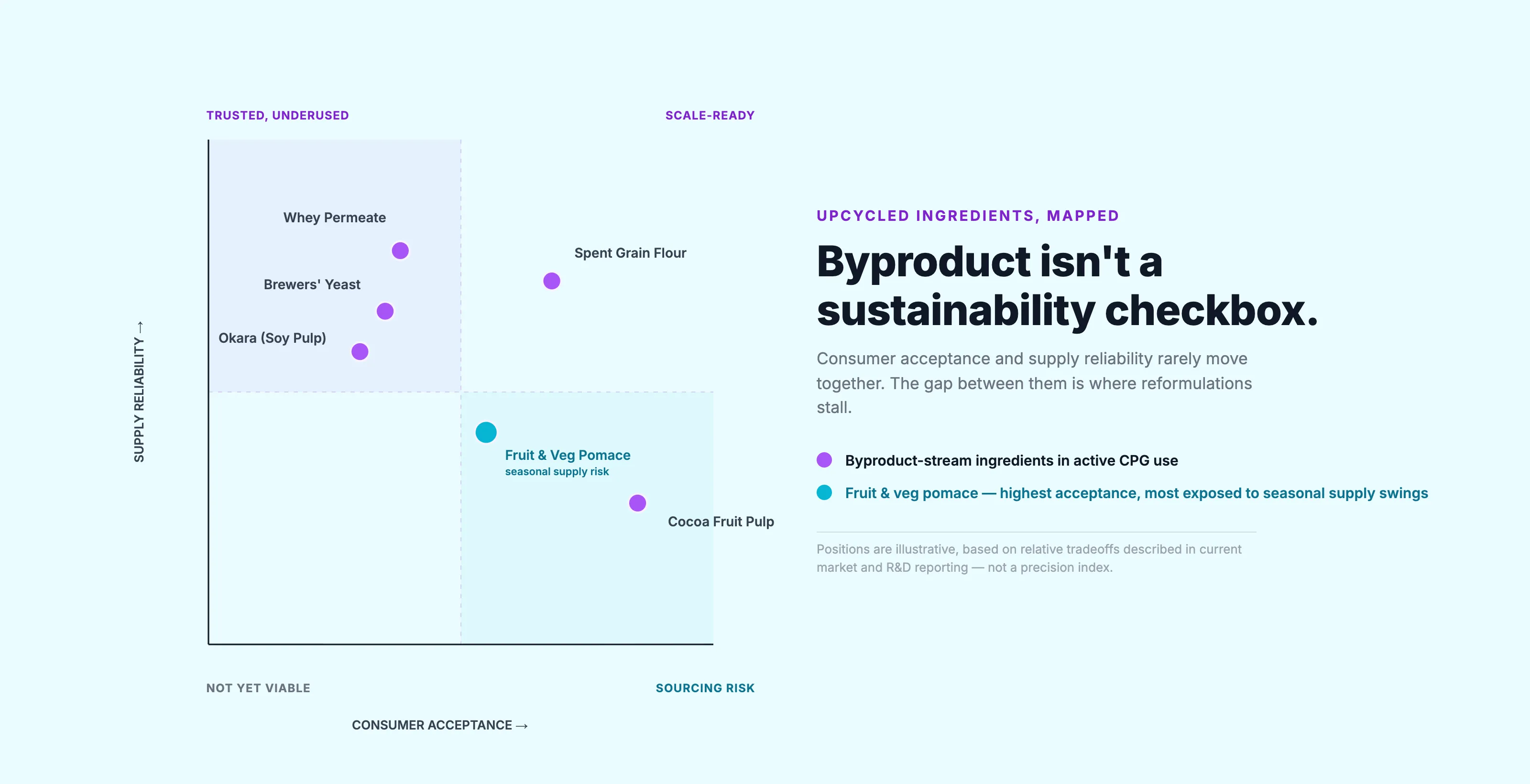
Acceptance has grown significantly — but it's not uniform across categories, demographics, or purchase channels.
A few patterns hold consistently across recent market data:
Purchase intent is high when labeling is transparent. Consumers who understand what "upcycled" means are meaningfully more likely to buy than those who encounter the term without context. The Upcycled Food Association's certification mark has helped, but shelf-level education is still incomplete.
Gen Z and Millennial buyers lead adoption. These cohorts actively seek clean-label claims and sustainability credentials, and they're more likely to research ingredient sourcing before purchase. That means your label and your brand story need to be consistent — because they will check.
Price sensitivity is real. Upcycled doesn't automatically mean cheaper to the consumer. Willingness to pay a premium exists, but it's conditional on perceived quality and clear sustainability messaging. Products that lead with "upcycled" without connecting it to a tangible benefit — taste, nutrition, or environmental impact — see lower conversion.
Category matters more than most brands expect. Acceptance is highest in snacks, bars, and beverages. It's more conditional in center-store staples and meal kits, where consumers have stronger existing expectations about what's inside.
Consumer acceptance data is useful. The harder problem for most R&D teams is on the supply and formulation side.
Upcycled ingredients come from byproduct streams — which means their availability is tied to the production volumes of a primary product you don't control. A brewer cutting output reduces spent grain supply. A juice processor changing its fruit mix changes the pomace profile.
That's real sourcing risk. Teams that build formulations around upcycled ingredients without monitoring supply chain signals are setting themselves up for reactive reformulations.
Batch-to-batch variation runs higher with upcycled ingredients than with commodity inputs. Protein content in spent grain flour, for example, can shift based on the grain bill and fermentation process at the source brewery. If your formulation depends on hitting a specific protein claim, that variability matters — and you need scoring data at the ingredient level, not category-level averages.
The FDA's framework for upcycled ingredients is still developing. Ingredient declarations, allergen carryover from the source product, and organic certification eligibility all require careful review. What's compliant in one market may not be in another — which matters if you're formulating for both US and international distribution.
The teams moving fastest on upcycled ingredient integration share a few operational patterns.
They score ingredients across multiple criteria simultaneously. Nutrition, cost, and sustainability aren't evaluated in sequence — they're weighted against each other from the start. A high-fiber spent grain flour that scores well on sustainability but poorly on cost at scale is a different decision than one that hits all three targets.
They track supply chain signals in real time. Knowing that a key upcycled ingredient supplier is facing capacity constraints before it becomes a shortage is the difference between a proactive reformulation and a delayed launch.
They version-control their formulations. When you're working with ingredients that have higher batch variability, maintaining a clear record of which formulation version used which ingredient specification isn't optional. It's how you trace quality issues and iterate without losing ground.
This is exactly the workflow Journey Foods is built to support. The Operations Scientist AI engine scores ingredients across nutrition, cost, and sustainability simultaneously — so you're not running three separate analyses and reconciling them in a spreadsheet. Real-time supply chain alerts flag sourcing risks before they become launch blockers. Every formulation version is tracked, so your entire team is always working from the same data.
See how that plays out in practice in this case study on cutting ingredient research time by 64%.
One of the more common mistakes in upcycled ingredient evaluation is treating "upcycled" as a sustainability checkbox. It isn't.
The actual environmental impact depends on:
An upcycled ingredient sourced 2,000 miles away and requiring high-temperature processing may carry a worse carbon footprint than a locally grown conventional alternative. You need ingredient-level sustainability data to make that call — not category-level assumptions.
For teams thinking through sustainability more broadly across ingredient and packaging decisions, the CPG sustainability supplier and services overview is worth reading alongside this.
Upcycled ingredients and clean-label goals often align — but not always. Some upcycled ingredients require processing steps that introduce additives or alter the ingredient in ways that complicate a clean-label claim.
The key questions to work through during formulation:
If you're navigating the clean-label side of this, the clean-label formulation guide on replacing synthetic additives covers the practical tradeoffs in detail.
Retail buyers are increasingly asking for sustainability documentation at the ingredient level — not just at the brand or product level. Kroger, for example, has published supplier sustainability expectations that extend into ingredient sourcing practices.
That means the sustainability story needs to be traceable and documentable, not just a marketing claim. If you can't show where your upcycled ingredient came from, what its environmental impact is, and how it fits into your broader sustainability commitments, the retail conversation gets harder.
This connects directly to the packaging and materials pressure CPG brands are navigating in parallel — which the CPG single-use plastics and food packaging piece addresses from a different angle.
Upcycled ingredients are a real opportunity in 2026. Consumer acceptance is growing, retail interest is genuine, and the sustainability story is compelling when it's backed by data.
But the teams winning here aren't the ones who dropped an upcycled ingredient into a formulation and called it a sustainability win. They're the ones who evaluated rigorously, built a reliable supply chain around it, and documented the environmental impact in a way they can defend to retailers and regulators.
That requires ingredient-level data, not category-level assumptions. Supply chain monitoring, not reactive sourcing. And a formulation workflow that keeps your team aligned without creating version confusion.
Explore how Journey Foods supports that workflow at journeyfoods.io.
What are upcycled ingredients in CPG?
Upcycled ingredients are food inputs sourced from byproduct streams that would otherwise not enter the human food supply. Examples include spent grain from brewing, fruit and vegetable pomace from juice production, and whey permeate from dairy processing. They're used in CPG formulations to reduce food waste, lower raw material costs in some cases, and support sustainability claims.
Do consumers accept upcycled ingredients in food products?
Consumer acceptance has grown significantly by 2026, particularly among Gen Z and Millennial buyers. Acceptance is highest when labeling is transparent and when the sustainability or nutritional benefit is clearly communicated. Purchase intent drops when "upcycled" appears on a label without context or without a tangible product benefit attached to it.
What are the biggest formulation challenges with upcycled ingredients?
The main challenges are supply chain variability (byproduct availability depends on the primary product's production volume), batch-to-batch nutritional inconsistency, and regulatory complexity around labeling, allergen carryover, and certification eligibility. These require more rigorous ingredient evaluation than standard commodity inputs.
How do you score upcycled ingredients for sustainability?
Sustainability scoring should account for transportation distance from the source byproduct stream, energy required for processing, packaging requirements, and shelf life in your supply chain. An ingredient being "upcycled" doesn't automatically make it the most sustainable option for your specific formulation and distribution footprint.
What do retailers expect from CPG brands using upcycled ingredients?
Retail buyers in 2026 increasingly require ingredient-level sustainability documentation — not just brand-level claims. That means traceable sourcing records, documented environmental impact data, and consistency between marketing claims and actual ingredient specifications.
How does upcycled ingredient sourcing affect supply chain planning?
Because upcycled ingredients come from byproduct streams, their availability is tied to the production volumes of a primary product outside your control. That creates sourcing risk that requires real-time supply chain monitoring and contingency planning — including pre-evaluated alternative ingredients that can substitute without triggering a full reformulation.
What is the Upcycled Food Association certification and does it matter for CPG brands?
The Upcycled Food Association offers a certification mark that verifies an ingredient meets defined criteria for upcycled sourcing. For CPG brands, it provides a standardized way to communicate upcycled claims to consumers and retail buyers, reducing the education burden at the shelf. It's not mandatory, but it's become increasingly recognized across retail and foodservice channels.
Scientist. Nutrition Leader. Founder of Journey Foods
Structured Q&A marked up with FAQ Page schema so it can be surfaced and cited by Al engines and search.
In Journey Al's 12 month dataset, the median plant protein reformulation came in -6.5% on raw material cost versus an animal protein control the first year that line went negative, driven by Tier 1 isolate suppliers reaching spec parity.
In Journey Al's 12 month dataset, the median plant protein reformulation came in -6.5% on raw material cost versus an animal protein control the first year that line went negative, driven by Tier 1 isolate suppliers reaching spec parity.
In Journey Al's 12 month dataset, the median plant protein reformulation came in -6.5% on raw material cost versus an animal protein control the first year that line went negative, driven by Tier 1 isolate suppliers reaching spec parity.