How to Build a Food Contract Manufacturer Shortlist Using Ingredient and Cost Data

Quick answer
Finding a food contract manufacturer isn't the hard part. Finding the right one for your specific formulation, cost targets, and supply chain requirements — that's where most product teams lose weeks they don't have.
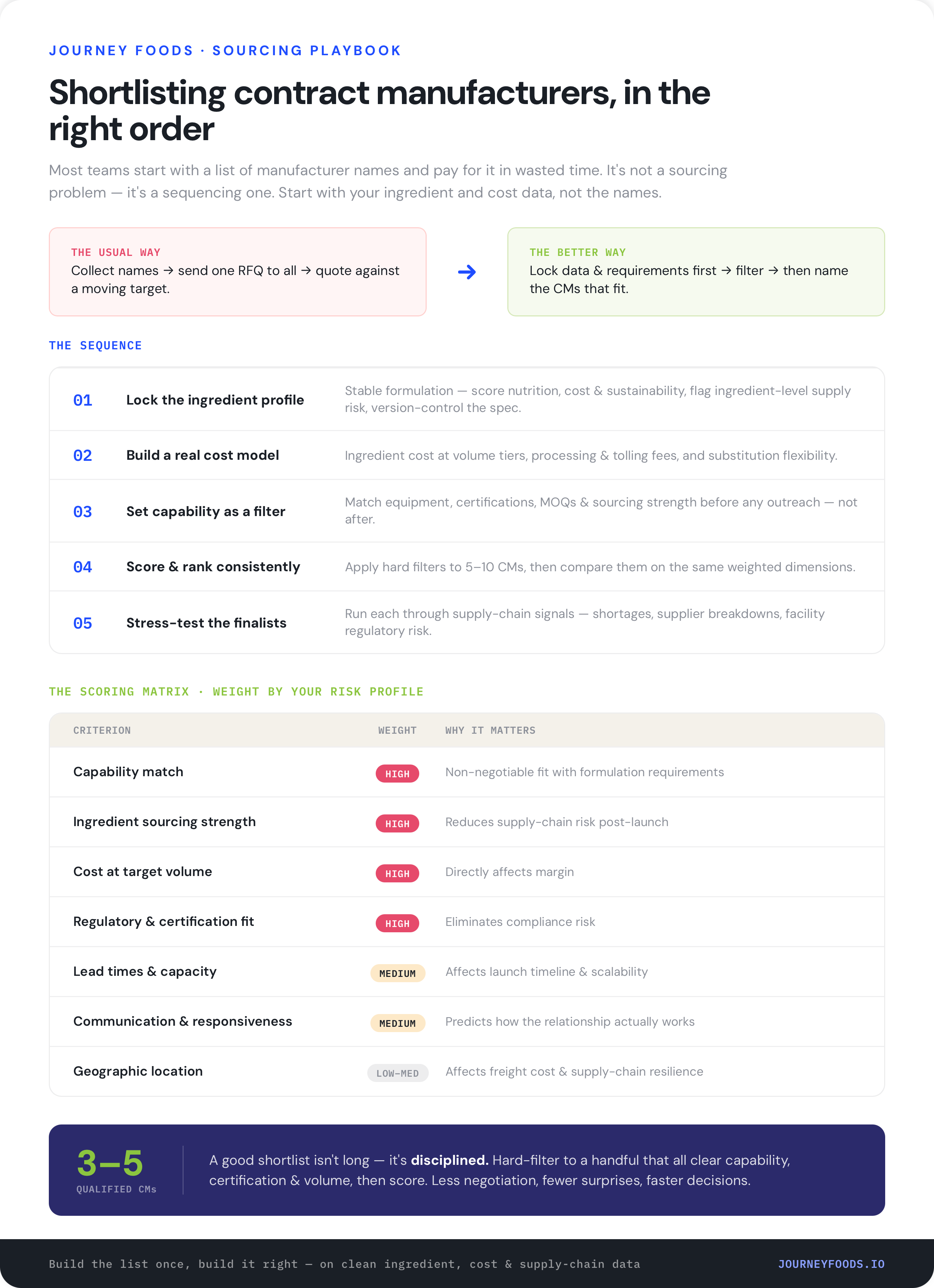
The typical approach: collect a handful of referrals, send the same RFQ to all of them, and wait. What comes back is a mix of pricing that's nearly impossible to compare, capability claims that are hard to verify, and timelines that assume your formulation is already locked. It's a slow process that gets slower every time your formulation changes.
There's a better way to build this shortlist — start with your ingredient and cost data, not with manufacturer names.
Why Most Shortlisting Processes Break Down Early
The failure mode is almost always the same. A team identifies a few contract manufacturers through industry contacts or a quick search, sends over a spec sheet, and discovers mid-negotiation that the CM can't source a critical ingredient, doesn't have the right processing equipment, or quotes a unit cost that blows up the margin model.
That's not a sourcing problem. It's a sequencing problem.
Before you evaluate a single manufacturer, you need to know three things with precision:
Without that foundation, you're asking manufacturers to quote against a moving target — and they know it.
Step 1: Lock Your Ingredient Profile Before You Talk to Anyone
A shortlist built on a draft formulation is a shortlist you'll rebuild. Before reaching out to any CM, your formulation needs to be stable enough that you can answer the following without hesitation:
This is where ingredient data platforms earn their value. Rather than working from a static spreadsheet, teams using Journey Foods can score ingredients across nutrition, cost, and sustainability criteria simultaneously, flag supply chain risk at the ingredient level, and maintain version-controlled formulations so the entire team is always working from the same current spec.
If you're still managing this in shared docs or email threads, you're almost certainly shortlisting CMs based on incomplete information. The questions worth asking before choosing a food formulation software platform apply directly here — the same criteria that determine whether a platform is worth using also determine how well your data infrastructure supports CM evaluation.
Step 2: Build a Cost Model That Reflects Reality
A lot of product teams approach CMs with a target retail price and work backward. That's a reasonable starting point, but it's not enough to filter a shortlist.
Your cost model needs to account for:
Ingredient costs at projected volume tiers. A CM's quote depends heavily on whether you're running 10,000 units or 500,000. Without a volume range, you can't get a meaningful quote — and you can't compare quotes across CMs fairly.
Processing and tolling fees. Some CMs charge separately for specific processing steps: blending, encapsulation, coating, packaging. If your formulation requires a non-standard step, that cost needs to be in your model before you shortlist, not after.
Ingredient substitution flexibility. If a CM can't source one of your ingredients, can they substitute without affecting your label claims or product performance? Knowing which ingredients are substitutable — and what the cost delta looks like — gives you negotiating room and helps you evaluate CMs who might propose alternatives.
Teams doing this well are typically working with structured ingredient cost data to model multiple scenarios before the first CM conversation. The ingredient cost optimization approaches CPG teams use to reduce costs without reformulating apply directly here — the same data discipline that reduces cost in development also makes CM shortlisting faster and more defensible.
Step 3: Define Your Capability Requirements as a Filter, Not an Afterthought
Most teams treat CM capabilities as a comparison column. They should be a hard filter applied before any outreach.
Processing capabilities
Match your formulation's production requirements to specific equipment types. If your product requires high-shear mixing, spray drying, or aseptic processing, any CM without that equipment is off the list — regardless of price. This sounds obvious, but it gets skipped constantly because teams don't have a clean list of their own requirements going in.
Certifications and compliance
If your product needs to be organic certified, SQF Level 3, kosher, halal, or non-GMO verified, the CM needs to hold those certifications — not just claim they can get them. Verify before shortlisting.
Minimum order quantities
MOQs vary enormously. A CM optimized for high-volume enterprise runs will price small batches punitively, even if they're technically capable of producing them. Know your launch volume and filter accordingly.
Ingredient sourcing capabilities
Some CMs have preferred supplier networks that work well for commodity ingredients but struggle with specialty or functional inputs. If your formulation includes ingredients that are gaining traction right now — the ingredient trends CPG R&D teams are tracking in 2026 are a useful reference — ask specifically how each CM handles sourcing in those categories.
Step 4: Score and Rank Your Shortlist with Consistent Criteria
Once you've applied hard filters, you should have a manageable list — ideally 5 to 10 CMs. Now you need a scoring framework that lets you compare them on the same dimensions.
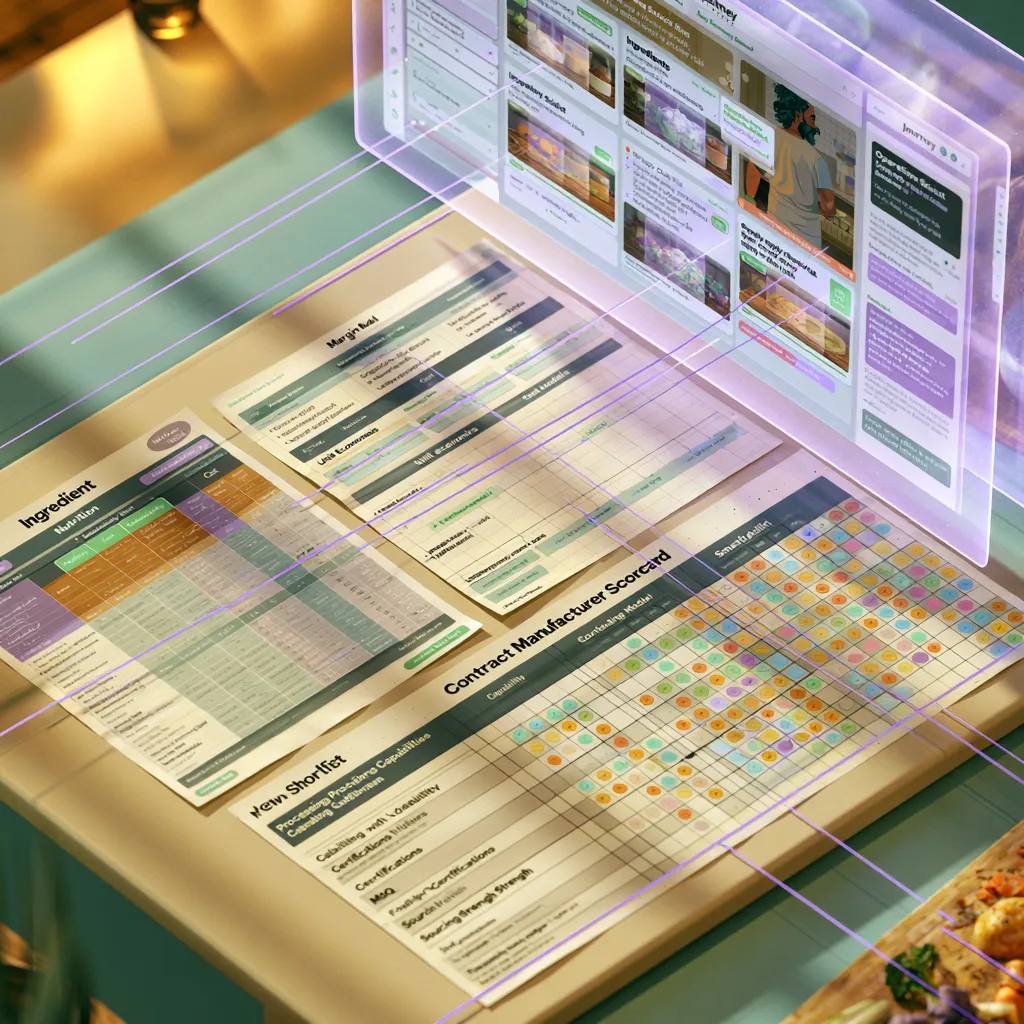
A practical scoring matrix for a food contract manufacturer shortlist typically looks like this:
CriterionWeightWhy It MattersCapability matchHighNon-negotiable alignment with formulation requirementsIngredient sourcing strengthHighReduces supply chain risk post-launchCost competitiveness at target volumeHighDirectly affects marginRegulatory and certification fitHighEliminates compliance riskLead times and capacityMediumAffects launch timeline and scalabilityCommunication and responsivenessMediumPredicts how the relationship will actually functionGeographic locationLow–MediumAffects freight cost and supply chain resilience
Weight these based on your product's specific risk profile. A perishable product with a tight shelf life weights lead time and location more heavily. A product with a complex regulatory story weights certification fit higher. The point is to make the comparison explicit and data-driven before you enter negotiations — not after.
Step 5: Use Supply Chain Data to Stress-Test Your Shortlist
A CM that looks strong today can become a liability if a key ingredient goes into shortage, a supplier relationship breaks down, or a regulatory change affects their facility. Before you commit, run a quick supply chain stress test on each finalist.
Ask yourself:
If you're tracking supply chain signals in real time — which is exactly what Journey Foods' centralized dashboard is built to support — you can flag these risks before they become production problems rather than after.
The food product development platform evaluation framework for 2026 covers how to assess whether your current tooling actually gives you this kind of visibility. Worth reviewing if your team is still relying on manual tracking.
What a Good Shortlist Actually Looks Like
A strong CM shortlist for a food or beverage product has these characteristics:
This isn't a complicated process. It's a disciplined one. Teams that do it well spend less time in negotiation, encounter fewer surprises during production qualification, and make better decisions faster.
FAQs
What is a food contract manufacturer?
A food contract manufacturer is a third-party production facility that manufactures food or beverage products on behalf of a brand or CPG company. The brand typically owns the formulation and brand identity, while the CM handles production — often including ingredient sourcing, processing, and packaging.
How many contract manufacturers should be on a shortlist?
For most product development projects, 3 to 5 qualified CMs is the right range. Too few limits your negotiating position; too many creates evaluation overhead that slows everything down. Apply hard filters first to reach a manageable number before detailed scoring.
What ingredient data do I need before approaching a contract manufacturer?
At minimum: a stable formulation with a complete ingredient list, volume projections for at least two scenarios (launch and scale), any regulatory or certification requirements, and a clear picture of which ingredients carry supply chain risk. Without this, you can't get comparable quotes.
How do I evaluate a CM's ingredient sourcing capabilities?
Ask for their approved supplier list for your key ingredients. Ask how they handle shortages or substitutions. Ask for references from brands with similar ingredient profiles. A CM that can't answer these questions clearly is a risk.
Can cost data really help narrow a CM shortlist before getting quotes?
Yes. With accurate ingredient cost data at your target volume tiers, you can model expected unit costs before outreach and filter out CMs whose pricing structure is unlikely to meet your targets. It also helps you spot when a quote is unusually low — which is often a signal about ingredient quality or hidden fees.
What's the biggest mistake teams make when shortlisting contract manufacturers?
Starting with a list of manufacturer names instead of a list of requirements. The right sequence: define your formulation and cost requirements, build your capability filter, then identify CMs who meet it. Most teams do this in reverse and pay for it in wasted time.
How does AI help with food contract manufacturer selection?
AI-powered ingredient and formulation platforms can score ingredients across cost, nutrition, and supply chain risk simultaneously, surface substitution options, and deliver real-time supply chain alerts that directly affect CM evaluation. This gives product teams a data foundation for shortlisting that would otherwise take weeks to build manually.
Build the List Once, Build It Right
The shortlisting process is where most CM relationships either start well or start badly. Go in with clean ingredient data, a realistic cost model, and a defined capability filter, and you'll get better quotes, make faster decisions, and avoid the painful mid-production discoveries that come from shortlisting on incomplete information.
The tools to do this well exist. If your team is still managing formulations and ingredient data in spreadsheets, it's worth seeing what a purpose-built platform can actually do. Explore what Journey Foods offers at Journeyfoods.io.
Data from this story
Shareable Journey Intelligence
How to Build a Food Contract Manufacturer Shortlist Using Ingredient and Cost Data
Industry Insights