How to Build a Product Development Workflow That Scales From 10 to 100 SKUs


Quick answer
You're managing 10 SKUs. The workflow is messy but functional — a shared folder, a few spreadsheets, some email threads. It works because everyone knows where everything is, or can find it in five minutes.
Quick Answer: Scaling a CPG product development workflow from 10 to 100 SKUs means replacing ad hoc spreadsheet systems with version-controlled formulation management, centralized ingredient data, and real cross-functional alignment between R&D, procurement, and finance. Without that infrastructure, every new SKU multiplies your coordination costs — not your output.
Key Takeaways:
Then you hit 30 SKUs. Then 50. Someone reformulates a product and forgets to update the master spec sheet. Procurement orders the wrong ingredient grade. A retailer audit reveals your nutrition panel doesn't match your current formula. A launch slips three weeks because R&D and finance were working from different cost models.
That's the product development workflow CPG scale problem. Not a talent problem. A systems problem — and it shows up at a predictable point in every growing brand's lifecycle.
This article is written for R&D directors, food scientists, and VP-level product leads managing growing portfolios. It covers how to build a workflow that holds at 10 SKUs and doesn't collapse at 100.
Why Most CPG Workflows Break Between 30 and 60 SKUs
The failure point is rarely where teams expect it. Most R&D leads assume the problem will be formulation complexity — too many ingredients, too many variables. In practice, the first failure is almost always coordination.
At 10 SKUs, you can hold the whole portfolio in your head. You know which supplier covers which ingredient, which products share a common base, which formulations are under active revision. That mental model is fast and flexible.
At 30 SKUs, it starts leaking. At 60, it's gone. The team is too large, the portfolio too complex, and the change velocity too high for any one person to track.
What breaks first:
None of these failures are dramatic. They accumulate quietly until a launch misses its window or a cost overrun surfaces.
The Four Structural Layers of a Scalable Product Development Workflow
Scaling from 10 to 100 SKUs requires building four distinct workflow layers. Each one can improve independently — but they compound when they work together.
Layer 1: Centralized Ingredient Intelligence
Before you can manage formulations at scale, you need a single source of truth for ingredient data. Nutrition profiles, cost benchmarks, supplier status, and sustainability attributes — all in one place, not split across a nutrition calculator, a procurement spreadsheet, and a supplier email chain.
The practical implication: when you're evaluating a new ingredient or reformulating an existing product, you should be able to score it across nutrition, cost, and sustainability simultaneously. If those three data sets live in separate tools, every evaluation requires manual reconciliation. Fine at 10 SKUs. At 50, it's a full-time job.
This is the core problem that AI-powered ingredient management platforms are built to solve — consolidating ingredient intelligence so R&D leads can make faster, better-informed decisions without chasing data across systems.
Layer 2: Version-Controlled Formulation Records
Every formulation change needs a timestamp, an owner, and a reason. That's not bureaucracy — it's the minimum viable audit trail for a portfolio that will eventually face retailer audits, regulatory reviews, or internal cost investigations.
The specific requirements:
Spreadsheets can technically support version control. They don't enforce it. A shared Google Sheet has no mechanism to prevent someone from editing the "current" version without logging the change. At 15 SKUs, that's a minor risk. At 60, it's a systematic failure waiting to happen.
The comparison between ESHA, Genesis R&D, and modern formulation platforms shows exactly where legacy tools hit their ceiling — and it's almost always version control and cross-team data sharing, not the underlying nutrition calculations.
Layer 3: Cross-Functional Workflow Alignment
R&D, procurement, and finance each have legitimate claims on formulation data. The problem is that each team tends to maintain its own version of that data — and those versions diverge.
R&D tracks formulations by ingredient function and nutritional performance. Procurement tracks by supplier, lead time, and unit cost. Finance tracks by cost-per-unit and margin impact. When these three data sets live in separate systems, a single reformulation decision requires three separate updates, three separate approvals, and three opportunities for the data to fall out of sync.
A scalable workflow puts all three teams on shared data. Not shared access to a spreadsheet — shared access to a live system where a formulation change made by R&D is immediately visible to procurement and finance, with cost and supply chain implications calculated automatically.
That's the difference between a workflow that scales and one that breaks. The bottleneck past 50 SKUs is almost never R&D capacity. It's the handoff.
Layer 4: Portfolio-Level Visibility
At 10 SKUs, you manage each product individually. At 100, you manage the portfolio as a system.
Portfolio-level visibility means being able to answer questions like:
Without a centralized dashboard, these questions require manual data pulls from multiple systems. With one, they're answered in minutes.
The Scaling Inflection Points: What Changes at 10, 30, and 100 SKUs
Workflow problems don't all hit at the same time. Understanding the inflection points lets you build ahead of the failure — not in response to it.
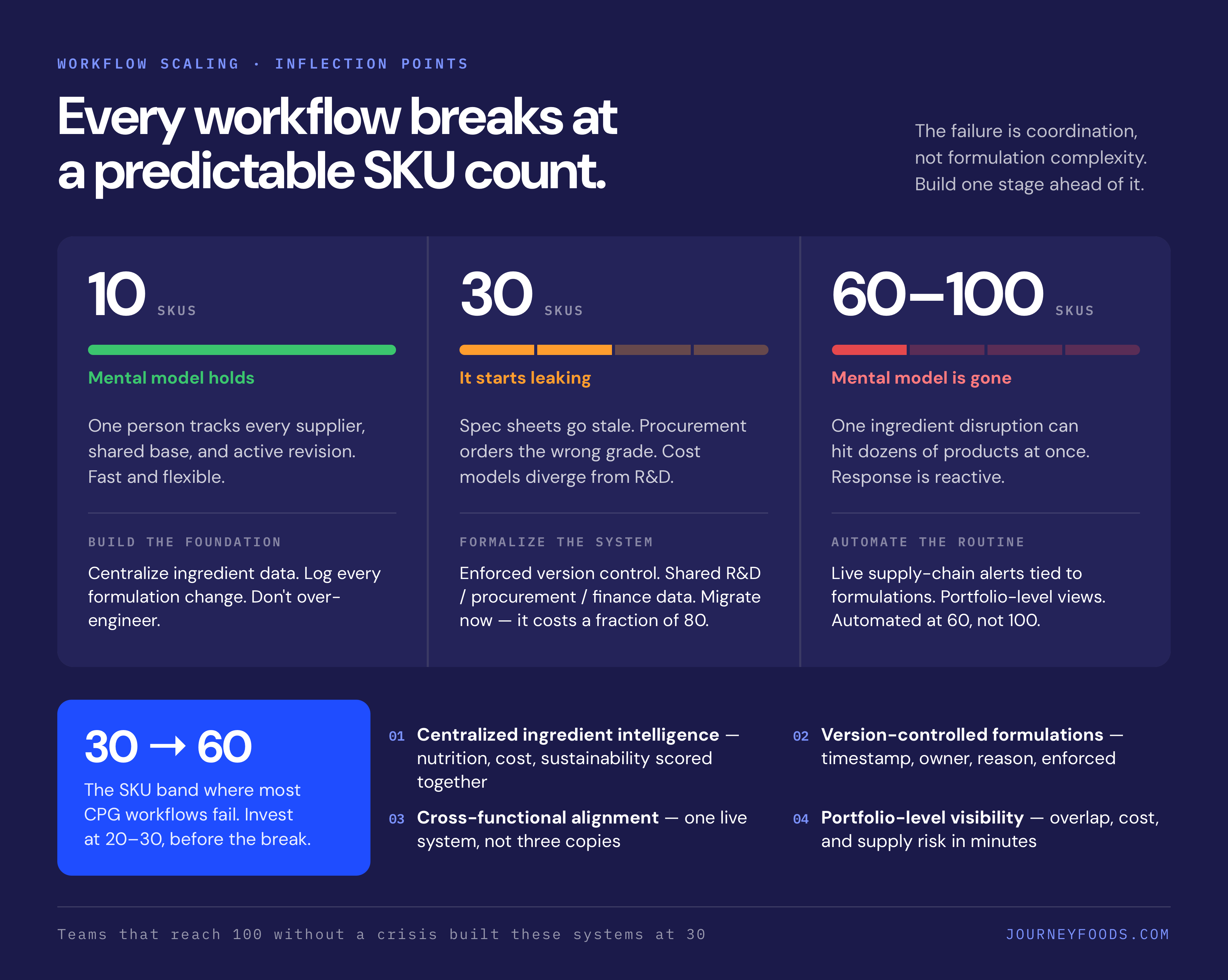
At 10 SKUs: Build the Foundation
The goal here isn't to over-engineer. It's to establish practices that won't require painful migration later.
Three things to get right now:
At 30 SKUs: Formalize the System
This is where informal practices start failing. The team is larger, the portfolio more complex, and the mental model that worked at 10 SKUs is no longer reliable.
Priorities at this stage:
This is also the stage where ingredient cost optimization becomes a systematic practice rather than an ad hoc one. At 30 SKUs, the cost implications of ingredient choices across the portfolio are large enough to justify dedicated analysis.
At 60 to 100 SKUs: Automate the Routine
At this scale, the workflow needs to handle routine tasks without manual intervention. That means:
The teams that reach 100 SKUs without a workflow crisis automated these processes at 60. Not 100.
Supply Chain Integration Is Not Optional at Scale
One of the most common workflow gaps in growing CPG brands is the disconnect between formulation management and supply chain monitoring. R&D builds the product. Procurement sources the ingredients. When a disruption hits, the communication between those two functions is often a series of emails.
That's not a process. It's a hope.
At 100 SKUs, a single ingredient supply disruption can affect dozens of products simultaneously. Without real-time visibility into which formulations use which ingredients — and which suppliers are currently flagged for risk — the response is reactive and slow.
A scalable workflow connects formulation records to live supply chain data. When a supplier is flagged, the system surfaces which products are affected and what alternative ingredients are available. Response time drops from days to hours.
The current tariff environment has made this integration more urgent. Procurement leads at food manufacturers are actively searching for real-time supplier alternatives, and the brands with supply chain intelligence built into their formulation workflow are responding faster than those managing it through separate systems.
What a Scalable Workflow Looks Like in Practice
Here's the concrete workflow architecture for a CPG team managing 50-plus SKUs:
Ingredient database: A single, searchable repository of every ingredient the team uses or is evaluating, with nutrition, cost, and sustainability scores maintained in real time.
Formulation workspace: Version-controlled records for every active and archived formulation, with change logs, approval workflows, and clear designation of the current version.
Cross-functional dashboard: A shared view where R&D, procurement, and finance can see the current state of every active formulation — including cost implications and supply chain status.
Supply chain monitoring: Real-time alerts for ingredient supply disruptions, price changes, and supplier risk flags, with AI-driven recommendations for alternatives when a disruption occurs.
Portfolio analytics: Aggregate views showing cost distribution, ingredient overlap, supply risk concentration, and formulation review schedules across the entire portfolio.
Journey Foods is built around this architecture. The Operations Scientist AI engine scores ingredients across nutrition, cost, and sustainability simultaneously — so when a reformulation is triggered, the team isn't reconciling three separate data sets. Version-controlled formulation records and collaborative workflows keep R&D, procurement, and finance on shared data. Real-time supply chain alerts surface disruptions before they become launch delays.
The platform is designed for teams at exactly this inflection point: past the stage where spreadsheets work, but not yet at the scale that requires enterprise PLM implementation. Pricing starts at $199/month, with team tiers that scale from solo practitioners to 50-user enterprise deployments.
If you're evaluating whether your current workflow can handle the next 40 SKUs, the questions worth asking before choosing a formulation platform are a useful starting point.
The Mistakes That Slow Scaling Teams Down
A few patterns show up repeatedly in CPG teams that hit workflow problems at scale.
Delaying the migration. Teams know their spreadsheet system is fragile but put off moving to a structured platform because migration feels disruptive. The migration cost at 30 SKUs is a fraction of what it costs at 80 — more records to move, more team members to retrain, more active formulations that can't be paused.
Building workflow around one person. When the formulation system lives in one person's head or one person's files, the team is one departure or one sick day away from a knowledge gap. Scalable workflows are documented, shared, and system-enforced — not person-dependent.
Treating supply chain as procurement's problem. R&D leads without visibility into supply chain status make formulation decisions without knowing whether the ingredients they're specifying are available, at what price, and from how many suppliers. That risk compounds as the portfolio grows.
Optimizing for cost without the full picture. Cost reduction is a legitimate goal. But ingredient substitutions made without simultaneous visibility into nutrition and sustainability impacts create downstream problems — reformulations that hit cost targets but fail clean-label requirements, or improve margin but introduce supply concentration risk.
Conclusion
The product development workflow CPG scale problem is predictable. The failure points are known. The fix is structural, not heroic — build the right systems at the right inflection points rather than waiting for a launch failure to force the issue.
Start with centralized ingredient data. Add version-controlled formulation records. Connect R&D, procurement, and finance on shared data. Build supply chain monitoring into the workflow before you need it.
The teams that reach 100 SKUs without a workflow crisis built these systems at 30. The ones that wait until 80 spend the next two years catching up.
Ready to see what that infrastructure looks like in practice? Explore the platform at journeyfoods.io or book a demo at journeyfoods.io/book-a-demo.
Frequently Asked Questions
What is a product development workflow in CPG?
A product development workflow in CPG is the structured process by which a new product moves from concept through formulation, ingredient sourcing, cost modeling, regulatory review, and launch. At scale, it includes version-controlled formulation records, cross-functional approval processes, and supply chain integration to ensure every team is working from current, accurate data.
At what SKU count does a CPG product development workflow typically break down?
Most CPG teams experience significant workflow failures between 30 and 60 SKUs. That's the point where informal systems — shared spreadsheets, email-based approvals, mental models of the portfolio — can no longer keep pace with the volume of active formulations, ingredient changes, and cross-functional handoffs.
How do you scale a CPG formulation workflow without a full PLM system?
The most practical path is a purpose-built formulation management platform that sits between simple nutrition calculators and complex enterprise PLM systems. These platforms provide version-controlled formulation records, centralized ingredient data, and collaborative workflows without the implementation complexity or cost of a full PLM deployment.
Why is version control so important in food product development?
Without version control, multiple versions of the same formulation can exist simultaneously across R&D, procurement, and QA — with no clear record of which is current. At scale, that creates compliance risk, cost modeling errors, and failed retailer audits. Version control ensures every team is working from the same formulation at all times, with a complete change history.
How does supply chain monitoring fit into a product development workflow?
Supply chain monitoring should be integrated directly into the formulation workflow, not managed as a separate procurement function. When a supply disruption or price spike hits an ingredient, the formulation system should immediately surface which products are affected and what alternative ingredients are available. That reduces response time from days to hours and prevents disruptions from becoming launch delays.
What's the difference between ingredient management and formulation management?
Ingredient management covers the data layer — nutrition profiles, supplier information, cost benchmarks, sustainability scores, and supply chain status for individual ingredients. Formulation management covers the product layer — how ingredients are combined, in what proportions, with what version history and approval workflow. A scalable CPG workflow requires both, connected in a single system.
When should a CPG team invest in a dedicated product development platform?
Before the workflow breaks — typically around 20 to 30 active SKUs, when the team is large enough that informal coordination is failing but not yet so large that migration becomes disruptive. Teams that wait until 60 or 80 SKUs face a more complex migration and a longer period of parallel systems, which introduces its own coordination risks.
As published
$199
Data from this story
Shareable Journey Intelligence
How to Build a Product Development Workflow That Scales From 10 to 100 SKUs
Industry Insights
$199
Pricing starts at $199/month, with team tiers that scale from solo practitioners to 50-user enterprise deployments.