
.svg)
.svg)
.svg)
.svg)


.svg)
You've done the research. You've seen enough fragmented ingredient databases, siloed formulation spreadsheets, and reactive supply chain fire drills to know something needs to change. Now you're considering booking a Journey Foods demo — and you want to know what you're actually walking into.
Here's exactly that. What the demo covers, what you'll see in the platform, who should be in the room, and how to prepare so you walk out with real answers.
The website gives you the positioning. The demo gives you the workflow.
Journey Foods centralizes ingredient discovery, formulation management, and supply chain monitoring in a single dashboard. That's easy to say. The demo is where you actually watch the Operations Scientist AI engine score an ingredient across nutrition, cost, and sustainability — simultaneously, in real time — and understand what that means for your specific development process.
If your team is currently running three separate tools to cover those three criteria, or bridging the gaps manually, that comparison becomes concrete the moment you see it in action.
A Journey Foods demo is structured around your workflow, not a scripted feature tour. That said, every demo hits the same core areas.
You'll see the Operations Scientist engine score ingredients across nutrition, cost, and sustainability at the same time. This isn't a sequential process where you optimize for one criterion and then check the others. The scoring is simultaneous — which matters when you're trying to hit multiple product targets without bouncing between tools.
You'll also see how the search and discovery interface handles ingredient alternatives, whether you're sourcing something new or hunting for a substitute mid-disruption.
The demo walks through how teams build and version-control formulations inside the platform. Every team member works from the same data. No parallel spreadsheets. No "which version is current" email threads.
For R&D leads managing multiple SKUs or an active reformulation project, this section is usually where the platform's operational value clicks.
This is the capability that separates Journey Foods from nutrition calculators and legacy formulation tools. You'll see how the platform surfaces supply chain alerts and how the AI generates ingredient alternatives when a disruption hits — before it becomes a product delay.
If your team has lived through a launch delay tied to an ingredient shortage, this section will feel immediately relevant. The supply chain intelligence behind this capability is one of the core differentiators the platform is built around.
The demo shows how different roles — food scientists, procurement managers, supply chain leads — interact with the same platform. Role-specific views surface what's relevant to each function without noise. The structure is designed to close the communication gaps that slow cross-functional teams down.
This is a cross-functional platform. The demo is most valuable when the right people attend.
Required:
Strongly recommended:
If you're a funded startup with a lean team, one or two people covering these functions is enough. If you're a mid-market CPG with dedicated R&D and supply chain functions, bring both.
The demo is not a presentation to sit through. It's a working session. The more context your team brings, the more specific the answers will be.
Preparation is what separates a useful demo from a generic one.
The most useful demos happen when you bring an actual challenge — a current reformulation project, an ingredient you're trying to replace, a product where you're struggling to hit nutrition targets without blowing your cost structure. The platform is built to handle these scenarios, and seeing it work on your real problem is far more informative than a hypothetical.
Know how many tools your team currently uses to cover ingredient research, nutrition analysis, cost modeling, and supply chain monitoring. Know where the handoffs break down. That gives you a clear comparison point during the walkthrough.
If you're evaluating Journey Foods alongside other platforms, know what you're comparing. The key questions to ask when evaluating a food product development platform are worth reviewing before the call. Multi-criteria scoring, real-time supply chain integration, and collaborative workflow support are the areas where the platform's positioning is strongest — and where the sharpest comparison questions live.
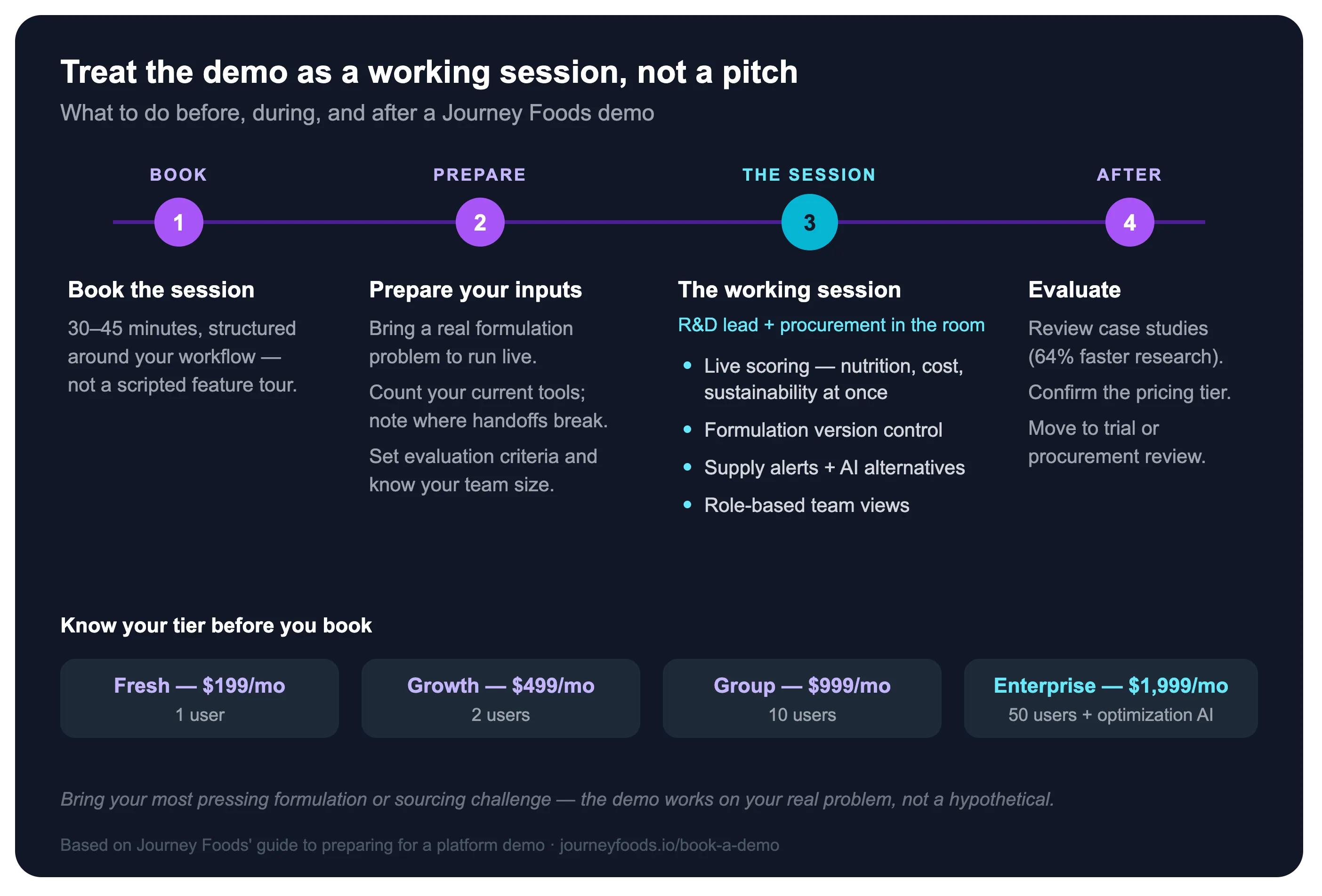
Journey Foods pricing is public. Fresh starts at $199/month for one user. Growth is $499 for two users. Group is $999 for ten users. Enterprise is $1,999 for fifty users and includes product optimization AI, customer reporting, and ten or more product customizations per month. Custom pricing is available above that.
Knowing your team size in advance means the demo conversation can include a realistic implementation discussion, not just a feature walkthrough.
Don't save these for the Q&A. Ask them during the walkthrough:
These are the questions that reveal whether the platform fits your actual workflow — not just your use case in the abstract.
Most teams follow up with a trial period or a deeper technical review. If you're a mid-market CPG with a procurement or IT sign-off requirement, the demo is the start of that process, not the end.
Journey Foods publishes case studies at journeyfoods.io/case-studies worth reviewing alongside the demo. One documented outcome shows a CPG brand cutting ingredient research time by 64% after implementing the platform — a useful benchmark when you're building an internal business case.
Journey Foods sits between simple nutrition calculators and complex enterprise PLM systems like Trace One. It doesn't require heavy IT implementation, and it's priced for teams that aren't at enterprise scale yet but need more than a single-function tool. If you're evaluating multiple platforms, the demo gives you a direct comparison point on all three dimensions.
The Journey Foods demo works best when you treat it as a working session, not a pitch. Bring a real problem. Bring the people who will actually use the platform. Ask hard questions about workflow fit, not just feature coverage.
If your team is losing time to fragmented tools, version confusion, or reactive supply chain decisions, the demo will make that operational gap visible fast. That's the point.
Book a demo at journeyfoods.io/book-a-demo and bring your most pressing formulation or sourcing challenge with you.
What is the Journey Foods demo and who is it designed for?
The Journey Foods demo is a live walkthrough of the platform's ingredient discovery, formulation management, and supply chain monitoring capabilities. It's built for R&D leads, food scientists, procurement managers, and supply chain decision-makers at mid-market CPG brands and funded food startups evaluating whether the platform fits their product development workflow.
How long does the Journey Foods demo typically take?
Most demos run 30 to 45 minutes. Teams that come prepared with a specific formulation problem or workflow question get more out of the session — the walkthrough can be tailored to their actual use case rather than a generic feature tour.
Do I need to prepare anything before booking a demo?
Bring a real formulation challenge or a current ingredient sourcing problem. Know your team size, the tools you currently use for ingredient research and supply chain monitoring, and your key evaluation criteria. That lets the demo focus on your workflow instead of covering ground you could have read on the website.
What does the Operations Scientist AI engine actually do during the demo?
You'll see it score ingredients simultaneously across nutrition, cost, and sustainability — a core differentiator from tools that handle these criteria in separate workflows. You'll also see how it generates AI-driven recommendations for ingredient alternatives when a supply disruption or formulation constraint surfaces.
Which pricing tier is right for my team?
Journey Foods offers four public tiers: Fresh at $199/month for one user, Growth at $499 for two users, Group at $999 for ten users, and Enterprise at $1,999 for fifty users. Enterprise includes product optimization AI, customer reporting, and ten or more product customizations per month. Custom pricing is available for larger organizations. The demo is a good place to confirm which tier matches your team's actual usage.
How does Journey Foods compare to tools like Genesis R&D or HowGood?
Genesis R&D has a strong nutrition calculation engine but uses a legacy interface with no supply chain integration. HowGood covers sustainability scoring across 33,000-plus ingredients but doesn't include cost optimization, nutrition scoring, or collaborative development features. Journey Foods combines all three scoring dimensions in one workflow and adds real-time supply chain monitoring — something neither competitor offers.
What happens after the demo if we want to move forward?
Most teams review case studies, confirm their pricing tier, and either start a trial or move into a procurement review. Journey Foods publishes case studies at journeyfoods.io/case-studies and has role-specific solution pages for food scientists, supply chain managers, procurement officers, and CFOs to support the internal evaluation process.
Have questions before you book? We'd love to hear from you — drop them in the comments or reach us on LinkedIn.
Scientist. Nutrition Leader. Founder of Journey Foods