
.svg)
.svg)
.svg)
.svg)


.svg)
Precision fermentation is one of the most consequential ingredient production methods to reach commercial scale in recent years. If you're formulating food or beverage products and haven't started evaluating these ingredients yet, you're already behind.

.svg)
This primer covers what precision fermentation actually is, how it differs from conventional fermentation, which ingredient categories are at commercial scale in 2026, and what formulation and sourcing decisions you need to work through before adding any of these inputs to your pipeline.
Precision fermentation uses microorganisms — typically yeast, fungi, or bacteria — that have been genetically engineered to produce specific proteins, fats, enzymes, or other functional compounds. The microorganism acts as a biological factory: feed it a carbon source, it produces the target molecule, you extract and purify the output.
This is not traditional fermentation. When you ferment sourdough or produce vinegar, you're working with an organism's natural metabolic outputs. Precision fermentation reprograms those metabolic pathways to produce compounds the organism wouldn't otherwise make — or to produce them at volumes that aren't naturally achievable.
The result is an ingredient that is functionally and molecularly identical to its animal- or plant-derived counterpart, produced without the source organism.
Three forces converged to move precision fermentation from biotech curiosity to real formulation consideration.
Cost curves dropped. Fermentation infrastructure scaled. The cost per kilogram of precision fermentation proteins has fallen significantly over the past five years, and several categories are now cost-competitive with conventional equivalents at commercial volumes.
Regulatory pathways clarified. The FDA's GRAS self-affirmation process and Generally Recognized as Safe notices have been granted for a growing list of precision fermentation ingredients. Formulators have clearer compliance paths today than they did even two years ago.
Pressure on animal inputs increased. Sustainability reporting requirements, retailer sustainability scorecards, and consumer demand for lower-impact products are all pushing R&D teams toward alternatives to animal-derived ingredients. Precision fermentation offers a direct swap in many cases.
Here's where this gets practically useful. These are the main categories relevant to CPG formulators in 2026.
Whey and casein proteins produced via precision fermentation are the most commercially mature category. Perfect Day pioneered this space, and these proteins are now available as B2B ingredients. They perform identically to conventional whey and casein in formulation — which matters for texture, emulsification, and heat stability in dairy analogs, protein bars, and beverages.
Precision fermentation is producing specific fatty acid profiles that are difficult or expensive to source conventionally. Structured fats with defined ratios of saturated, monounsaturated, and polyunsaturated fatty acids can now be engineered rather than blended. That has direct implications for clean-label fat systems in baked goods, confectionery, and spreads.
This is the oldest commercial application of precision fermentation in food. Chymosin — the enzyme used in cheese production — has been produced this way since the early 1990s. Lipases, proteases, and amylases are now standard in industrial food processing. If you're formulating with enzyme systems, there's a reasonable chance you're already using precision fermentation outputs.
Leghemoglobin, the iron-containing protein that gives Impossible Burger its meat-like color and flavor response, is produced via precision fermentation. Myoglobin analogs and other heme proteins are in development for broader application in meat analogs and protein-forward products.
B vitamins — particularly B12, riboflavin, and folate — are increasingly produced via precision fermentation rather than synthetic chemistry or animal extraction. Coenzyme Q10, certain carotenoids, and other nutraceutical actives fall into this category too. For formulators building functional nutrition products, this opens sourcing options that can improve both the sustainability profile and supply chain stability of your stack.
Precision fermentation ingredients don't automatically slot in as 1:1 replacements. Here's what to evaluate before you commit.
Molecular identity doesn't guarantee functional equivalence in your specific system. A precision fermentation whey protein that is molecularly identical to bovine whey will behave the same in most applications — but your processing conditions, pH environment, and co-ingredient interactions still need validation. Don't skip bench testing because the spec sheet looks clean.
How these ingredients appear on your declaration matters. "Whey protein (produced via fermentation)" reads differently to different consumer segments. If you're building a clean-label product, you need to think through how precision fermentation fits your label architecture. The clean-label formulation decisions you make here affect retail placement and consumer trust.
Dairy proteins and enzymes have mature, multi-supplier supply chains. Heme proteins and structured fats are earlier stage — fewer qualified suppliers, more concentration risk. Before you design a formulation around a precision fermentation ingredient, map the supplier landscape. Two suppliers globally is a supply chain risk you need to price in.
Published cost-per-kilogram figures are often based on large-volume contracts. If you're a mid-market CPG brand buying at smaller volumes, your actual cost may be meaningfully higher. Get real quotes at your projected volume before you build a business case.
Precision fermentation ingredients generally carry lower land use, lower water use, and lower greenhouse gas emissions than their animal-derived counterparts. But the actual profile varies by ingredient, production facility, and energy source. If you're making sustainability claims or responding to retailer scorecards, you need supplier-specific environmental data — not a category average.
Precision fermentation is producing ingredients that are already in commercial products on shelf. The question isn't whether to pay attention. The question is which categories are relevant to your formulations, which suppliers are qualified, and how these ingredients score against your nutrition, cost, and sustainability targets — simultaneously.
That last part is where most R&D teams get stuck. Evaluating a new ingredient class across all three dimensions at once, while managing an active development pipeline, is more than a spreadsheet problem. The teams moving fastest are the ones who've centralized their ingredient intelligence so they can score, compare, and track precision fermentation ingredients alongside conventional alternatives in a single workflow.
Journey Foods' Operations Scientist engine scores ingredients across nutrition, cost, and sustainability at the same time — so you can evaluate precision fermentation proteins, fats, or functional compounds against your existing stack without running three separate analyses. Explore the platform at journeyfoods.io.
If you're also working through the sustainability angle, the CPG industry's broader push on reducing environmental footprint in packaging and ingredients is directly relevant context for how precision fermentation fits your brand's sustainability story.
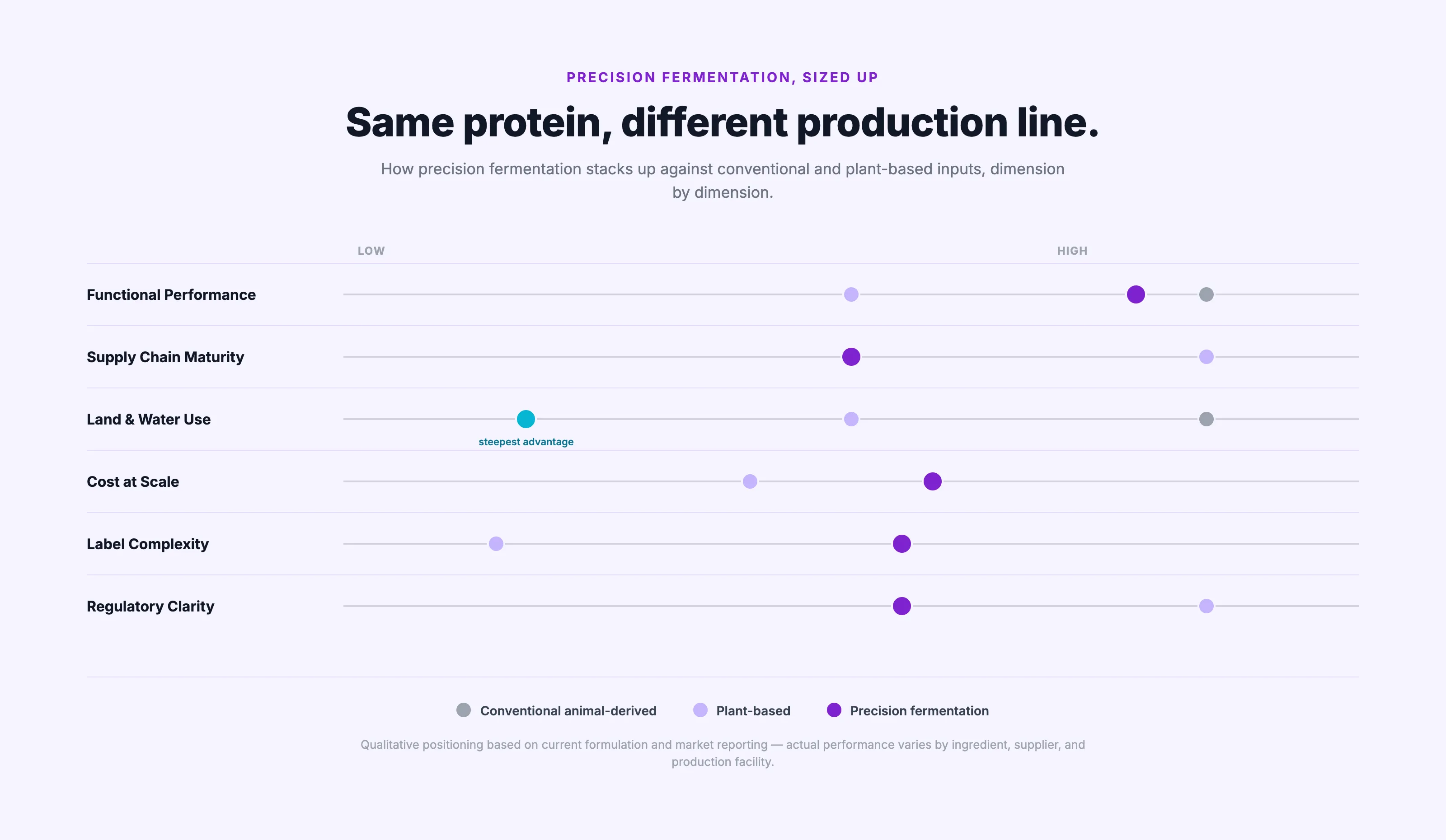
This table is a starting framework, not a final answer. Your specific ingredient, supplier, and formulation context will shift every cell.
If you're at the evaluation stage, here's a focused action list.
For teams building functional products, the 2026 formulator's guide to functional ingredients covers complementary ingredient categories worth evaluating alongside precision fermentation inputs.
What is precision fermentation in simple terms?
Precision fermentation is a production method where microorganisms are genetically programmed to produce specific food compounds — proteins, fats, enzymes — that are molecularly identical to conventionally sourced versions. The output is extracted and purified for use as a food ingredient.
Is precision fermentation the same as GMO food?
No. Precision fermentation uses genetically engineered microorganisms to produce an ingredient, but the ingredient itself is typically a purified protein or compound — not a genetically modified organism. The final ingredient does not contain the production microorganism. Regulatory classification varies by ingredient and jurisdiction.
What precision fermentation ingredients are available for CPG formulation right now?
The most commercially available categories in 2026 are dairy proteins (whey and casein), food enzymes, B vitamins, and certain fats and lipids. Heme proteins and structured fats are at earlier commercial stages with fewer qualified suppliers.
How do I score a precision fermentation ingredient against conventional alternatives?
You need to evaluate it across nutrition profile, cost at your actual purchase volume, and sustainability data from your specific supplier. A category-level average won't give you an accurate picture. Platforms like Journey Foods score ingredients across all three dimensions simultaneously so you can make a direct comparison.
Are precision fermentation ingredients considered clean label?
It depends on your brand's definition of clean label and your target retailer's standards. The ingredient is typically natural-identical at the molecular level, but consumer perception of "fermentation-derived" labeling varies. Work through your label architecture before committing to a formulation.
What are the main supply chain risks with precision fermentation ingredients?
Supplier concentration is the primary risk in newer categories — some precision fermentation ingredients have only one or two commercial suppliers globally. Energy cost and feedstock availability also affect production cost and availability. Treat these like any emerging ingredient: map the supply chain before you design around it.
How does precision fermentation support sustainability goals?
Precision fermentation ingredients generally have lower land use, water use, and greenhouse gas emissions than animal-derived equivalents. The actual reduction depends on the specific ingredient, the production facility's energy source, and the conventional comparator. Always request supplier-specific LCA data rather than relying on category benchmarks.
Precision fermentation is no longer a future-state technology. It's producing ingredients that are in products on shelf today. The formulation and sourcing work is real — and the teams who evaluate these ingredients systematically, against their actual nutrition, cost, and sustainability targets, will move faster than those who wait.
If your ingredient evaluation process is still running across disconnected tools, see how Journey Foods handles it. Book a demo at journeyfoods.io/book-a-demo and see the Operations Scientist engine score precision fermentation ingredients against your existing stack in a single workflow.
Scientist. Nutrition Leader. Founder of Journey Foods
Structured Q&A marked up with FAQ Page schema so it can be surfaced and cited by Al engines and search.
In Journey Al's 12 month dataset, the median plant protein reformulation came in -6.5% on raw material cost versus an animal protein control the first year that line went negative, driven by Tier 1 isolate suppliers reaching spec parity.
In Journey Al's 12 month dataset, the median plant protein reformulation came in -6.5% on raw material cost versus an animal protein control the first year that line went negative, driven by Tier 1 isolate suppliers reaching spec parity.
In Journey Al's 12 month dataset, the median plant protein reformulation came in -6.5% on raw material cost versus an animal protein control the first year that line went negative, driven by Tier 1 isolate suppliers reaching spec parity.