
Quick answer
BHT and BHA show up on ingredient labels across thousands of SKUs — snack crackers, breakfast cereals, cosmetic-grade oils. Most consumers read past them. Most formulators have a more complicated relationship with them.
If you're working on a formulation that needs oxidative stability, you've already asked the question: do these antioxidants still make sense for my product, my label, and my supply chain? Here's the technical foundation to answer that clearly.
What BHT and BHA Actually Are
Butylated hydroxytoluene (BHT) and butylated hydroxyanisole (BHA) are synthetic phenolic antioxidants. Both are oil-soluble and work by interrupting the chain reaction of lipid oxidation before it produces rancidity, off-flavors, or color degradation.
They are not preservatives in the antimicrobial sense — they don't inhibit microbial growth. Their job is specifically to slow the oxidative deterioration of fats and fat-soluble components in a formulation.
BHT has a single phenolic ring with two tert-butyl groups. BHA is a mixture of two isomers (2-BHA and 3-BHA) and is generally more effective at lower concentrations. Both are FDA-approved as GRAS at regulated use levels.
How Lipid Oxidation Works (and Why It Matters to Formulators)
Oxidation in food follows a free radical chain mechanism with three phases: initiation, propagation, and termination. During propagation, lipid radicals react with oxygen to form peroxyl radicals, which attack other lipid molecules. The process is autocatalytic — it accelerates as it progresses.
For your formulation, that means rancidity, shortened shelf life, and off-note development that no flavor masking fully corrects.
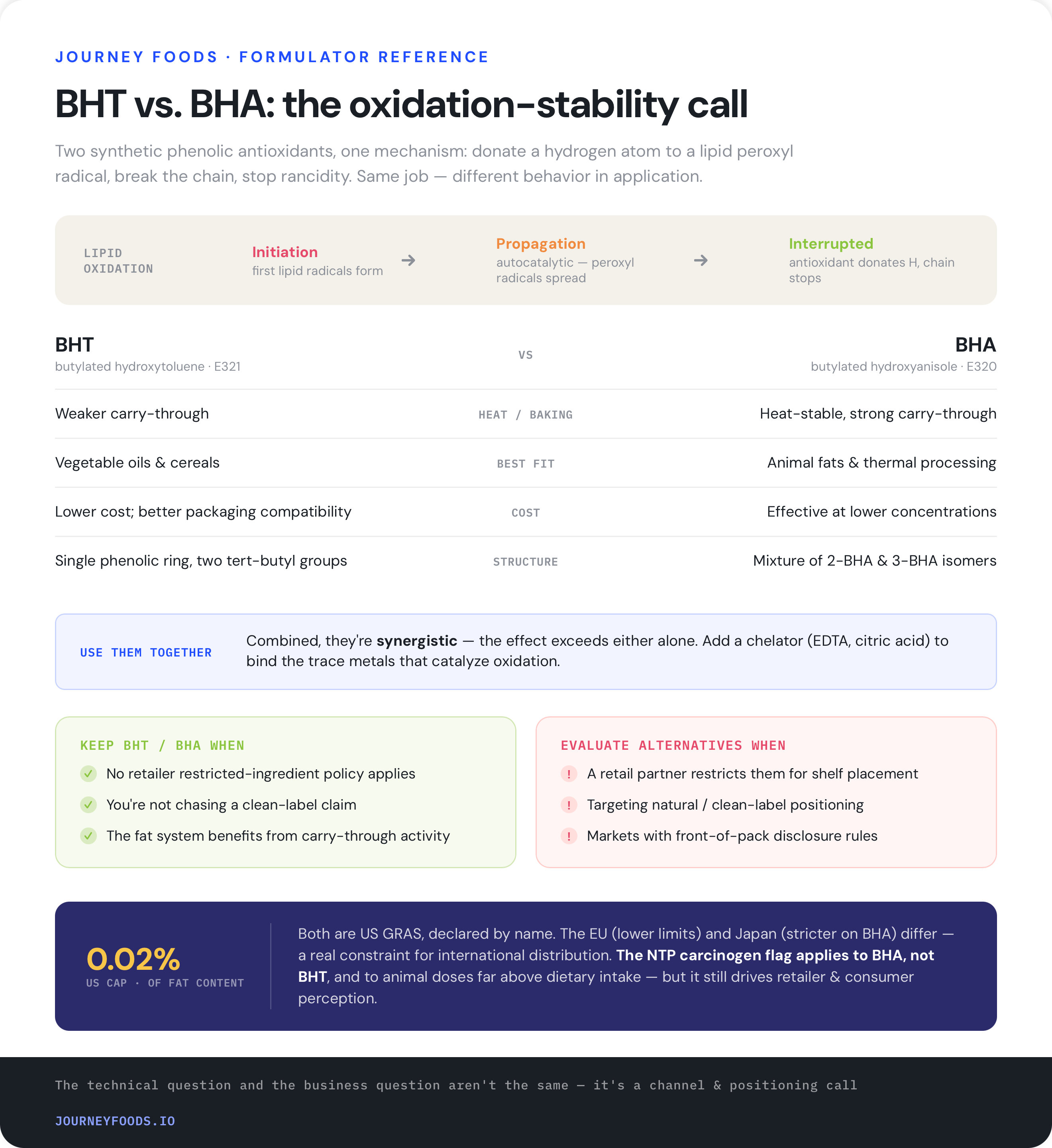
BHT and BHA interrupt the propagation phase by donating a hydrogen atom to the lipid peroxyl radical, converting it into a stable, non-reactive species. The antioxidant itself becomes a relatively stable radical that doesn't continue the chain. This is free radical scavenging, and it's why phenolic antioxidants are effective at very low inclusion levels.
Where BHT and BHA Are Commonly Used
Foods with BHT and BHA span a wide range of categories:
The FDA limits BHT and BHA to 0.02 percent of the fat or oil content of a food — not the total product weight. That distinction matters when you're calculating inclusion levels for a high-moisture product.
BHT vs. BHA: Practical Differences for Formulators
Same mechanism, different behavior in application.
BHA is more heat-stable and more effective in animal fats. It has a carry-through effect — it retains antioxidant activity after cooking or baking — which makes it particularly useful for products that undergo thermal processing. It's also more effective at lower concentrations than BHT in most fat systems.
BHT is more common in vegetable oils and cereal applications. It's less expensive than BHA and has better compatibility with certain packaging materials. Its carry-through effect is weaker, so it performs better in products that aren't thermally processed after addition.
Using them together is standard practice. BHT and BHA show synergistic antioxidant activity — the combined effect exceeds what either delivers alone, which is why you see both on the same ingredient panel in snack and cereal products.
Adding chelating agents like EDTA or citric acid alongside them extends protection further by binding trace metals that catalyze oxidation. This is a well-established approach for high-fat shelf-stable products.
Regulatory Status and Label Implications
In the US, both BHT and BHA are FDA-approved with established GRAS status. They must be declared on the ingredient label by name — no generic category grouping allowed.
Outside the US, the picture gets more complicated. The EU permits BHA (E320) and BHT (E321) but at lower maximum levels than the US, with restrictions that vary by food category. Japan permits BHT in fats and oils but applies stricter limits to BHA. Some markets have moved toward requiring front-of-pack disclosure for certain synthetic additives.
If your product has international distribution ambitions, the regulatory delta between markets is a real formulation constraint — not just a labeling footnote.
The Clean Label Pressure on BHT and BHA
This is where the decision gets more complex. BHT and BHA are effective, inexpensive, and well-characterized. They're also increasingly flagged by clean label scoring systems, retailer ingredient standards, and consumer-facing apps.
Several major retailers have published restricted ingredient lists that include both. Some have made reformulation a condition of shelf placement. If you're formulating for a retail channel with an active clean label program, that's a business constraint that overrides the technical case for these antioxidants.
The alternatives — mixed tocopherols, rosemary extract, ascorbyl palmitate — require different handling and often come with higher cost and shorter shelf life. The trade-offs are real and product-specific. For a closer look at what CPG teams are actually switching to, the BHT alternatives guide for CPG formulators covers the current landscape with specific replacement options.
The clean label trend also intersects with broader formulation strategy. If you're working through how to replace synthetic additives without compromising stability or margin, clean label formulation approaches for replacing synthetic additives walks through the decision framework in detail.
Safety Profile: What the Science Actually Shows
The safety debate around BHT and BHA is worth addressing directly because it shapes retailer and consumer perception — which in turn shapes your formulation decisions.
BHA has been classified as "reasonably anticipated to be a human carcinogen" by the National Toxicology Program, based on animal studies at high doses. The FDA has maintained its GRAS status because the evidence at typical dietary exposure levels doesn't support a causal link in humans. The doses used in animal studies are orders of magnitude above what anyone would consume from food.
BHT doesn't carry the same NTP classification. Some studies have shown antioxidant and even anti-carcinogenic effects at low doses, though the research is mixed.
Regulatory agencies in both the US and EU have reviewed this evidence and maintained approval with defined use limits. The practical implication: the safety concern is not settled science at dietary exposure levels, but it is a real perception driver that affects retail placement and consumer trust scores.
How Formulators Are Making the BHT and BHA Decision in 2026
The technical question and the business question are not the same question. Here's how most experienced formulators are framing it:
Keep BHT or BHA when:
Evaluate alternatives when:
This isn't a universal reformulation mandate. It's a channel and positioning decision that requires knowing your constraints before you change your formula.
For context on how synthetic additives appear in high-volume CPG products and what that signals for formulation strategy, the breakdown of Doritos ingredients and what they mean for CPG formulators is a useful reference point.
Managing Antioxidant Decisions Across a Product Portfolio
The challenge for most R&D teams isn't making the right call on a single SKU. It's maintaining consistency across a portfolio when ingredient decisions are scattered across spreadsheets, email threads, and the institutional knowledge of whoever last worked on that product.
When you're managing multiple formulations with different antioxidant systems, different supplier sources, and different retail channel requirements, the coordination cost compounds fast. A supply disruption on a natural antioxidant source — or a retailer updating its restricted ingredient list — can trigger a reformulation cascade that's nearly impossible to track without centralized ingredient data.
That's the workflow problem Journey Foods is built to solve. The platform's Operations Scientist AI engine scores ingredients across nutrition, cost, and sustainability simultaneously, so when you're evaluating a BHT replacement, you're not running three separate analyses. You get a single scored view across every dimension that matters. Explore the platform at journeyfoods.io.
FAQs
What is BHT in food and why is it used?
BHT (butylated hydroxytoluene) is a synthetic phenolic antioxidant used in food to slow lipid oxidation. It works by donating hydrogen atoms to lipid peroxyl radicals, interrupting the chain reaction that causes rancidity and off-flavors. Common applications include fats, oils, cereals, snack foods, and chewing gum.
What is the difference between BHT and BHA in food applications?
Both are phenolic antioxidants that work through free radical scavenging, but BHA is more effective at lower concentrations and retains activity after thermal processing. BHT is more common in vegetable oils and cereal applications and is generally less expensive. They're often used together because their combined effect exceeds either alone.
Is BHT safe to eat?
BHT is FDA-approved with GRAS status and is permitted in food at up to 0.02 percent of the fat content. The scientific consensus at typical dietary exposure levels does not support a safety concern. The NTP carcinogen classification that sometimes appears in consumer media applies to BHA, not BHT, and is based on animal studies at doses far above normal dietary intake.
Why are some brands removing BHT and BHA from their products?
Retailer restricted ingredient lists, clean label scoring systems, and consumer perception are the primary drivers. The decision is usually a channel and positioning choice rather than a safety-driven reformulation. Brands targeting natural or clean label positioning — or selling through retailers with active ingredient standards programs — face the most direct pressure to reformulate.
What are the regulatory limits for BHT and BHA in food?
In the US, the FDA limits both to 0.02 percent of the fat or oil content of a food. EU limits are lower and vary by food category. Japan permits BHT in fats and oils but applies stricter limits to BHA. Formulators targeting international distribution need to verify the specific limits for each target market.
Can BHT and BHA be used together in a formulation?
Yes, and it's standard practice. They show synergistic antioxidant activity, and adding chelating agents like citric acid or EDTA alongside them provides additional protection by binding trace metals that catalyze oxidation.
How do I decide whether to replace BHT or BHA in my formulation?
Start with your retail channel requirements, label positioning, cost constraints, and distribution markets. If a retail partner has a restricted ingredient policy or you're targeting a clean label claim, evaluate alternatives. If neither applies and the fat system benefits from carry-through antioxidant activity, BHT and BHA remain technically sound choices.
BHT and BHA are well-understood tools with a clear mechanism, defined regulatory limits, and decades of application data. Whether they belong in your next formulation depends on your channel, your label strategy, and your supply chain constraints — not on a generic answer.
If you're managing those trade-offs across a growing SKU portfolio and need a single place to track ingredient decisions, supply chain risks, and formulation versions, see how Journey Foods handles it at journeyfoods.io/book-a-demo.
Data from this story
Shareable Journey Intelligence
How BHT and BHA Work in Food: A Formulator's Plain-Language Breakdown
Ingredients