How to Use the Journey Foods API to Build an Internal Ingredient Data Pipeline

Quick answer
Food ingredient data is messy, fragmented, and expensive to maintain. If you've tried to build anything meaningful on top of it — a nutrition calculator, a reformulation tool, a supply chain alert system — you already know the problem. Data lives in PDFs, locked databases, and siloed spreadsheets that don't talk to each other. A food ingredient data API changes that architecture entirely.
The Journey Foods API gives technical teams programmatic access to scored, structured ingredient intelligence across nutrition, cost, and sustainability. Here's how to actually build with it — and why more CPG engineering and R&D teams are treating ingredient data as a first-class data layer in 2026.
Quick Answer: The Journey Foods API exposes ingredient search and scoring, formulation recommendations, supply chain monitoring, and version-controlled formulation history — all queryable programmatically. Technical teams use it to replace manual, spreadsheet-based ingredient workflows with automated, real-time decision infrastructure.
Key Takeaways:
The Problem With Ingredient Data at Scale
Most food and CPG companies treat ingredient data as an operational afterthought. It gets entered manually, maintained inconsistently, and queried only when something breaks — a reformulation, a supplier disruption, a regulatory flag.
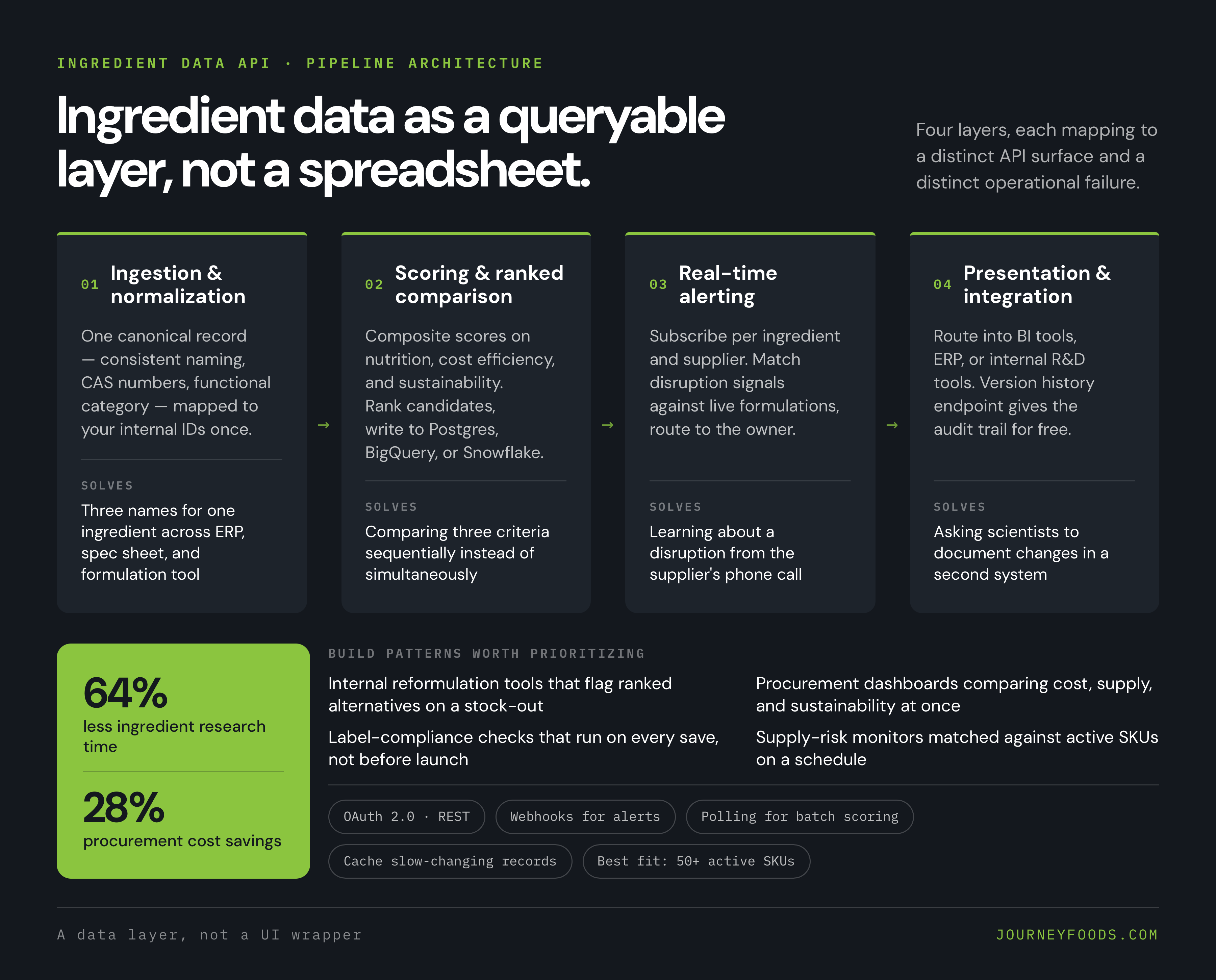
That approach doesn't hold at scale. When you're managing hundreds of SKUs across multiple suppliers and markets, bad ingredient data compounds fast. The teams that have cut ingredient research time by 64% aren't doing it by working harder. They're doing it by building smarter data infrastructure. That's a documented result from one CPG brand using Journey Foods, detailed in this case study on ingredient research efficiency.
The underlying shift is structural. Ingredient data needs to be queryable, scored, and connected to live supply chain signals — not frozen in a static spreadsheet. A food ingredient data API isn't a convenience feature. It's the foundation of a scalable data architecture.
What the Journey Foods API Actually Exposes
The API gives developers programmatic access to ingredient intelligence across three core dimensions: nutrition, cost, and sustainability. Every ingredient carries a scored profile across all three. That means you can build applications that rank, filter, and compare ingredients without manually assembling that data from scratch.
Primary data surfaces:
That's not just a database query layer. That's a decision-support system with an API surface.
Building Your Internal Ingredient Data Pipeline
A pipeline built on the Journey Foods API typically has four layers: ingestion, scoring, alerting, and presentation. Each maps to a different part of the platform's API surface. Each solves a distinct operational problem.
Layer 1: Ingredient Ingestion and Normalization
The first problem most teams hit is normalization. Your ERP has one name for an ingredient. Your supplier's spec sheet uses another. Your formulation software uses a third. Before you can score or compare anything, you need a canonical identifier.
The Journey Foods API handles this at the query layer. Search for an ingredient and the platform returns a normalized record — consistent naming, CAS numbers where applicable, functional category tagging. Your pipeline ingests that normalized record and maps it back to your internal identifiers. Once, cleanly, at the source.
This single step eliminates a category of manual work most food tech teams underestimate. Normalization isn't glamorous. It's where most ingredient data pipelines break down.
Layer 2: Scoring and Ranked Comparison
Once you have normalized records, the scoring layer is where the API earns its keep. Every ingredient includes composite scores across nutrition, cost efficiency, and sustainability. Pull these programmatically and build ranked comparisons into any downstream tool.
The architecture is straightforward: query the API for a set of ingredient candidates, receive scored records, rank them against your product's stated objectives, write the output to whatever data store your team already uses — Postgres, BigQuery, Snowflake, or a simple internal API endpoint.
R&D leads can then query that ranked output from their existing tools without ever touching the Journey Foods interface directly. The intelligence surfaces where they already work.
Layer 3: Real-Time Supply Chain Alerting
This is where the pipeline shifts from passive to active. The supply chain monitoring layer lets you subscribe to alerts for specific ingredients and suppliers. When a disruption signal appears — availability drops, price spikes, a supplier goes offline — the API surfaces it.
Build a monitoring service that queries this layer on a schedule. Compare current availability signals against your active formulations. When a flagged ingredient appears in a live SKU, trigger an alert to the right person: the procurement lead, the R&D scientist who owns that formulation, or both.
The alternative is finding out about a supply disruption when your procurement team gets a call from a supplier. That's reactive sourcing. It's expensive, and it's avoidable.
Layer 4: Presentation and Integration
This is where most of the engineering flexibility lives. The Journey Foods API doesn't dictate how you present the data. Route scored ingredient records and supply chain alerts into:
The version-controlled formulation history endpoint is particularly useful here. Pull it into your internal product development tool and you get a full audit trail — who changed what ingredient, when, and why — without asking scientists to document their work in a separate system.
Four Build Patterns Worth Prioritizing
Internal Reformulation Tools
R&D teams at mid-size CPG companies often maintain custom internal tools for formulation tracking. The problem is those tools are usually disconnected from live ingredient data. Connect them to the Journey Foods API and you can surface real-time ingredient scores and substitution recommendations directly inside your existing workflow — without asking scientists to switch platforms.
When a supplier goes out of stock or a cost threshold gets breached, your internal tool automatically flags viable alternatives ranked by nutritional equivalence and cost delta. The scientist sees options, not a dead end.
Procurement Decision Dashboards
Procurement leads need to compare ingredient options across cost, availability, and sustainability criteria simultaneously — not sequentially. Building a dashboard on top of the API means scored comparisons are available programmatically, presented in whatever BI tool your team already uses.
28% cost savings on ingredient procurement is a benchmark Journey Foods clients have documented. That figure comes from having better comparative data at the point of decision. Not from negotiating harder.
Regulatory and Label Compliance Pipelines
Clean-label compliance is increasingly non-negotiable. The API's ingredient scoring and nutritional data can feed directly into label review workflows, flagging formulations that include off-standard ingredients before they reach production.
This matters especially for teams managing products across multiple markets with different regulatory requirements. A pipeline that checks formulations against compliance criteria automatically — on every save, not just before launch — catches problems when they're cheap to fix.
Supply Chain Risk Monitoring
Build a monitoring layer that queries the Journey Foods API on a schedule, compares current availability signals against your active formulations, and alerts the right people before a disruption becomes a production problem. This is the build pattern with the clearest ROI — the cost of a missed supply alert is concrete and large.
Supply chain intelligence at this level is what separates teams that respond to disruptions from teams that anticipate them.
Integration Architecture: What to Expect
A few practical notes for developers scoping the build:
Authentication follows standard OAuth 2.0 patterns. If you've integrated any modern SaaS API, the auth flow is familiar.
Rate limits apply at the query level. For most internal pipeline use cases — batch ingredient scoring, scheduled supply chain checks — you'll stay well within standard limits. High-frequency monitoring services should implement a caching layer for ingredient records that don't change frequently.
Webhooks vs. polling is a real architectural decision. For supply chain alerts where latency matters, webhooks are the right choice. For batch scoring and analytics pipelines, scheduled polling is simpler and sufficient.
Data freshness varies by endpoint. Ingredient scores update as the platform's underlying data changes. Supply chain signals are closer to real time. Build your pipeline's refresh logic to match the freshness requirements of each data type.
One more thing worth noting: data your pipeline writes back — scored formulations, flagged ingredients, version history — is visible to the entire team through the platform's centralized dashboard. Not just the developer who built the integration.
Who This Pipeline Is Actually For
Be honest about the audience before you scope the build. This isn't a project for every engineering team.
It's a strong fit if:
It's a weaker fit if:
For teams evaluating where Journey Foods fits relative to other platforms, the comparison of AI-powered ingredient management platforms for CPG companies in 2026 is worth reading before scoping a build. If your current workflow runs on Genesis R&D or Excel-based formulation tracking, the breakdown of where those workflows break down at scale is directly relevant to the architectural decision you're making now.
The Competitive Context
Most legacy formulation tools weren't designed to be queried programmatically. They're built around a UI, and the API — if it exists at all — is an afterthought. That means the data is locked inside the platform and can't participate in the broader data infrastructure your engineering team is building.
The Journey Foods API is designed from the start as a data layer, not a UI wrapper. That's a meaningful architectural difference. Ingredient intelligence can flow into your ERP, your BI tools, your alerting systems, and your internal R&D tools — wherever decisions actually get made.
That's the argument for treating a food ingredient data API as infrastructure rather than a feature. The teams building on it now are the ones with cleaner, faster, more defensible product development processes in 12 months.
Explore what your team can build at Journeyfoods.io.
FAQs
What is a food ingredient data API and what can it be used for?
A food ingredient data API provides programmatic access to structured ingredient records — including nutritional data, cost scores, sustainability metrics, and supply chain signals. Development and R&D teams use it to build internal tools like reformulation dashboards, procurement comparison tools, compliance pipelines, and supply chain monitoring systems without manually assembling ingredient data from disparate sources.
What data does the Journey Foods API expose?
The Journey Foods API exposes ingredient search and scoring across nutrition, cost, and sustainability dimensions; AI-generated formulation recommendations; real-time supply chain monitoring and alerts; version-controlled formulation history; and portfolio-level analytics. Every ingredient record carries a composite score that makes ranked comparisons programmatic.
How does the Journey Foods API handle supply chain alerts?
The supply chain monitoring layer lets you subscribe to signals for specific ingredients and suppliers. When disruption indicators appear — availability drops, pricing anomalies, supplier status changes — the platform surfaces them. Build a monitoring service that queries this layer on a schedule and triggers alerts to procurement or R&D leads before a disruption affects production.
What technical stack does the Journey Foods API require?
The API uses standard OAuth 2.0 authentication and REST conventions, so it integrates with any modern development stack. Most teams connect it to existing BI tools (Tableau, Looker, Power BI), internal dashboards, ERP systems, or custom R&D tools. The platform doesn't dictate a specific stack — it exposes data that your team routes into whatever presentation layer already exists.
Is the Journey Foods API suitable for small CPG brands?
It's best suited for teams managing 50 or more active SKUs with meaningful ingredient complexity, multiple suppliers, or cross-functional R&D and procurement teams working from different data sources. Very early-stage brands with a small, stable product line and narrow supplier base may not need the full pipeline architecture — though even smaller teams benefit from the platform's centralized dashboard and AI-driven ingredient scoring.
How does version-controlled formulation history work through the API?
The formulation history endpoint returns a full audit trail for any product formulation — every ingredient change, the timestamp, and the user who made it. Pull this into internal product development tools or BI systems and you get a searchable record of formulation decisions without requiring scientists to document changes in a separate system.
What's the difference between using the Journey Foods platform directly versus building on the API?
The platform UI is designed for food scientists and product managers who want a guided interface for ingredient discovery, scoring, and formulation tracking. The API is designed for engineering teams who want to embed that ingredient intelligence into existing internal tools, automate data flows, or build custom applications. Most teams use both: the platform for day-to-day R&D work, and the API to connect ingredient data to the broader infrastructure the organization already runs on.
As published
64%
Data from this story
Shareable Journey Intelligence
How to Use the Journey Foods API to Build an Internal Ingredient Data Pipeline
Industry Insights
64%
The teams that have cut ingredient research time by 64% aren't doing it by working harder.
28%
28% cost savings on ingredient procurement is a benchmark Journey Foods clients have documented.