Journey Foods Book a Demo: What to Bring and What to Expect From Your First Session

Quick answer
You've done the research. You've seen enough fragmented ingredient databases, siloed formulation spreadsheets, and reactive supply chain fire drills to know something needs to change. Now you're considering booking a Journey Foods demo, and you want to know what you're actually walking into.
Here's exactly that: what the demo covers, what you'll see in the platform, who should be in the room, and how to prepare so you walk out with real answers instead of a follow-up email chain.
Why the Demo Is Worth Your Time
The website gives you the positioning. The demo gives you the workflow.
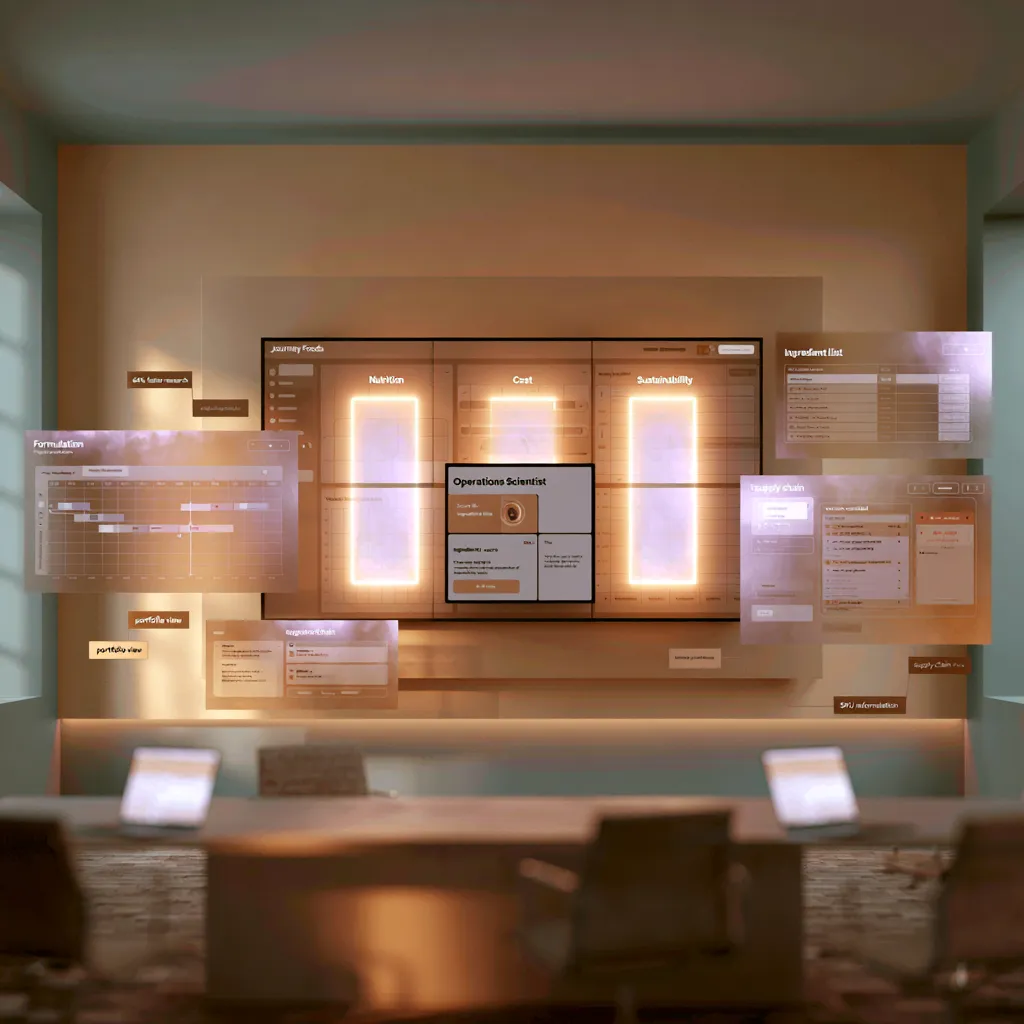
Journey Foods centralizes ingredient discovery, formulation management, and supply chain monitoring in a single dashboard. That's easy to say. The demo is where you actually watch the Operations Scientist AI engine score an ingredient across nutrition, cost, and sustainability simultaneously — in real time — and understand what that means for your specific development process.
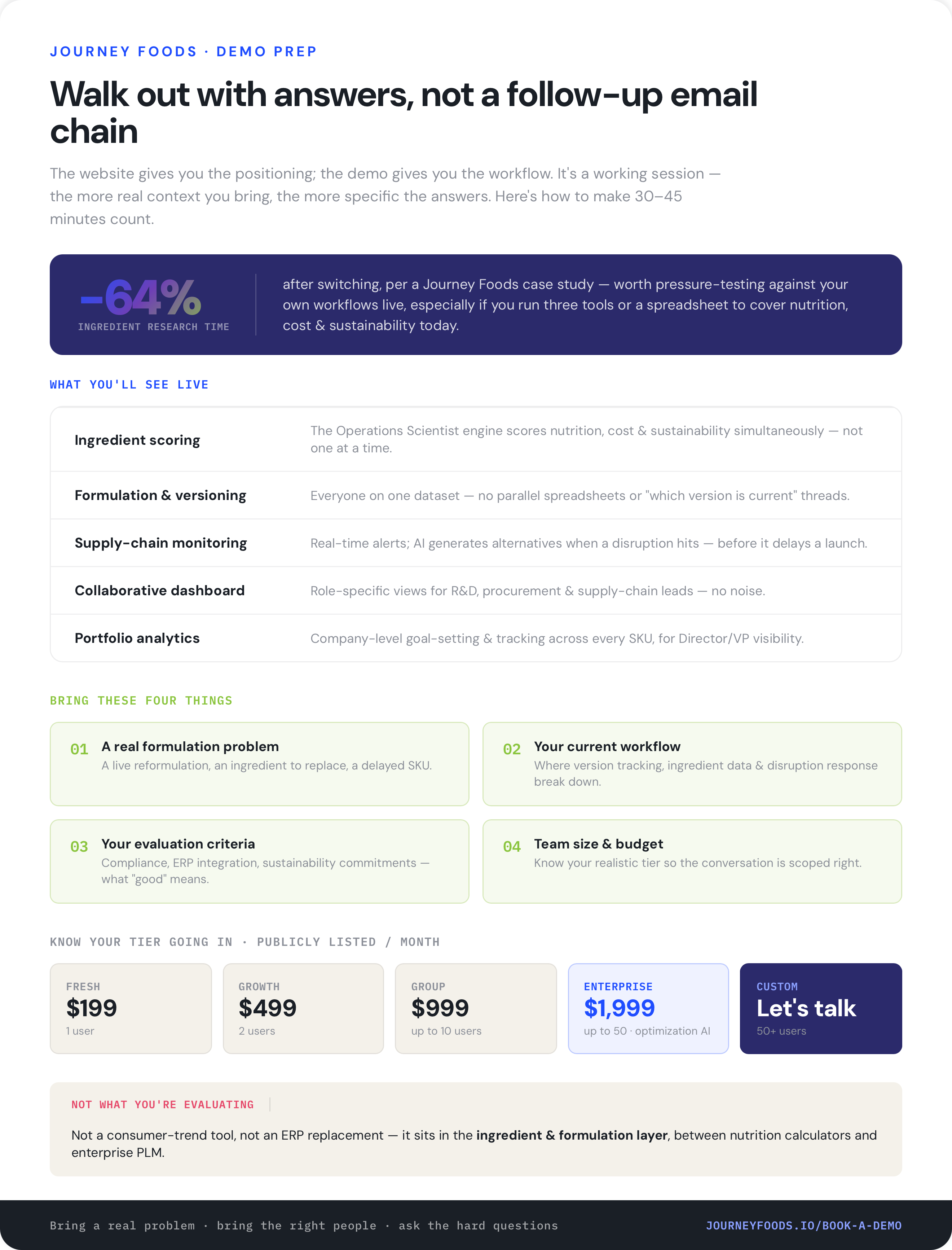
If your team currently runs three separate tools to cover those three criteria, or bridges the gaps manually in a spreadsheet, that comparison becomes concrete the moment you see it live. Teams that have gone through the evaluation process have cut ingredient research time by 64 percent after switching, according to a Journey Foods case study. That number is worth pressure-testing against your actual workflows during the session.
What the Demo Actually Covers
A Journey Foods demo is structured around your workflow, not a scripted feature tour. That said, every session hits the same core areas.
Ingredient Discovery and Scoring
You'll see the Operations Scientist engine score ingredients across nutrition, cost, and sustainability at the same time. This isn't a sequential process where you optimize for one criterion and then check the others — the scoring is simultaneous. That matters when you're trying to hit multiple product targets without bouncing between tools or waiting on a supplier to send updated spec sheets.
You'll also see how the search and discovery interface handles ingredient alternatives, whether you're sourcing something new or hunting for a substitute mid-disruption.
Formulation Management and Version Control
The demo walks through how teams build and version-control formulations inside the platform. Everyone works from the same data. No parallel spreadsheets. No "which version is current" email threads. No institutional knowledge walking out the door when a senior scientist leaves.
For R&D leads managing multiple SKUs or an active reformulation project, this section is usually where the platform's operational value becomes obvious.
Real-Time Supply Chain Monitoring
This is the capability that separates Journey Foods from nutrition calculators and legacy formulation tools. You'll see how the platform surfaces supply chain alerts and how the AI generates ingredient alternatives when a disruption hits — before it becomes a product delay or a missed launch window.
If your team has lived through a launch delay tied to an ingredient shortage, this section will feel immediately relevant. The supply chain intelligence behind this capability is one of the platform's core differentiators, and it's where the gap between Journey Foods and tools like Genesis R&D or ESHA is most visible.
Collaborative Dashboard and Team Workflows
The demo shows how different roles interact with the same platform. Food scientists, procurement managers, and supply chain leads each see what's relevant to their function without noise. Role-specific views are built in. That structure closes the communication gaps that slow cross-functional teams down and force decisions through email.
Portfolio Management and Analytics
If you're managing a portfolio of SKUs rather than a single product, the demo covers how the platform handles goal-setting, analytics, and portfolio tracking at the company level. This section is most relevant to Directors of R&D and VP-level buyers who need visibility across the full product line, not just individual formulations.
Who Should Be in the Room
This is a cross-functional platform. The demo is most valuable when the right people attend.
Required:
Strongly recommended:
Worth including if available:
If you're a funded startup with a lean team, one or two people covering these functions is enough. If you're a mid-market CPG with dedicated R&D and supply chain functions, bring both sides of the house.
The demo is not a presentation to sit through. It's a working session. The more context your team brings, the more specific the answers will be.
What to Bring: How to Prepare Before the Demo
Preparation is what separates a useful demo from a generic one. Arrive with these four things ready.
A Real Formulation Problem
The most useful demos happen when you bring an actual challenge. A current reformulation project. An ingredient you're trying to replace. A product where you're struggling to hit nutrition targets without blowing your cost structure. A SKU that keeps getting delayed because supplier data is scattered across three inboxes.
The platform is built to handle these scenarios. Seeing it work on your real problem is far more informative than watching a demo product that has nothing to do with your category.
Documentation of Your Current Workflow
Know your current process before you walk in. How does your team track formulation versions today? Where does ingredient data actually live? When a supply disruption hits, how long does it typically take to identify an alternative?
You don't need a formal process map — but having a clear picture of where your current workflow breaks down gives the demo team something concrete to address. It also makes the comparison sharper when you see how the platform handles the same steps.
Your Evaluation Criteria
Be specific about what you need the platform to do. If regulatory compliance documentation is non-negotiable, say so. If you need integration with an existing ERP or procurement system, bring that requirement. If your team has a sustainability commitment that affects ingredient selection, that's relevant to how the scoring engine gets configured.
Journey Foods is not a one-size-fits-all implementation. The demo is more useful when the team knows what "good" looks like for your specific situation. If you're still building out your evaluation framework, the food product development platform evaluation guide is a practical starting point.
Your Team Size and Budget Range
Pricing is publicly listed. Fresh is $199 per month for one user. Growth is $499 for two users. Group is $999 for up to ten users. Enterprise is $1,999 for up to fifty users and includes product optimization AI, customer reporting, and ten or more product customizations per month. Custom enterprise pricing is available above that.
Know which tier is realistic for your team before the demo. It focuses the conversation on what's actually available at your budget and avoids a follow-up cycle where finance kills a deal that was never scoped correctly.
Questions Worth Asking During the Demo
Don't leave these to a follow-up email.
On the AI engine:
On supply chain:
On formulation and version control:
On integration:
On implementation:
These questions move the demo from a product tour into a real evaluation. The answers will tell you as much about the team behind the platform as they do about the software itself.
After the Demo: What the Evaluation Process Looks Like
Most mid-market CPG teams move through a predictable sequence after the demo.
Internal debrief. The people who attended need to align on what they saw before the conversation goes to VP or CFO level. Document the specific capabilities that address your current pain points. Note anything that wasn't covered or needs follow-up.
Stakeholder presentation. Purchase decisions at this level typically require VP of R&D or CFO sign-off. Build a short internal case using concrete numbers from the demo: time savings, supply chain risk reduction, formulation cycle time. The 64 percent reduction in ingredient research time is a useful anchor if your team validated something similar during the session.
Pilot or trial scope. If you need to validate the platform against a live project before committing, define that scope clearly. One product line, one reformulation project, one quarter. A narrow pilot with clear success criteria is faster to approve and faster to evaluate than an open-ended trial.
Integration and IT review. If your team flagged API or integration requirements during the demo, get IT or your systems lead involved early. This is where enterprise implementations sometimes stall. Journey Foods is designed to be operational without a six-month rollout, but integration complexity depends on your existing stack.
Pricing and contract. The Fresh, Growth, and Group tiers are straightforward. Enterprise and custom pricing involves a direct conversation — the demo team will route you appropriately.
What Journey Foods Is Not
Worth being clear on scope before the demo, so you're evaluating the right things.
Journey Foods is not a consumer trend intelligence platform. If you're looking for retail scanner data or consumer sentiment analysis, that's a different category. It's also not a full ERP replacement. The platform sits in the ingredient and formulation layer of your product development process, not the financial or distribution layer.
It's built for the gap between nutrition calculators and enterprise PLM systems. Teams that have outgrown spreadsheets and point solutions but can't justify a six-month Trace One implementation are exactly who the platform is designed for.
If you're evaluating alternatives, the food product development platform comparison guide covers the decision criteria in detail.
Book the Demo
If you've read this far, you have a specific problem the platform is built to address. The demo is the fastest way to find out whether Journey Foods solves it for your team.
Book your session at journeyfoods.io/book-a-demo. Bring a real problem. Bring the right people. Ask the hard questions.
The platform either works for your workflow or it doesn't. The demo is where you find out.
Frequently Asked Questions
How long is a Journey Foods demo?
Most demos run 30 to 45 minutes. If you bring a specific formulation problem or integration requirement, the session may run longer. Come prepared with your questions and your team's specific use case so the time is spent on what actually matters.
Who should attend the Journey Foods demo from our team?
At minimum, the Director of R&D or Product Development Manager and a Senior Food Scientist. If supply chain monitoring is a priority, bring your Procurement Manager or VP of Supply Chain. If finance needs to approve the purchase, having them in the demo saves a full follow-up cycle.
Do I need to prepare anything before booking a Journey Foods demo?
Yes. Bring a real formulation challenge, a clear picture of where your current workflow breaks down, your evaluation criteria, and your team size so pricing can be scoped accurately. The more specific your inputs, the more useful the session.
What does Journey Foods pricing look like after the demo?
Pricing starts at $199 per month for a single user on the Fresh plan. Growth is $499 for two users, Group is $999 for up to ten users, and Enterprise is $1,999 for up to fifty users. Custom enterprise pricing is available for larger teams. All tiers are publicly listed at journeyfoods.io.
How is Journey Foods different from Genesis R&D or ESHA?
Genesis R&D and ESHA focus on nutrition analysis and regulatory compliance. Neither includes supply chain monitoring or simultaneous cost and sustainability scoring. Journey Foods scores ingredients across all three criteria at once and layers in real-time supply chain alerts and version-controlled collaborative formulation tools — all in a single platform.
What happens after the demo if we want to move forward?
Most teams run an internal debrief, build a brief stakeholder case for VP or CFO sign-off, and then define a pilot scope or move directly to contract. The Journey Foods team will follow up with documentation and can support your internal evaluation process with additional materials if needed.
Is Journey Foods suitable for a small R&D team, or is it built for large manufacturers?
It's built specifically for mid-market teams that have outgrown spreadsheets and point solutions but don't need a six-month enterprise PLM implementation. The Fresh plan at $199 per month supports a single user, and the platform is designed to be operational on day one — not after a long IT-led rollout.
As published
$199
Data from this story
Shareable Journey Intelligence
Journey Foods Book a Demo: What to Bring and What to Expect From Your First Session
Industry Insights
$199
Fresh is $199 per month for one user.
$499
Growth is $499 for two users.