Red Dye 40 Alternatives: What Formulators Are Actually Using After the 2026 Restrictions

Quick answer
The 2026 restrictions on Red Dye 40 (Allura Red AC) didn't come out of nowhere. The FDA's phased approach gave R&D teams a runway. But now that the timeline has arrived, a lot of product developers are discovering that "we'll deal with it when we have to" wasn't actually a plan.
This is for the food scientists, R&D leads, and CPG product developers who are actively reformulating right now. What natural red colorants are viable at scale, what you're giving up with each one, and how teams are managing the formulation complexity that comes with moving off a synthetic dye.
Why Red Dye 40 Replacements Are Harder Than They Look
Red Dye 40 earned its dominance. It's heat-stable, pH-stable across a wide range, light-fast, and inexpensive. It performs consistently across beverages, confections, snacks, dairy analogs, and baked goods. It doesn't bleed, doesn't shift hue under processing, and plays well with most other ingredients.
Natural red colorants don't share those properties. Most are pH-sensitive. Several degrade under heat. Some interact with proteins or oxidize under light. Replacing Red Dye 40 isn't a single line change in your formulation software — it often means adjusting pH, modifying processing parameters, or rethinking packaging.
That's the honest starting point.
The Main Red Dye 40 Alternatives Formulators Are Using in 2026
Carmine (Cochineal Extract, CI 75470)
Carmine is still the most stable natural red on the market. It holds up across a wide pH range (though it shifts toward purple below pH 4), survives heat, and delivers a clean, vivid red in the pH 5–7 range. Typical usage rates run 0.01–0.1% depending on application.
The trade-offs are significant: it's animal-derived (from the cochineal insect), which disqualifies it for vegan-certified products and creates labeling friction in markets where consumers read ingredient lists carefully. Some jurisdictions require an allergen declaration. Cost runs higher than Red Dye 40, and supply can be volatile given its dependence on South American sourcing.
For non-vegan confections, dairy, and meat products where stability is the priority, carmine remains the first call for many formulators.
Beet Juice / Betanin (Beetroot Red, E162)
Betanin is the most widely used natural red in clean-label reformulations right now. It's plant-derived, consumer-friendly on the label, and delivers a strong red-pink hue. The problem is stability: betanin degrades rapidly above 60°C and is highly sensitive to oxygen, light, and pH outside the 4–6 range.
That limits it to cold-fill beverages, refrigerated dairy, yogurt, ice cream, and confections where processing temperatures stay low. Encapsulated betanin has improved heat tolerance somewhat, but it's not going into a baked good that sees 180°C.
Water activity matters too. High-moisture applications accelerate degradation. If your product needs more than 12 months of shelf life, betanin will likely require significant formulation engineering to get there.
Lycopene (CI 75125)
Lycopene is a carotenoid extracted primarily from tomatoes. It delivers orange-red tones and is heat-stable, which makes it useful in applications where betanin fails. It's fat-soluble, so it performs well in oil-based systems, emulsions, and fat-containing snacks.
The hue skews more orange-red than the pure red of Red Dye 40 — which matters when consumers have a specific color expectation. Water-dispersible versions are commercially available, but natural lycopene has limited dispersibility in aqueous systems. Regulatory status also varies by market, so confirm your target geography before committing.
Red Radish Extract (Raphanus sativus)
Red radish extract contains anthocyanins that produce a red hue in acidic conditions — specifically below pH 3.5. That makes it a strong candidate for acidic beverages, sports drinks, and carbonated soft drinks where pH is already low.
Journey Ingredient Intelligence
Carrots
Anthocyanins from Black Carrot, Purple Sweet Potato, and Elderberry Black carrot and purple sweet potato extracts are among the most commercially mature anthocyanin so…
Carrots: 41 kcal and 0.9 g protein per 100 g; top producer China (42.2%, 2024); 0.43 kg CO2e per kg.
Above pH 4, the color shifts toward purple and then blue-green, which is a real problem in applications where pH isn't tightly controlled. Heat stability is moderate. It's a cleaner label than carmine and outperforms betanin in acidic systems.
Radish-derived colorants have gained meaningful traction in beverages as a direct Red Dye 40 replacement, and several major suppliers have expanded their radish extract lines specifically in response to 2026 demand.
Hibiscus Extract
Hibiscus delivers a vivid red-pink in acidic conditions and has strong consumer recognition as a natural ingredient. It's widely used in teas, beverages, and some confections. The color is pH-dependent — red below pH 3.5, shifting to pink-purple above — and it contributes a mild tart flavor that may or may not work depending on your product profile.
For beverages where that flavor contribution fits — hibiscus lemonade, botanical drinks, functional beverages — it's a natural match. For products where flavor neutrality matters, it's a liability.
Anthocyanins from Black Carrot, Purple Sweet Potato, and Elderberry
Black carrot and purple sweet potato extracts are among the most commercially mature anthocyanin sources for food use. They offer better stability than many other anthocyanin options and are available in liquid and powder form from multiple suppliers.
The color shifts from red to purple with rising pH — a known limitation. In acidic systems below pH 3.5, formulators can achieve a red reasonably close to Red Dye 40. At neutral pH, you're working with purple-pink tones.
Elderberry extract is less common in mainstream CPG but is gaining ground in functional food and supplement-adjacent products where the ingredient story adds value beyond color.
What the Trade-offs Actually Cost You
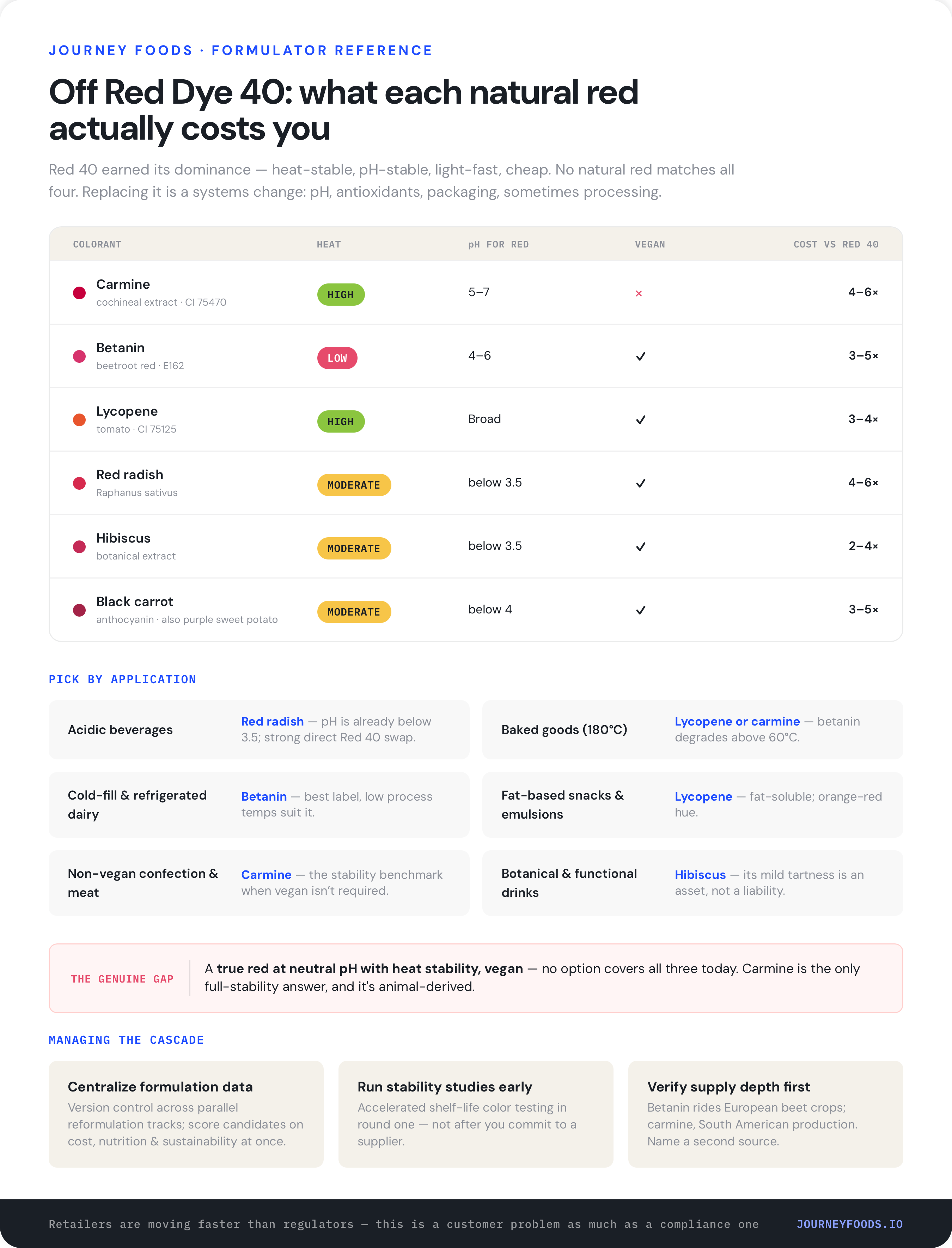
ColorantHeat StabilitypH Range for RedVeganLabel FriendlinessRelative Cost vs. Red 40CarmineHigh5–7NoModerate4–6x higherBetanin (Beet)Low4–6YesHigh3–5x higherLycopeneHighBroadYesHigh3–4x higherRed RadishModerateBelow 3.5YesHigh4–6x higherHibiscusModerateBelow 3.5YesHigh2–4x higherBlack CarrotModerateBelow 4YesHigh3–5x higher
Cost is the most consistent friction point. Natural colorants run 2–6x the price of Red Dye 40 at equivalent use levels, and some require higher usage rates to hit comparable color intensity. In high-volume, price-sensitive categories, that math hits margins hard.
How Formulation Teams Are Managing the Complexity
Switching from a synthetic dye to a natural alternative isn't a single-ingredient decision. It often triggers a cascade: pH adjustment, antioxidant addition (ascorbic acid is commonly used to stabilize betanin), packaging changes to reduce light exposure, and sometimes processing modifications.
Teams managing this well tend to share a few practices.
Centralizing formulation data. When you're testing multiple colorant candidates across different product lines, version control stops being optional. Formulation teams using platforms like Journey Foods can track ingredient substitutions, score candidates across cost, nutrition, and sustainability criteria simultaneously, and keep R&D, procurement, and regulatory working from the same data. When you're running parallel reformulation tracks across a portfolio, that coordination advantage compounds quickly.
Running stability studies early. The biggest time loss in natural colorant reformulation is discovering stability failures late in the process. Accelerated shelf-life testing for color stability should happen in the first round of prototyping — not after you've committed to a supplier.
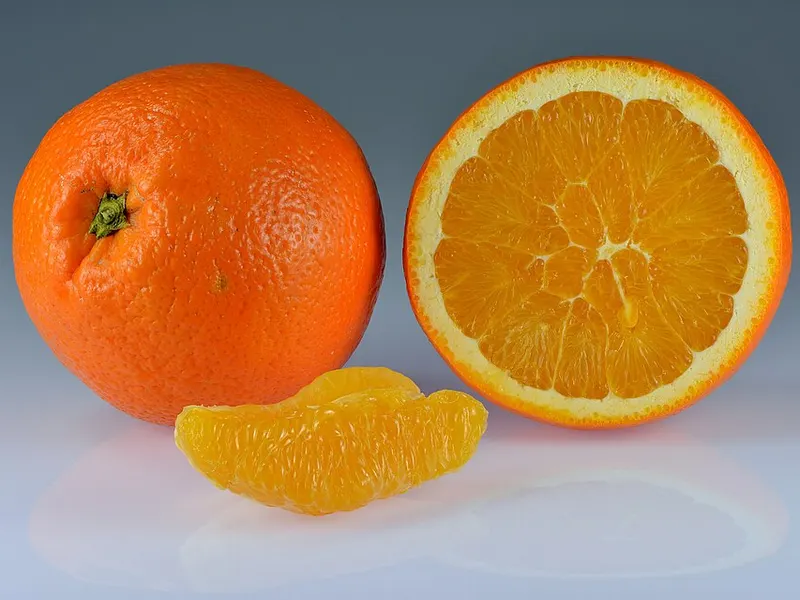
Journey Ingredient Intelligence
Oranges
It delivers orange-red tones and is heat-stable, which makes it useful in applications where betanin fails.
Oranges: 47 kcal and 0.9 g protein per 100 g; top producer Brazil (23.3%, 2024); 0.39 kg CO2e per kg.
Evaluating supply chain depth before committing. Natural colorant supply is more concentrated and more volatile than synthetic dye supply. Betanin supply depends heavily on European beet crops. Carmine is tied to South American production. Before locking in a colorant at scale, verify supplier depth and identify a secondary source.
Real-time supply chain monitoring matters here. Knowing when a supplier's lead time shifts or a crop year affects availability gives procurement teams the ability to act before a shortage hits production. That kind of visibility is built into platforms designed for modern CPG ingredient management.
The Regulatory Context Behind the 2026 Restrictions
The FDA's 2026 restrictions on Red Dye 40 are part of a broader regulatory shift that has been building for years. The restrictions primarily target products marketed to children and categories where consumption is highest among sensitive populations.
This follows sustained pressure from consumer advocacy groups and aligns with moves the EU made much earlier — Red Dye 40 (E129) has carried a mandatory hyperactivity warning label in Europe since 2010. Several US states had also moved toward state-level restrictions, which accelerated federal action.
For formulators, the practical implication is that this isn't purely a compliance issue. Retailers and major foodservice customers are moving faster than regulators on clean-label requirements. If your product still contains Red Dye 40 in 2026, you're not just managing a regulatory problem — you're managing a customer relationship problem.
This is part of a wider pattern CPG R&D teams are tracking across synthetic additives. If you're also working through similar questions on preservatives, the BHT alternatives in food guide for 2026 covers the same practical trade-off framework for that category.
What Clean-Label Reformulation Actually Requires
"Clean label" gets used loosely, but for formulators it has a specific operational meaning: replacing flagged ingredients with alternatives that are recognizable, natural-sounding, and functionally adequate.
Red Dye 40 replacement sits squarely in this work. But it's worth being clear that clean-label reformulation is not an ingredient swap — it's a systems problem. You're managing supplier relationships, cost structures, stability profiles, regulatory status across markets, and consumer perception at the same time.
The clean label formulation guide on replacing synthetic additives covers the broader framework for this kind of work, including how to evaluate functional equivalence and manage cost impact.
The teams doing this well are treating it as a portfolio-level initiative — not a product-by-product fire drill.
What's Actually Gaining Traction in 2026
Based on where supplier investment and formulation activity is concentrating, the clearest patterns right now are:
The ingredient trends CPG R&D teams are tracking in 2026 covers how natural colorants fit into the broader ingredient innovation picture this year.
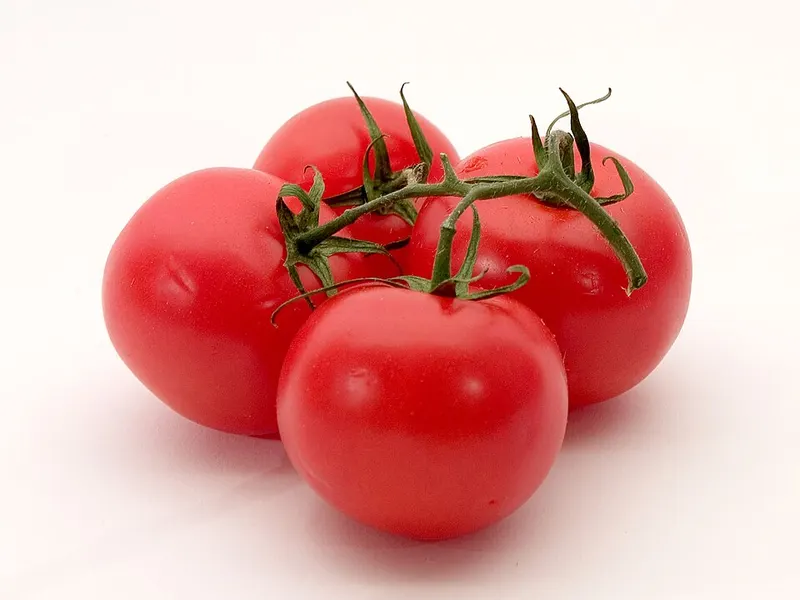
Journey Ingredient Intelligence
Tomatoes
Lycopene (CI 75125) Lycopene is a carotenoid extracted primarily from tomatoes.
Tomatoes: 18 kcal and 0.9 g protein per 100 g; top producer China (32.7%, 2024); 2.09 kg CO2e per kg.
How Journey Foods Supports Reformulation Work
Managing a Red Dye 40 reformulation across a product portfolio means evaluating dozens of ingredient candidates, running parallel stability tracks, coordinating with procurement on supply chain depth, and keeping regulatory and marketing aligned on label claims — all at the same time.
Journey Foods' AI-powered platform is built for exactly this kind of multi-variable ingredient decision. The Operations Scientist AI engine lets you search and score natural colorant candidates across nutrition, cost, and sustainability criteria simultaneously. Formulation version control keeps your team working from the same data as iterations evolve. Real-time supply chain alerts flag availability changes before they affect production timelines.
If you're in the middle of a reformulation cycle or planning one, it's worth seeing what the platform can do for your team. Explore Journey Foods at Journeyfoods.io.
FAQs
What is the best natural replacement for Red Dye 40?
There's no single answer — it depends on your application. Carmine offers the best stability but is animal-derived. Betanin (beet juice) is the most consumer-friendly but degrades under heat. Red radish and black carrot extracts perform well in acidic beverages. Lycopene works best in fat-containing systems. Match the colorant to your product's pH, processing temperature, and shelf-life requirements.
Why are natural red colorants more expensive than Red Dye 40?
Synthetic dyes are produced through chemical synthesis at industrial scale with consistent yields. Natural colorants require agricultural sourcing, extraction, and often encapsulation or stabilization processing — and supply is subject to crop variability. Those factors combine to make natural alternatives 2–6x more expensive at equivalent use levels.
Does betanin (beet red) work in baked goods?
Generally no. Betanin degrades rapidly above 60°C, which rules it out for most baked applications. Encapsulated versions improve heat tolerance somewhat but aren't a reliable solution for products baked above 100°C. For baked goods, lycopene or carmine are more practical options.
What pH range do I need for red radish extract to show a red color?
Red radish extract shows red tones at pH below approximately 3.5. Above pH 4, the color shifts toward purple and then blue-green. It's best suited for acidic beverages, carbonated drinks, and products where pH is tightly controlled at or below 3.5.
Are there vegan natural red colorants that are also heat-stable?
Lycopene is the strongest option — plant-derived, heat-stable, and fat-soluble. It delivers orange-red tones rather than a pure red. For applications requiring a true red at neutral pH with heat stability, options are limited without carmine. This is one of the genuine functional gaps in the current natural colorant market.
How do the 2026 FDA restrictions on Red Dye 40 affect existing products?
The restrictions primarily target products marketed to children and specific high-consumption categories. Products in affected categories require reformulation or label changes. Formulators should review the specific category scope with their regulatory counsel, as requirements vary by product type and distribution channel.
How can formulation software help manage a natural colorant switch?
Formulation platforms accelerate the process by centralizing ingredient data, enabling side-by-side scoring of alternatives across cost and functional criteria, tracking formulation versions as iterations evolve, and alerting teams to supply chain changes that affect ingredient availability. That reduces the coordination overhead that slows reformulation timelines across large product portfolios.
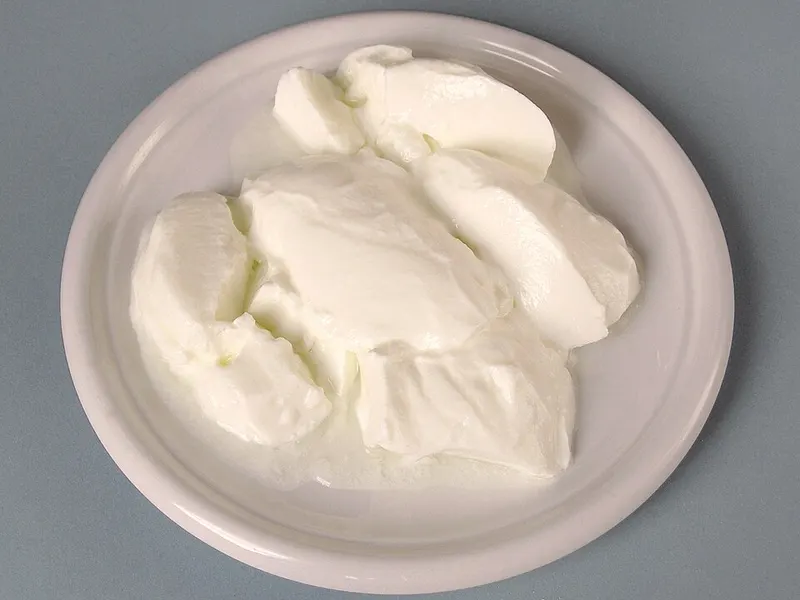
Journey Ingredient Intelligence
Yogurt
That limits it to cold-fill beverages, refrigerated dairy, yogurt, ice cream, and confections where processing temperatures stay low.
Yogurt: 61 kcal and 3.5 g protein per 100 g; top producer Germany (17.1%, 2023); 1.89 kg CO2e per kg.
Explore Yogurt dataAs published
0.1%
Journey Ingredient Intelligence · Comparison
Carrots
Oranges
Data from this story
Shareable Journey Intelligence
Red Dye 40 Alternatives: What Formulators Are Actually Using After the 2026 Restrictions
Ingredients
0.1%
Typical usage rates run 0.01–0.1% depending on application.
6x
Natural colorants run 2–6x the price of Red Dye 40 at equivalent use levels, and some require higher usage rates to hit comparable color intensity.