Food Traceability Software in 2026: What CPG Teams Need Beyond QR Codes and Certifications


Quick answer
QR codes on packaging and third-party certifications were supposed to solve food traceability. They didn't. They created a paper trail that satisfies auditors and frustrates everyone else.
For CPG teams actually responsible for product integrity, supply chain resilience, and regulatory compliance, the gap between what legacy traceability tools promise and what they deliver is a real operational problem. A QR code tells a consumer where a strawberry was grown. It doesn't tell your R&D team that the supplier switched processing facilities, or alert procurement that a key ingredient is now flagged under a new country-of-origin regulation.
This article is for the people who live inside that gap: food scientists, R&D leads, procurement managers, and technical decision-makers who need traceability to function as an operational system, not a marketing feature.
Why QR Codes and Certifications Are the Floor, Not the Ceiling
QR-based traceability satisfies consumer-facing transparency requirements. Certifications like FSSC 22000, SQF, or Non-GMO Project Verified give you a snapshot of a supplier's practices at the time of audit. Both are necessary. Neither is sufficient.
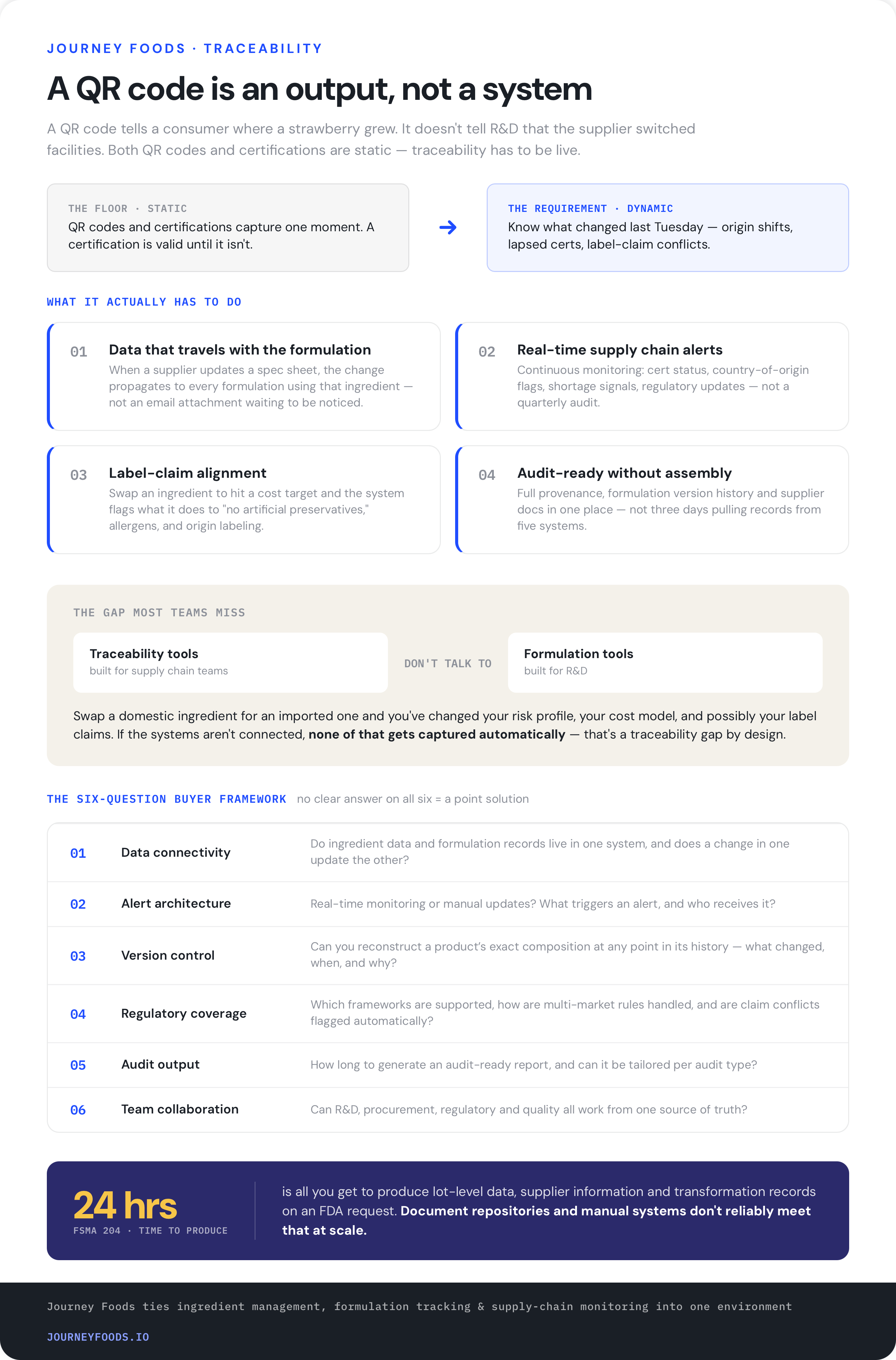
The core problem is that both are static. A certification is valid until it isn't. A QR code reflects the data entered at one point in time. Neither tells you what changed last Tuesday.
For CPG teams running complex multi-tier supply chains, traceability needs to be dynamic. You need to know when an ingredient's sourcing origin shifts, when a supplier's certification lapses, when a downstream formulation change affects your label claims, and when a supply disruption is about to create a compliance problem before it becomes a recall. That's a fundamentally different software requirement than what most legacy tools were built to handle.
What Functional Food Traceability Software Actually Needs to Do
The best food traceability software in 2026 doesn't just record where ingredients came from. It connects ingredient data to formulation decisions, regulatory requirements, and supply chain signals in real time.
Here's what that looks like in practice:
Ingredient-Level Data That Travels With the Formulation
Traceability breaks down when ingredient data lives in one system and formulation records live in another. When a supplier updates a spec sheet, that change needs to propagate to every formulation using that ingredient — not sit in an email attachment waiting for someone to notice.
That requires centralized ingredient management with version control, not just a document repository. Every change needs to be logged, attributed, and reflected across active formulations automatically.
Real-Time Supply Chain Alerts
Static supplier records don't catch the problems that cause recalls and production delays. Useful traceability software monitors supply chain conditions continuously and surfaces alerts when something changes: a supplier's certification status, a country-of-origin flag, a shortage signal, a regulatory update affecting a specific ingredient.
This is where AI-driven platforms have a meaningful advantage over traditional compliance tools. Instead of waiting for a quarterly audit or a supplier notification, your team gets a signal when the underlying data changes.
Regulatory and Label Claim Alignment
A formulation change that looks minor on paper can invalidate a label claim. Swap one ingredient to hit a cost target and your traceability system should immediately flag whether that change affects your "no artificial preservatives" claim, your allergen declarations, or your country-of-origin labeling obligations.
This matters especially for teams working across multiple markets. The FDA's FSMA 204 requirements, EU traceability rules, and country-specific import regulations don't align neatly, and managing them manually at scale is exactly how errors happen.
Audit-Ready Documentation Without Manual Assembly
When an audit hits — internal review, customer audit, or regulatory inspection — your team shouldn't be spending three days pulling records from five different systems. Traceability software should generate audit trails automatically, with full ingredient provenance, formulation version history, and supplier documentation accessible in one place.
The Formulation-Traceability Connection Most Teams Miss
Most food traceability software is designed for supply chain teams. Most formulation software is designed for R&D. The two rarely talk to each other, and that's where traceability actually breaks down in practice.
If your R&D team is iterating on a formulation in one tool while procurement manages supplier relationships in another, you have a traceability gap by design. A reformulation that swaps a domestic ingredient for an imported one changes your supply chain risk profile, your cost model, and potentially your label claims. If those systems aren't connected, none of that gets captured automatically.
This is why digital tools that strengthen transparency and traceability need to operate across the full product development lifecycle — not just at the point of shipping or certification.
Journey Foods addresses this directly. The platform connects ingredient discovery, formulation management, and supply chain monitoring in a single environment. When a formulation changes, the ingredient-level traceability data updates with it. When a supply chain alert fires, it's tied to the specific formulations and products affected — not just a generic supplier record.
Scoring Ingredients Across Multiple Criteria Simultaneously
One underappreciated capability in modern traceability software is evaluating ingredients across nutrition, cost, and sustainability at the same time — not sequentially.
Traditional workflows look like this: R&D selects an ingredient for functional reasons, procurement checks the cost, sustainability reviews the sourcing. Each review happens in isolation. By the time all three are done, the formulation has already moved forward, and reversing course is expensive.
When traceability data is integrated with ingredient scoring, your team can evaluate a potential substitution against all three criteria before it enters a formulation. This is how CPG R&D teams are tracking ingredient trends in 2026 more efficiently — by making multi-criteria decisions earlier in the development process rather than catching conflicts after the fact.
Journey Foods' Operations Scientist AI engine does exactly this: search and score ingredients across nutrition, cost, and sustainability in one workflow, so traceability considerations are built into ingredient selection rather than bolted on afterward.
Sustainability Traceability Is Now a Procurement Requirement
Sustainability claims used to be a marketing decision. In 2026, they're increasingly a procurement and compliance requirement. Major retailers and foodservice customers are asking for supplier sustainability data as part of vendor qualification. Investors want it for ESG reporting. Regulators in several markets are moving toward mandatory disclosure.
That means your traceability system needs to capture sustainability data at the ingredient level — not just at the brand or product level. Scope 3 emissions, water usage, land use change, and sourcing region data need to be tied to specific ingredients and formulations, not aggregated into a general sustainability report.
If you're still tracking this manually or relying on unverified supplier self-reporting, you're creating audit risk. Understanding what CPG brands are actually measuring on food sustainability metrics gives you a clearer picture of where the bar actually sits right now.
How to Evaluate Food Traceability Software: A Framework for Technical Buyers
If you're evaluating platforms, these are the questions that separate genuinely useful traceability software from tools that check compliance boxes without solving operational problems:
Data connectivity: Does the platform connect ingredient data to formulation records, or do those live in separate systems? Can a change in one automatically update the other?
Alert architecture: Does the system monitor supply chain conditions in real time, or does it rely on manual updates and periodic audits? What triggers an alert, and who receives it?
Version control: Does the platform maintain a full version history of formulations — what changed, when, and why? Can you reconstruct the exact ingredient composition of a product at any point in its history?
Regulatory coverage: Which regulatory frameworks does the platform support? How does it handle multi-market requirements? Does it flag label claim conflicts automatically?
Audit output: How long does it take to generate an audit-ready report? What does it include, and can it be customized for different audit types?
Team collaboration: Can R&D, procurement, regulatory, and quality teams all work from the same data? Is there a single source of truth, or are there still silos?
If a platform can't give you clear answers on all six, it's a point solution dressed up as a comprehensive system.
Where Nutrition Analysis Fits Into the Traceability Picture
Nutrition analysis tools are often treated as separate from traceability, but they're deeply connected. A formulation change that improves cost or sustainability performance can shift the nutritional profile enough to require a label update. If your nutrition analysis and traceability systems aren't integrated, that connection gets missed.
The question isn't just whether the tool calculates accurately — it's whether it connects to your formulation and ingredient data in a way that keeps label claims current as formulations evolve. If you're running a standalone nutrition analysis tool that doesn't talk to your formulation system, you have a traceability gap in your label compliance workflow. The alternatives to legacy nutrition analysis tools gaining traction in 2026 are precisely the ones solving this integration problem.
The Collaboration Problem Traceability Software Has to Solve
Even the best traceability data is useless if it's locked in a system only one team can access. One of the most common failure modes in CPG product development is version fragmentation: R&D is working from one version of a formulation, procurement is sourcing ingredients for a slightly different version, and quality is reviewing a third.
Traceability software without collaborative workflows and version control doesn't solve this. It just creates a more sophisticated record of the confusion.
The operational requirement is a single shared environment where every team member — R&D, procurement, regulatory, quality — is working from the same current data, with a clear history of what changed and who changed it.
FAQs
What is food traceability software and what does it do?
Food traceability software tracks the origin, movement, and transformation of ingredients and products throughout the supply chain. In functional terms, it connects supplier data, ingredient records, formulation history, and regulatory documentation so CPG teams can verify product integrity, respond to supply chain disruptions, and generate audit-ready documentation without manual assembly.
How is food traceability software different from a QR code traceability system?
QR code systems capture a static snapshot of ingredient provenance at a point in time, typically for consumer-facing transparency. Food traceability software operates as a live operational system — monitoring supply chain conditions, tracking formulation changes, flagging regulatory conflicts, and alerting teams when something changes. QR codes are an output of traceability. They're not a traceability system on their own.
What should CPG teams look for when evaluating food traceability platforms in 2026?
The most important criteria: real-time supply chain monitoring, integration between ingredient data and formulation records, version control for formulations, multi-market regulatory coverage, automated audit trail generation, and collaborative access for cross-functional teams. Platforms that handle only one or two of these are point solutions, not comprehensive traceability systems.
How does FSMA 204 affect food traceability software requirements?
FSMA 204 requires food companies to maintain detailed traceability records for foods on the FDA's Food Traceability List, including key data elements at each critical tracking event. That means traceability software needs to capture lot-level data, supplier information, and transformation records in a format that can be produced within 24 hours of an FDA request. Manual systems and document repositories don't meet this standard reliably at scale.
Can food traceability software help with sustainability reporting?
Yes — but only if it captures sustainability data at the ingredient level. Platforms that connect ingredient sourcing data (region of origin, processing method, supplier certifications) to specific formulations let teams generate sustainability reports tied to actual product composition rather than brand-level estimates. This is increasingly required by major retail customers and directly relevant to Scope 3 emissions reporting.
How does formulation version control relate to traceability?
Every formulation change is a traceability event. Swap an ingredient, change a supplier, update a processing specification — each of those affects ingredient provenance, label claims, and potentially regulatory status. Formulation version control ensures every change is logged and that the traceability record reflects the actual composition of the product at every point in its history.
What's the difference between food traceability software and food safety software?
Food safety software focuses on hazard analysis, HACCP documentation, sanitation records, and corrective action tracking. Food traceability software focuses on ingredient provenance, supply chain visibility, and formulation history. The two overlap significantly, and the best platforms integrate both — but they answer different operational questions. Traceability answers "where did this ingredient come from and what happened to it." Food safety answers "what controls were in place to prevent contamination."
Traceability in 2026 is an operational capability, not a compliance checkbox. CPG teams that treat it as infrastructure — connecting ingredient data to formulation decisions, supply chain signals, and regulatory requirements in a single system — are the ones catching problems before they become recalls, audits, or reformulation emergencies.
If your current setup relies on QR codes, periodic certifications, and manual documentation, you're managing traceability reactively. The platform infrastructure to do it proactively exists now.
Explore how Journey Foods connects ingredient management, formulation tracking, and supply chain monitoring at journeyfoods.io.
Data from this story
Shareable Journey Intelligence
Food Traceability Software in 2026: What CPG Teams Need Beyond QR Codes and Certifications
Industry Insights